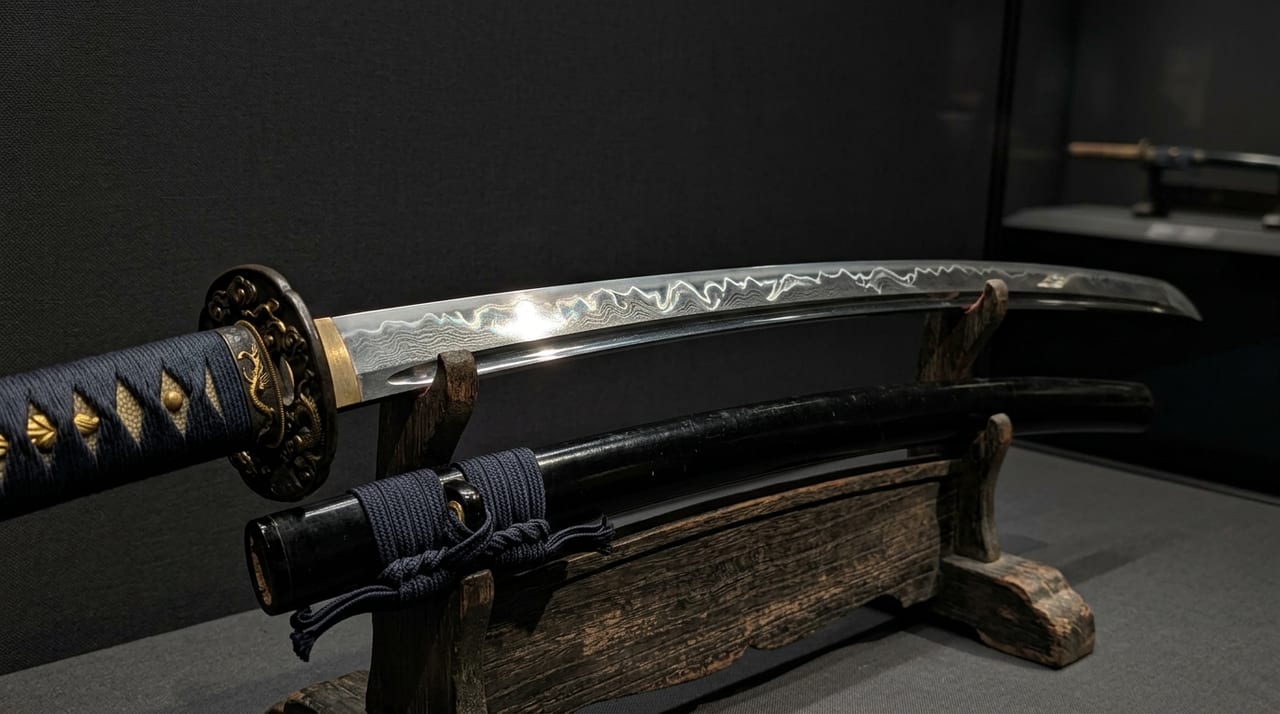
 * Image is for illustrative purposes only.
Raikiri
雷切
Also known as: Raikiri; Chidori; Beloved Sword of Tachibana Dōsetsu
Description
Overview of the Sword
Raikiri is a sword renowned as the beloved blade of Tachibana Dōsetsu, a celebrated general of the Sengoku period. It was originally a tachi, later suriage (shortened by reshaping the tang), and is now transmitted in the form of a wakizashi. It was first called "Chidori," but after the thunder-cutting legend described below it was renamed "Raikiri," and it has been passed down to later generations under that name. It is unsigned (mumei), the maker is unclear, and it has been attributed both as a Mihara work and as a Sōshū work.
Tachibana Dōsetsu and the History of Raikiri
Tachibana Dōsetsu (1513–1585) was a celebrated general who served the Ōtomo clan, the daimyo family that ruled Bungo and Chikuzen during the Sengoku period. His life is a story of martial valor and loyalty, and he earned his name as the fiercest general in Kyūshū. The Ōtomo Kōhaiki records that around the age of 35 he was struck by lightning, which left his left leg lame, and in his later years he directed his forces while riding in a palanquin (koshi). Even so, his battlefield command was praised as shinsan kibō (divine strategy and demonic cunning), and history remembers him as one of the generals whom Ōtomo Sōrin of Bungo relied on most. Raikiri has been bound up with Dōsetsu's life and has long been told as a symbol of loyalty to his lord and of martial valor.
Current Holdings and Transmission
Raikiri (Raikiri-maru) was passed down in the Tachibana family as a beloved blade of Tachibana Dōsetsu and is now held by the Tachibana Museum in Yanagawa, Fukuoka Prefecture. The museum houses armor and art objects handed down by the Tachibana family, former lords of Yanagawa Domain, and Raikiri is displayed from time to time as one of its central masterpieces. The surviving sword stands as a monument to Dōsetsu's martial valor, which endured the turbulent Sengoku period, and as a crowning example of Kyūshū's sword culture. Today it remains a place of pilgrimage for many sword enthusiasts.
Legends & Stories
The Day He Cut the Thunder
The heart of the Raikiri legend lies in the dramatic day when Tachibana Dōsetsu was struck by lightning. On a summer day traditionally dated to the 5th day of the 6th month of Tenbun 17 (1548), Dōsetsu was resting under a large tree, cooling off and napping. Suddenly a violent thunderstorm arrived, and lightning struck the tree under which he was resting. In that moment, Dōsetsu is said to have cut down the thunder god who was within the lightning, using the sword he had propped beside his pillow, which was then called "Chidori."
Although this tradition may seem wildly implausible at first glance, in the natural worldview of the time lightning was a manifestation of a deity (raijin), and cutting it with a sword signified both formidable valor and a challenge to the gods. Dōsetsu's survival is attributed to the spiritual power of the sword. From then on, the name "Chidori" was discarded, and the blade is said to have been renamed "Raikiri."
The Price: A Crippled Left Leg
According to the legend, Dōsetsu became lame in his left leg after this strike. Whether it was a divine punishment for his heroic act of cutting down the lightning, or whether a portion of the god's power, gained by cutting down the thunder god, bound his body, people interpreted it in various ways.
Yet Dōsetsu remained unbowed. Riding in a palanquin (koshi), he kept charging into enemy lines with a ferocity like the embodiment of the thunder he was said to have cut down. Tachibana Dōsetsu's Raikiri went beyond a mere weapon, becoming a spirit sword that embodied its owner's will and fate.
The Legend's Transmission
Throughout the Edo period, the Raikiri legend was widely passed down within the warrior society of Kyushu. Dōsetsu's descendants continued as lords of the Yanagawa Domain in Chikugo Province (about 110,000 koku), and they carefully preserved the memory of Dōsetsu's valor. The Raikiri-maru remained in the Yanagawa Tachibana family's hands afterward, and it is now held by the Tachibana Museum in Yanagawa, where it serves as an object that conveys Dōsetsu's valor to later generations. Among modern sword enthusiasts as well, the Raikiri enjoys special popularity as "the sword that cut lightning."