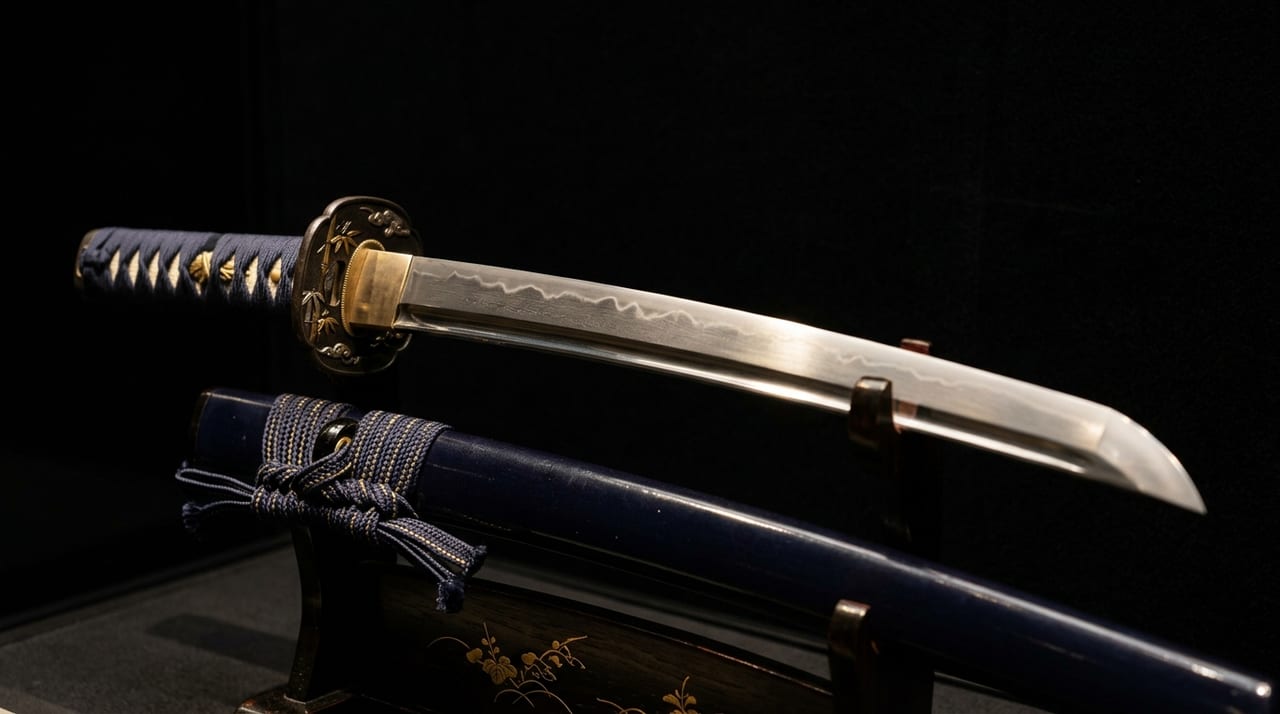
 * Image is for illustrative purposes only.
Himetsuru Ichimonji
姫鶴一文字
Also known as: Himetsuru / Uesugi Clan's Treasure Sword / Blade Pattern of Dancing Cranes
Description
Overview of the Blade
The Himetsuru Ichimonji is a tachi forged by the Bizen Ichimonji school during the Kamakura period, recorded in the history of the Sengoku period as one of the finest blades most deeply treasured by Uesugi Kenshin (1530–1578). The elegant name "Princess Crane" derives, it is said, either from how the rich hamon—exquisite yet powerful—evokes the graceful dance of a crane, or from a legend that Kenshin received this blade in a dream from a heavenly maiden in crane form. This tachi, bearing the characteristic chōji-midare of the Ichimonji school, displays a landscape of exceptional brilliance among the orthodox beauty of the Bizen tradition and stands at the pinnacle of the Uesugi family's sword collection as a masterpiece befitting the towering spirit of Kenshin, hailed as the "Dragon of Echigo" and the "God of War." That Kenshin bestowed upon his treasured blade the poetic name "Himetsuru" reveals the refined sensitivity and cultural refinement dwelling within this stern Sengoku warrior, continuing to convey to our day the multifaceted allure of Kenshin as a person.
Uesugi Kenshin and His Reverence for Blades
Uesugi Kenshin was a Sengoku daimyo of Echigo Province (present-day Niigata Prefecture) and is celebrated as an exceptional great commander who clashed five times with Takeda Shingen at Kawanakajima. Kenshin was known as the "General of Righteousness" and earned respect from later generations as a warrior who valued righteousness over profit. Throughout his life remaining unmarried and a devout believer in Bishamonten, for Kenshin swords were not mere weapons but rather spiritual tools through which to bear divine protection. When taking the field, to gird oneself with a renowned blade was equivalent to directly embodying the power of Bishamonten, and Kenshin was particularly devoted to collecting exceptional blades. Born in Echigo, a region geographically scarce in renowned swords, that Kenshin acquired a tachi of the Bizen Ichimonji school—the supreme achievement of the Kamakura period—attests to both his profound understanding of sword craft and the material and political power commensurate with it. Among Kenshin's collection, the Himetsuru Ichimonji and Yamatorige are celebrated as "the twin pillars of Kenshin," and the felicitous coincidence that both are supreme masterpieces of the Ichimonji school demonstrates the refinement of his aesthetic eye.
Blade Details and the Beauty of the Ichimonji School
The jigane of the Himetsuru Ichimonji displays finely forged ko-itame skin with chōji-utsuri appearing with exceptional clarity, manifesting the bright and lustrous iron color distinctive to the Bizen tradition. Chōji-utsuri are reflections floating within the jigane in the form of clove flowers—a characteristic feature of Ichimonji blades and an important point of appreciation. The hamon is the representative chōji-midare of the Ichimonji school, where large cloves are arrayed with regularity and abundance in a landscape exemplifying the pinnacle of Kamakura-period blade aesthetics. Interspersed among the cloves are abundant reciprocal forms, small irregularities, feet, and leaves, with a bright, keen mouth where the nie adheres well. The blade curve is irregularly undulating with deep return at the point, and the richness of the hamon continues toward the kissaki. As a whole, the landscape is not merely brilliant but displays the apotheosis of Kamakura warrior aesthetic sensibility, wherein power and elegance are unified. The mei on the nakago is said to be either "Ichimonji" or part of the craftsman's name, exemplifying the traditional mei form of the Ichimonji school. When one gazes upon this blade, each clove of the hamon resonates with the others, giving rise to a dynamic quality as if cranes were dancing in succession—this is the essence of the landscape that the name "Himetsuru" conveys.
The Princess Crane Dream and the Name's Origin
Regarding the origin of the name "Himetsuru Ichimonji," multiple legends have been transmitted. The most widely known legend originates from when the Uesugi family ordered polishing and regrinding: in the dreams of both the polisher and the sword attendant, a maiden calling herself "Crane" appeared and begged them to halt the regrinding, and in compliance with this divine dream, the regrinding was stopped and the blade was given the name "Himetsuru." The Uesugi family, while emphasizing strict military discipline and deep piety, also possessed refined cultural attainment in poetry and the arts, and it would have been entirely natural within their spiritual world to act in accordance with such a dream revelation. According to another interpretation, the name "Himetsuru" was given because the rich chōji-midare hamon appears to resemble the elegant form of a crane spreading its wings. In any case, the name "Himetsuru" exemplifies the poetic sensibility of a warrior living in the Sengoku age, embodying one aspect of the multifaceted allure of blades associated with the Uesugi family. Kenshin's awesome martial might on the battlefield and the poetic sensibility surrounding the divine dream of the Princess Crane—the fact that these two aspects are unified in the name of a single blade reveals the essential complexity of the Uesugi family and its treasured blades.
Lineage Within the Uesugi Family and Turbulent History
After Kenshin's death, the Himetsuru Ichimonji was inherited through the Otate no Ran (1578–1579), a succession dispute, and passed down through successive generations of the Uesugi family. In the Battle of Sekigahara (1600), the Uesugi family, which had sided with the Western forces, was greatly reduced from Aizu domain with 1.2 million koku to Yonezawa domain with 300,000 koku. Yet the Uesugi family persisted as the Yonezawa clan and continued to preserve the family treasures and renowned blades inherited from Kenshin's time. The Himetsuru Ichimonji survived through this difficult era without loss and is now designated an Important Cultural Property. As one of the highest treasures of the Uesugi family's sword collection, standing alongside Yamatorige, the Himetsuru Ichimonji continues to bear Kenshin's memory within its blade down to the present day. Even after Yamatorige was transferred to Bizen Setouchi in 2019–2020 through crowdfunding, the Himetsuru Ichimonji remains its counterpart, conveying to this day Kenshin's love for blades in the lands associated with the Uesugi family.
The Artistic Legacy of the Bizen Ichimonji School and Kenshin's Aesthetic Eye
The Bizen Ichimonji school was a collective of sword makers that flourished during the Kamakura period, based in Bizen Province along the northern coast of Okayama Prefecture and the Seto Inland Sea. The school's name derives from its distinctive custom of inscribing only a single ideograph of the character for "one" on the nakago as the maker's signature. The chōji-midare of the Ichimonji school is known among Japanese sword blade patterns as requiring the most elegant and advanced technique, and it is regarded as one of the finest crafts and arts produced by the samurai society of the Kamakura shogunate. The Himetsuru Ichimonji is recognized by sword researchers as a supreme masterpiece of exceptional completion among the beauty of the Bizen Ichimonji school, and its provenance connected to Kenshin, the greatest military commander of the Sengoku age, further elevates its historical significance. The fact that a Kamakura-period sword maker's work was chosen, across more than seven centuries, as the beloved blade of the "God of War" of the Sengoku age demonstrates that the beauty of the Ichimonji school possessed a universality transcending time.
Legends & Stories
The Dream of Himetsuru—The Legend of Kenshin's Divine Bestowal of the Blade
Uesugi Kenshin remained unmarried throughout his life and held profound faith in Bishamonten, the divine warrior god who protects Buddhism. It is well known that Kenshin believed himself to be an incarnation of Bishamonten and carried banners emblazoned with the character '毘' into battle. According to legend surrounding Himetsuru Ichimonji, one night Kenshin dreamed of a beautiful princess in the form of a crane descending from the heavens and bestowing upon him this tachi. Upon waking, Kenshin, following the divine revelation of his dream, sought out this blade, and upon obtaining the tachi of the Ichimonji School, he gave it this name. This legend, which vividly reflects Kenshin's spiritual world of faith and obedience to divine dreams, is far more than a mere tale; it is transmitted as a symbolic narrative that speaks to Kenshin's profound faith and refined aesthetic discernment.
Kawanakajima and Kenshin's Beloved Blade
From 1553 to 1564, Uesugi Kenshin of Echigo and Takeda Shingen of Kai clashed five times at Kawanakajima (in present-day Nagano City). In particular, the Fourth Battle of Kawanakajima in 1561 was a fierce engagement, sometimes called 'Japan's greatest cavalry engagement,' and from this battle comes the famous account that Kenshin charged alone into Shingen's headquarters. While no definitive record exists of whether Himetsuru Ichimonji was worn during this engagement, as Kenshin's most cherished blade, it remains inseparably bound to the memory of Kawanakajima.
The Uesugi Clan's Tragedy and the Blade's Survival
After Kenshin's sudden death, the Uesugi clan was engulfed in civil strife known as the Otate no Ran (1578–1579), where Kenshin's adopted sons Kagekatsu and Kagetora fought over succession. While many of Kenshin's personal effects and treasures were scattered during this internal conflict, Himetsuru Ichimonji was inherited by Kagekatsu and was preserved as a treasure of the Uesugi clan for posterity. After the Battle of Sekigahara (1600), the Uesugi clan was drastically reduced in domain from Aizu to Yonezawa, yet still the blade was carefully preserved. The fact that this celebrated blade, imbued with Kenshin's spirit, has been transmitted down to the present day while witnessing the entire rise and fall of the Uesugi clan is testimony to the spiritual power of this sword.