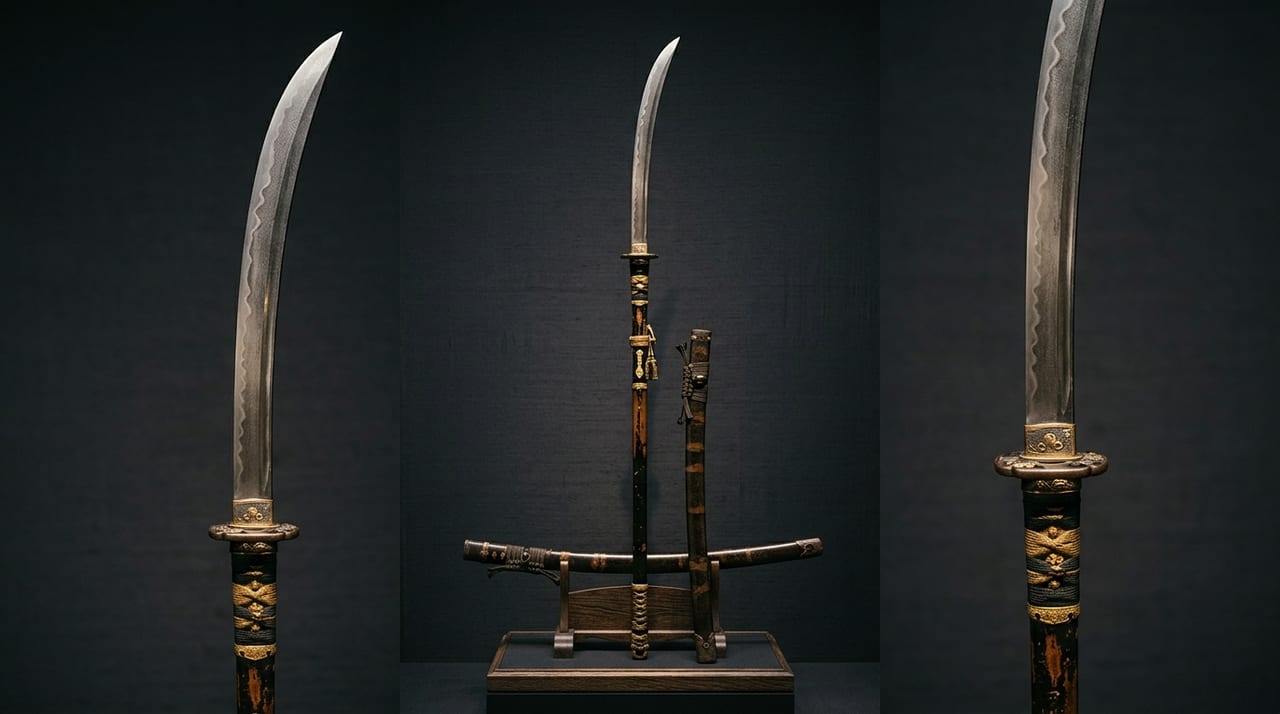
 * Image is for illustrative purposes only.
Oda Nobunaga's Beloved Sword
織田信長の愛刀
Also known as: Complete Record of Nobunaga's Swords (Yagen Tōshirō, Sōza Samonji, Fudō Yukimitsu, Heshikiri Hasebe)
Description
Oda Nobunaga (1534–1582) was a warlord who came closest to achieving the unification of Japan during the Sengoku and Azuchi-Momoyama periods, and he possessed extraordinary interest and connoisseurial acumen regarding swords. Nobunaga valued celebrated blades not merely as weapons, but as symbols of authority and prestige, and as gifts through which to confirm the bonds between lord and retainer. Four representative swords associated with him, passed down through history as his treasured blades, are the Yagen Tōshirō, Sōza Samonji, Fudō Yukimitsu, and Heshikiri Hasebe.
Yagen Tōshirō—The Phantom Celebrated Short Sword
The Yagen Tōshirō is a tantō by Awataguchi Tōshirō Yoshimitsu, a swordsmith of the mid-Kamakura period, and is counted among the masterwork short swords of Awataguchi Yoshimitsu. Its name is said to come from an anecdote in which the Muromachi-period provincial governor Hatakeyama Masanaga, after a defeat, tried to commit seppuku with this tantō, but the blade would not pierce his belly; when he threw it aside, it pierced a nearby yagen (a mortar for grinding medicine). The blade later passed through the Ashikaga shogunal house and Matsunaga Hisahide, who presented it to Nobunaga in Genki 2 (1571). It is said to have burned in the Honnō-ji Incident (1582) (another account holds that it passed through Toyotomi Hideyoshi and Hideyori to Tokugawa Ieyasu); the Kyōhō Meibutsuchō lists it among the lost swords, and it does not survive today.
Sōza Samonji—The Celebrated Blade Sought After by Rulers of All Japan
The Sōza Samonji is a tachi (later shortened into a katana) made by a smith of the Samonji school of Chikuzen Province (present-day Fukuoka Prefecture) in the Nanbokuchō period, and is also called the "Yoshimoto Samonji." Its names come from its owners: it passed from Miyoshi Masanaga (Buddhist name Sōsan) through Takeda Nobutora to Imagawa Yoshimoto, the great daimyo who was defeated and killed by Nobunaga at the Battle of Okehazama. Following the Battle of Okehazama in 1560, Nobunaga obtained it as a spoil of war. Nobunaga had the blade shortened and its tang inlaid in gold with the inscriptions "Eiroku 3, fifth month, nineteenth day: Yoshimoto defeated, his sword engraved" and "Oda Owari-no-kami Nobunaga," and made it his own beloved sword. It subsequently passed to Toyotomi Hideyoshi and then to Tokugawa Ieyasu, becoming a celebrated blade known in history as one that traveled between successive unifiers of Japan. It is now housed at Kenkun Shrine in Kita Ward, Kyoto City (on deposit at the Kyoto National Museum) and is designated as an Important Cultural Property.
Fudō Yukimitsu—The Blade Nobunaga Boasted of at Banquets
The Fudō Yukimitsu is a tantō attributed to Yukimitsu, a celebrated swordsmith of Sagami Province (present-day Kanagawa Prefecture) in the late Kamakura period, deriving its name from the carving of Fudō Myōō that it bears. It was a blade that Nobunaga deeply treasured; it is said that when drunk at banquets he would boast of it, singing "Fudō Yukimitsu, Tsukumo-gami, and for men, I have Gorōza." It is said to have been lost in the Honnō-ji Incident, but according to a tradition of the Ogasawara family it was later given by Oda Nobukatsu to Ogasawara Tadazane, and the surviving Fudō Yukimitsu is in a private collection.
Heshikiri Hasebe—The Celebrated Blade of the Kuroda
The Heshikiri Hasebe is a katana (a large tachi later shortened) attributed to Hasebe Kunishige, a celebrated swordsmith of Yamashiro Province (present-day Kyoto Prefecture) in the Nanbokuchō period, acquiring its name from the anecdote in which Nobunaga cut down a tea attendant hiding under a serving shelf by pressing the blade against him (heshikiru). As a blade possessing "the keenness to crush-cut through objects," it symbolized Nobunaga's authority, and was later granted to the Kuroda family (accounts differ as to whether it was given to Kuroda Kanbe [Jōsui] or, via Hideyoshi, to his son Nagamasa). It became a treasured heirloom of the Kuroda family and is now housed in the Fukuoka City Museum, where it is designated as a National Treasure. Because it was heavily shortened, its blade length is a compact 64.8 cm, but it is the only work of the Hasebe school listed in the Kyōhō Meibutsuchō and is regarded as the school's representative masterpiece.
Nobunaga's View of Swords—Celebrated Blades as Instruments of Authority
What unites these four swords is their character as "political instruments" transcending mere weapons. Nobunaga employed celebrated blades as proof of his unification of Japan, and valued them alongside tea implements—the prized utensils of the tea ceremony—as symbols of authority. The collection of celebrated blades and utensils, sometimes termed "the hunting of famous objects," was a crucial demonstration of the capacity and judgment of a unifier of Japan. Though many of Nobunaga's sword collection were lost in the burning of Azuchi Castle and during the Honnō-ji Incident, the surviving pieces remain precious legacies bearing witness to the aesthetic sensibility and ambitions of the greatest wielder of power in the Sengoku period.
Legends & Stories
Among Nobunaga's beloved swords, the Yagen Tōshirō carries the legend of a blade that would not cut its own master. The Muromachi-period provincial governor Hatakeyama Masanaga, after a defeat, tried to commit seppuku with this tantō, but the blade would not pierce his belly; when he threw it aside, it pierced a nearby yagen (medicine mortar), and this is said to be the origin of its name. The tantō later passed through Matsunaga Hisahide to Nobunaga, but it is said to have burned in the Honnō-ji Incident of 21 June 1582 (Tenshō 10/6/2).
Furthermore, Sōza Samonji passed from Miyoshi Masanaga (Buddhist name Sōsan) through Takeda Nobutora to become the sword worn by Imagawa Yoshimoto. Nobunaga seized it as a spoil of war when he slew Yoshimoto at the Battle of Okehazama in the third year of Eiroku (1560). Nobunaga greatly favored this blade; after having it shortened, he had "the feat of slaying Yoshimoto" inscribed in gold inlay and treasured it. Nobunaga's sword collection transcended mere connoisseurship: it was an expression of his will to hold the fate of the realm in his own hands, and in each beloved blade are inscribed both his dream of unification and the tragic end that cut it short.