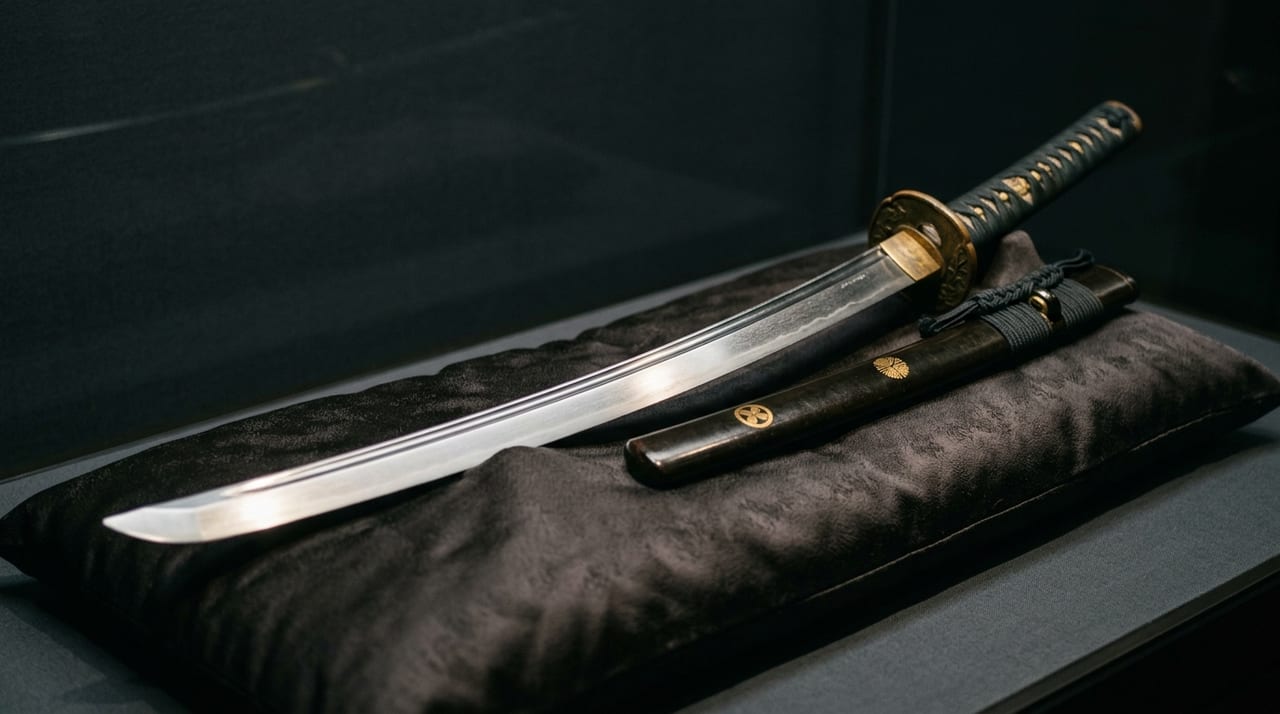
 * Image is for illustrative purposes only.
Ichigo Hitofuri
一期一振
Also known as: Ichigo Hitofuri · the sole tachi forged in a lifetime by a master of tanto · the supreme masterpiece of Awataguchi Yoshimitsu, one of the Tenka Sansaku · the tachi cherished by Toyotomi Hideyoshi
Description
Overview of the Sword
Named 'Ichigo Hitofuri' because it is said to be the only tachi that Awataguchi Yoshimitsu, one of the Tenka Sansaku, forged in his lifetime, this is the rarest and most narrative-rich celebrated tachi in the history of the Japanese sword. The blade length is approximately 68.8 cm. According to the Kyōhō Meibutsu-chō, it was originally 2 shaku 8 sun 3 bu, but it has been shortened through suriage, yet it still retains the commanding presence of a tachi. Awataguchi Yoshimitsu, a master of tanto and ken, produced countless masterpieces during his life, yet he is said to have made only this one tachi. Of Yoshimitsu's surviving works, tanto make up the vast majority, and this Ichigo Hitofuri is the only surviving tachi, so its rarity is immeasurable.
Forging Method and Characteristics
The jigane shows Yoshimitsu's distinctive fine ko-itame skin, densely packed, with fine ji-nie giving a moist, nashiji-like sheen. However, because the blade was retempered after it was burned in the Summer Campaign of Osaka, the present hamon is not the work of Yoshimitsu's original quenching; this point requires attention. The retemper is attributed to Echizen Yasutsugu and is a refined work based on a suguha hamon. What Yoshimitsu's original hamon looked like remains an eternal mystery, yet traces of Yoshimitsu's forging survive in the jigane, and its identity as a work of Yoshimitsu is preserved. The name 'Ichigo Hitofuri' is traditionally said to have been given by Hosokawa Yūsai, because Yoshimitsu is said to have made only this one tachi in his lifetime.
History and Provenance
Its provenance before Toyotomi Hideyoshi is uncertain, with various theories, including transmission through the Asakura house of Echizen, presentation by the Mōri house, and passage through the Honami family of Sakai. It is known, however, that Hideyoshi held it in particular affection. After Hideyoshi's death, it was burned together with Osaka Castle in the Summer Campaign of Osaka (1615), becoming a yakimi, but it was revived when retempering was carried out by order of Tokugawa Ieyasu.
Current Custody
Thereafter, it passed through the Tokugawa house and was presented to the Imperial Household; it is now managed by the Imperial Household Agency as gomotsu.
Legends & Stories
Legend and Anecdotes
'Ichigo Hitofuri'—no other sword name carries a meaning as beautiful in Japanese, yet as weighty. Resonating with 'ichigo ichie,' the expression of the tea ceremony spirit, this name condenses into four characters the miracle that Awataguchi Yoshimitsu forged a tachi only once in his lifetime, and that this one-time blade became a masterpiece for a thousand years. Toyotomi Hideyoshi's attachment to the Ichigo Hitofuri was exceptional.
Custody Under the Edo Shogunate
In the course of unifying the realm, Hideyoshi collected famous swords from across Japan, and many of the meibutsu recorded in the Kyōhō Meibutsu-chō passed through his hands. In the Toyotomi-ke Okoshimono-chō, the Ichigo Hitofuri is placed in the top category, the 'Ichi no Hako' (First Box), and is recorded second, after Honebami Tōshirō. When Hideyoshi died in Keichō 3 (1598), the Ichigo Hitofuri remained at Osaka Castle. In the 5th month of Keichō 20 (1615), during the Summer Campaign of Osaka, the Toyotomi house was destroyed and Osaka Castle was engulfed in flames. In these flames the Ichigo Hitofuri also burned, and Yoshimitsu's original hamon was lost forever. Yet the blade itself was recovered from the ruins, and two months after the fall of Osaka Castle, retempering was ordered under Tokugawa Ieyasu. For Ieyasu too, the Ichigo Hitofuri was a famous treasure of the realm, and it could not be allowed to remain burned. Echizen Yasutsugu performed the retempering, and the Ichigo Hitofuri was revived with a new edge. What the hamon of the Ichigo Hitofuri was before the burning is now unknown to anyone. Because many of Yoshimitsu's tanto have refined hamon based on suguha, it is conjectured that the original Ichigo Hitofuri was of a similar style, but this remains an eternal mystery. 'Yoshimitsu's lost hamon'—this story of loss is itself part of the legend of the Ichigo Hitofuri. After being presented from the Tokugawa house to the Imperial Household, the Ichigo Hitofuri has continued as a supreme blade, managed by the Imperial Household Agency as gomotsu. In the game 'Touken Ranbu,' it is depicted as a proud tachi that served Toyotomi Hideyoshi, a character who continues to stand with nobility while carrying the memory of Osaka Castle, and it has gained wide popularity. The name 'Ichigo Hitofuri,' as a word for 'one of a kind, unrivaled thing' beyond the world of swords, is deeply rooted in the Japanese aesthetic sensibility.