Complete Guide to Hirazukuri: Characteristics, Notable Examples, and Viewing Points
 * Image is for illustrative purposes only.
Table of Contents
Hirazukuri—The Basics of Japanese Sword Cross-Sections
"Tsukurikomi" (造り込み) is a technical term for the cross-sectional shape of a Japanese sword's blade. The sword's cross-section is not a perfect flat plane; rather, diverse shapes form through the positional relationships and slopes of each section (spine, ridge, surface, and edge).
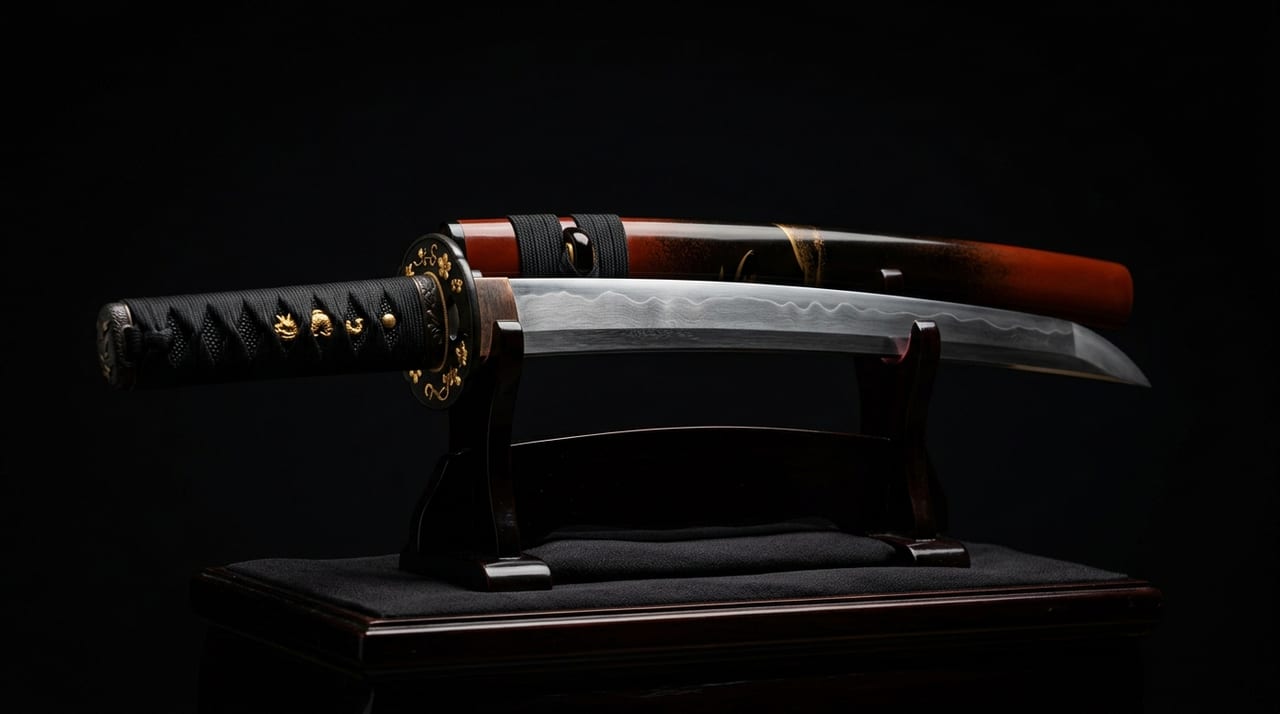
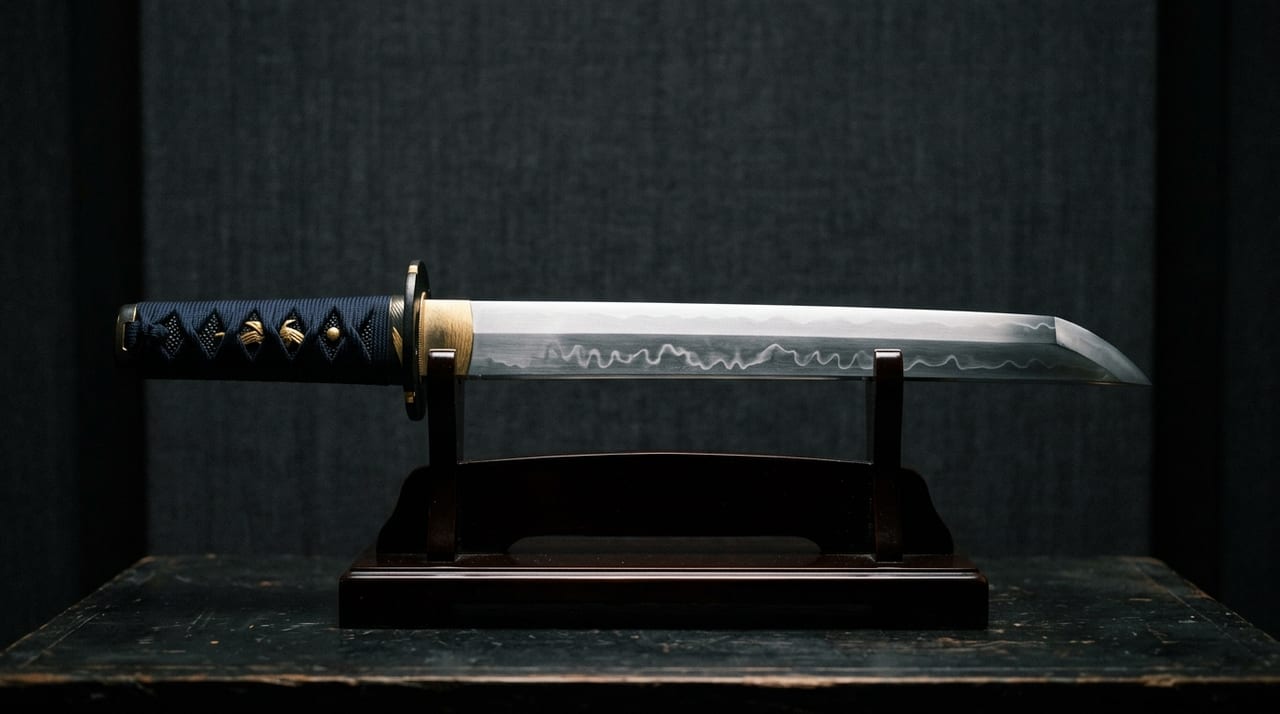
"Hirazukuri" (平造り) is the simplest construction method among these, characterized by the absence of a "shinogi" (鎬)—the ridge line on the cross-section. The blade's cross-section continues in a uniform slope (or gentle slope) from spine to edge, creating a flat form.
The Cross-Sectional Structure of Hirazukuri—A World Without Ridges
The standard construction of typical uchigatana (打刀) is "shinogi-zukuri" (鎬造り). In shinogi-zukuri, the blade's cross-section has a ridge called "shinogi-suji" (鎬筋), with a flat "shinogi-ji" (鎬地) on the spine side and the "ji" (地) on the edge side separated by this ridge.
In contrast, hirazukuri features:
- No ridge exists: The cross-section continues as a single plane from spine to edge
- No distinction between ji and shinogi-ji: The surface extends to the spine
- Thin blades as a tendency: Without the reinforcing ridge, thickness is modest
Due to these structural characteristics, hirazukuri is considered optimal for the following applications and sword types.
Sword Types Primarily Using Hirazukuri
Tantō (Short Swords)
Hirazukuri is primarily used for short swords. The reasons include:
- Short blade length: With short blade length, the bending stress is insufficient to require reinforcing ridge structures
- Aesthetic of thinness: Hirazukuri short swords possess thin, stylish appearances. They balance elegance and functionality as concealable self-defense tools
- Displaying blade patterns: The flat surface without a ridge readily displays complex hamon patterns such as chōji-midare (丁子乱れ) and toranba (涛乱刃)
Wakizashi (Companion Swords)
Shorter wakizashi sometimes feature hirazukuri, though shinogi-zukuri is more common for this type.
Specific Long Swords and Naginata
Hirazukuri occasionally appears in longer swords, though it is less common than in short swords from a strength perspective.
Historical Development of Hirazukuri
Koto Period (~1596)
The earliest straight swords (chokutō) of the Yamato and Nara periods, known as jōkotō, often featured forms close to hirazukuri. As Japanese sword design evolved, shinogi-zukuri became mainstream, yet short swords continued to employ hirazukuri.
From the Kamakura through Nanboku-chō periods, Awataguchi Yoshimitsu (粟田口吉光) created masterpieces of hirazukuri short swords. Yoshimitsu's works such as "Harakiri" and "Yagen Tōshirō" remain transmitted as fine examples of hirazukuri short swords. Yoshimitsu's extant works are covered in more detail in Awataguchi Yoshimitsu (Tōshirō): surviving masterpieces and where they are held.
Shintō Period (~1596–1780)
During the Shintō period (from Keichō onward), hirazukuri remained standard for short swords. As blade pattern diversity progressed in this era, hirazukuri's broad surface became a stage for complex hamon expression.
Shinshintō Period (~1780–1868)
Shinshintō craftsmen were enthusiastic about copying (imitating) koto works, resulting in numerous hirazukuri short sword pieces modeled after famous koto specimens.
Representative Masterpieces of Hirazukuri
Hone-bami Tōshirō (骨喰藤四郎)
A wakizashi attributed to Awataguchi Yoshimitsu, remade from a naginata (naginata-naoshi). Its blade length is about 58.7 cm (1 shaku 9 sun 4 bu), and it is said to have originally been a naginata that was shortened (suriage) and converted into a wakizashi. Also known for having been owned by Toyotomi Hideyoshi, it is now held by Toyokuni Shrine (Kyoto). It is a nationally designated Important Cultural Property.
Ichigo Hitofuri (一期一振)
Ichigo Hitofuri is said to be the only tachi Awataguchi Yoshimitsu ever forged. It was named after the legend that "Yoshimitsu made only this one blade." It is now held at the Sannomaru Shōzōkan, under the jurisdiction of the Imperial Household Agency.
Yagen Tōshirō (薬研藤四郎)
Famous as a hirazukuri short sword owned by Oda Nobunaga. According to legend, Nobunaga tried to use it to take his own life at the Honnō-ji Incident, but its edge chipped and it could not be used. Its current location is unknown.
Appreciation Points for Hirazukuri
Key points to note when appreciating hirazukuri blades:
1. Surface Breadth and Hamon Development
Without a ridge, the surface expands widely. The hamon patterns displayed across this broad surface possess a dynamism distinct from shinogi-zukuri. Particularly, hirazukuri short swords with large chōji-midare or gunome-midare can express the beauty of hamon patterns to their fullest.
2. Blade Thinness and Uniformity
One beauty of hirazukuri lies in uniform blade thinness. The cross-section continuing with consistent slope from spine to edge demonstrates the smith's high skill. Non-uniform thickness may indicate forging issues.
3. Spine Shape
In hirazukuri, the spine shape is also an appreciation point. The "iori-mune" (庵棟)—triangular in cross-section—is most common, though "maru-mune" (丸棟)—circular in cross-section—and "kaku-mune" (角棟)—square in cross-section—also appear.
4. Nakago (Tang) Finishing
Because hirazukuri short swords are compact overall, the nakago's finishing is an important appreciation point. Observe the signature's calligraphy, rust condition, and tang shape (栗尻 or 舟底).
Difference Between Hirazukuri and Moroha-zukuri (Dual-Edged Construction)
A frequently confused construction method is "moroha-zukuri" (諸刃造り). Moroha-zukuri features edges on both sides with a lozenge-shaped symmetrical cross-section, commonly found in jōkotō (ancient straight blades).
Differences between hirazukuri and moroha-zukuri:
| Feature | Hirazukuri | Moroha-zukuri |
|---|---|---|
| Edge location | Single side | Both sides |
| Cross-section shape | Asymmetrical (spine side thicker) | Left-right symmetrical |
| Ridge | Absent | Absent (typically) |
| Application | Short swords, self-defense | Jōkotō, ceremonial swords |
Conclusion—Perfect Beauty in Simplicity
Hirazukuri is the simplest construction among Japanese sword forms, yet this simplicity carries its own challenges and beauty. Without superfluous structural elements, the smith's skill manifests directly in appearance.
Masterpiece hirazukuri short swords such as "Yagen Tōshirō" evidence how genius Awataguchi Yoshimitsu condensed maximum artistic expression within the hirazukuri form. Rather than overlooking hirazukuri as a "simple shape," deeply observing the technique and aesthetics embedded within it constitutes one of the profound joys of Japanese sword appreciation.