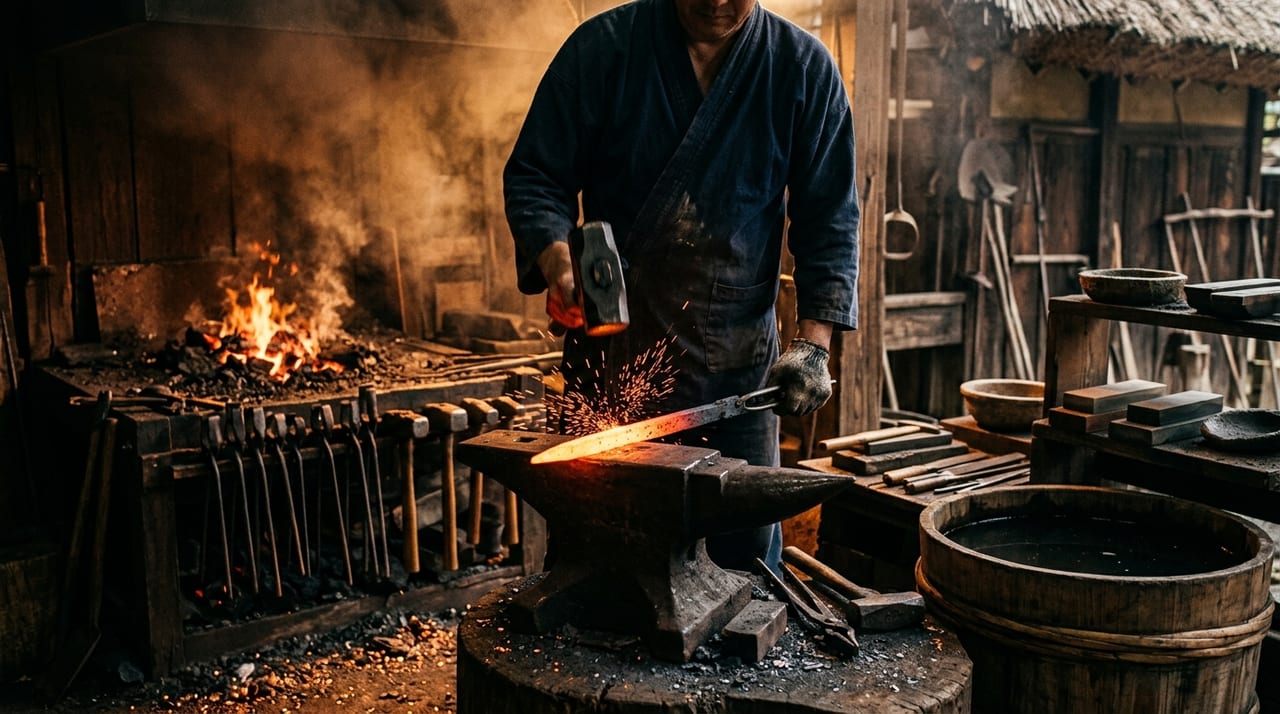
 * Image is for illustrative purposes only.
Awataguchi Yoshimitsu
粟田口吉光
Description
Awataguchi Yoshimitsu was a swordsmith active in Awataguchi, Yamashiro Province (Kyoto), in the mid-Kamakura period. His common name was Tōshirō. He belonged to the Awataguchi school, a prestigious lineage representing the Yamashiro-den (Yamashiro tradition), and is said to have been either a child or a disciple of its master smith, Kuniyoshi. The Awataguchi school was a constellation of brilliant master smiths. Its effective founders were the six children of the sword progenitor Kuniie: Kunitomo, Hisakuni, Kuniyasu, Kunikiyo, Arikuni, and Kunitsuna. Some of these smiths also served as goban-kaji (rotating smiths in imperial service) for Retired Emperor Go-Toba. Yoshimitsu was the one who brought a brilliant close to this lineage. He left no signed works with dates, so his exact birth and death years are unknown. Based on his school's style, however, he is generally believed to have lived around the middle of the thirteenth century.
Yoshimitsu is known as a master of tantō and ken, and most of his surviving works are tantō. His jigane (steel) is famed for its exceptionally fine, tightly packed ko-itame-hada, and its thickly formed ji-nie gives rise to the name nashiji-hada. His hamon is based on an elegant sugu-ba with abundant ko-nie, and its hataraki (activity) is fine. Its nioikuchi is deep and bright. A tantō with thick kasane, a dignified sugata, and an elegant blade is often called the perfected form of the tantō and the highest peak of all time.
His representative works include many famous pieces collectively known as the Tōshirō-mono. Among the tantō, the twin pinnacles are Atsu Tōshirō (National Treasure, Tokyo National Museum), named for its thick kasane, and Gotō Tōshirō (National Treasure, Tokugawa Art Museum), which was passed down to Tokugawa Mitsutomo. Other well-known works include Shinano Tōshirō and Hakata Tōshirō (both Important Cultural Properties) and Hirano Tōshirō, held in the Gyobutsu (Imperial Household collection). A rare tachi by Yoshimitsu that is famous is Ichigo Hitofuri, now in the Gyobutsu. It was burned in the Siege of Ōsaka and was shortened (suriage). During this process, its original signature was cut out and inlaid, forming a gaku-mei (inlaid plaque signature). Similarly, Namazuo Tōshirō (Tokugawa Art Museum) was a naginata-naoshi (a blade remade from a naginata) that was also burned in the fall of Ōsaka Castle. Honebami Tōshirō (Important Cultural Property, owned by Toyokuni Shrine and on deposit at the Kyoto National Museum) was burned later in the Great Fire of Meireki. Both were re-tempered (saiha) after burning and have been handed down to the present day.
Later, Yoshimitsu was counted, along with Masamune and Gō Yoshihiro, among the Tenka Sansaku (the three great smiths under Heaven) that Toyotomi Hideyoshi held in exceptional esteem. In the Kyōhō Meibutsuchō, compiled by the Hon'ami family at the command of Tokugawa Yoshimune, a large number of Yoshimitsu's works are recorded in a special category as meibutsu. This conveys their high regard to the present day. His rank is listed as saijō-saku (highest grade), and his reputation as a master of tantō remains unshaken.
Famous Works
- Ichigo Hitofuri (Imperial Collection, Gyobutsu)
- Namazuo Tōshirō (collection of the Tokugawa Art Museum)
- Honebami Tōshirō
- Atsushi Tōshirō (National Treasure)