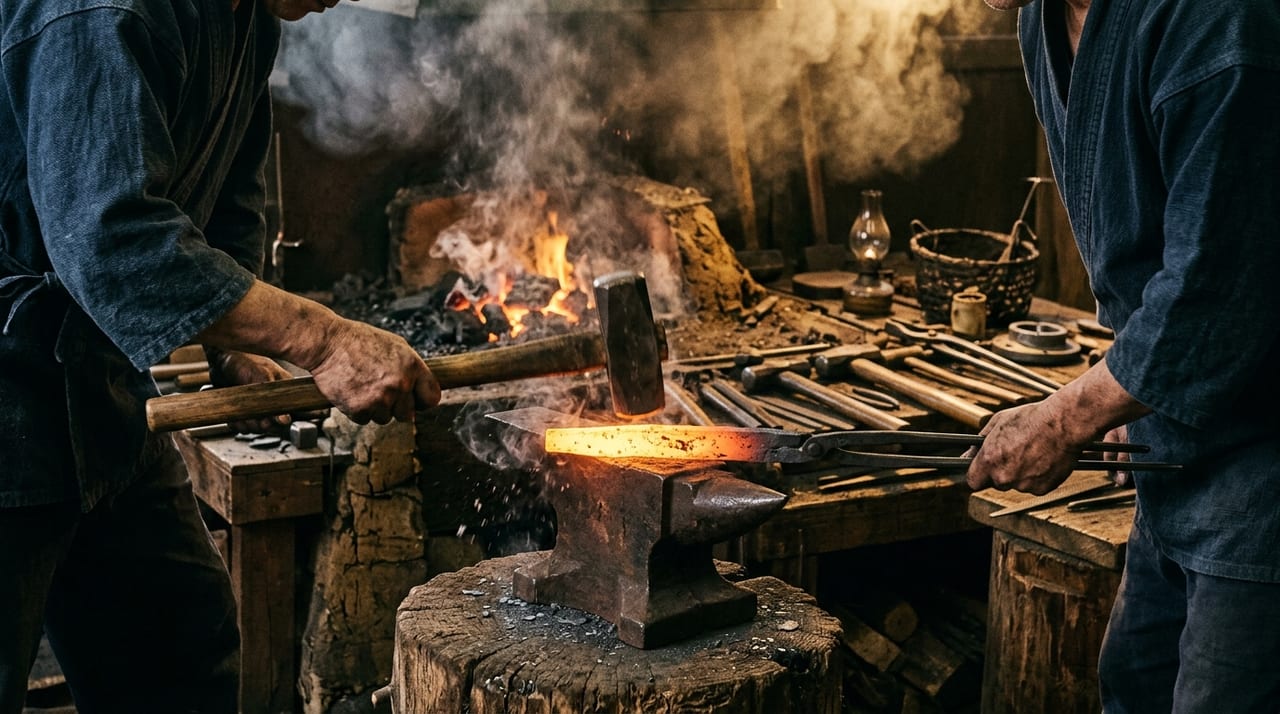
 * Image is for illustrative purposes only.
Kanabō Masatsugu
金房政次
Description
Kanabō Masatsugu was a swordsmith who was active in Yamato Province (present-day Nara Prefecture) during the Sengoku period, and is known as the leading figure of the Kanabō school, which was based around Kōfuku-ji.
The Kanabō School and Its Base
The Kanabō school was a group of swordsmiths based near Kōfuku-ji in Nara, which produced a large number of weapons for temple monks, samurai and soldiers. Although it belonged to a branch of the Yamato tradition, it set itself apart from traditional styles and produced many swords with sharp cutting edges, placing emphasis on practicality.
Stylistic Characteristics
The style of the Kanabō school differs from the aesthetic sensibility of the traditional Yamato tradition. It is said to be characterized by a broad blade width and a curvature resembling that of Sue-Bizen or Sue-Seki. The hamon also displays large, irregular patterns.
Representative Works
Among Masatsugu's representative works is the jūmonji-yari used in Hōzōin-ryū spearmanship, a martial art originating in Yamato Province. In addition, the famous spear Nihongō, regarded as one of the Tenka Sanmeisō (the Three Famous Spears of the Realm), is unsigned but is presumed to be a work of the Kanabō school of Yamato Province.
Changes in the Evaluation of the Kanabō School
As the Kanabō school continued to meet mass demand at the end of the Sengoku period, the quality of its output gradually declined. In later ages it came to be regarded as the foremost example of kazu-uchi-mono, mass-produced swords made in hasty, careless volume. Masatsugu himself is regarded as the swordsmith who, as head of the school, carried it through its period of greatest prosperity.