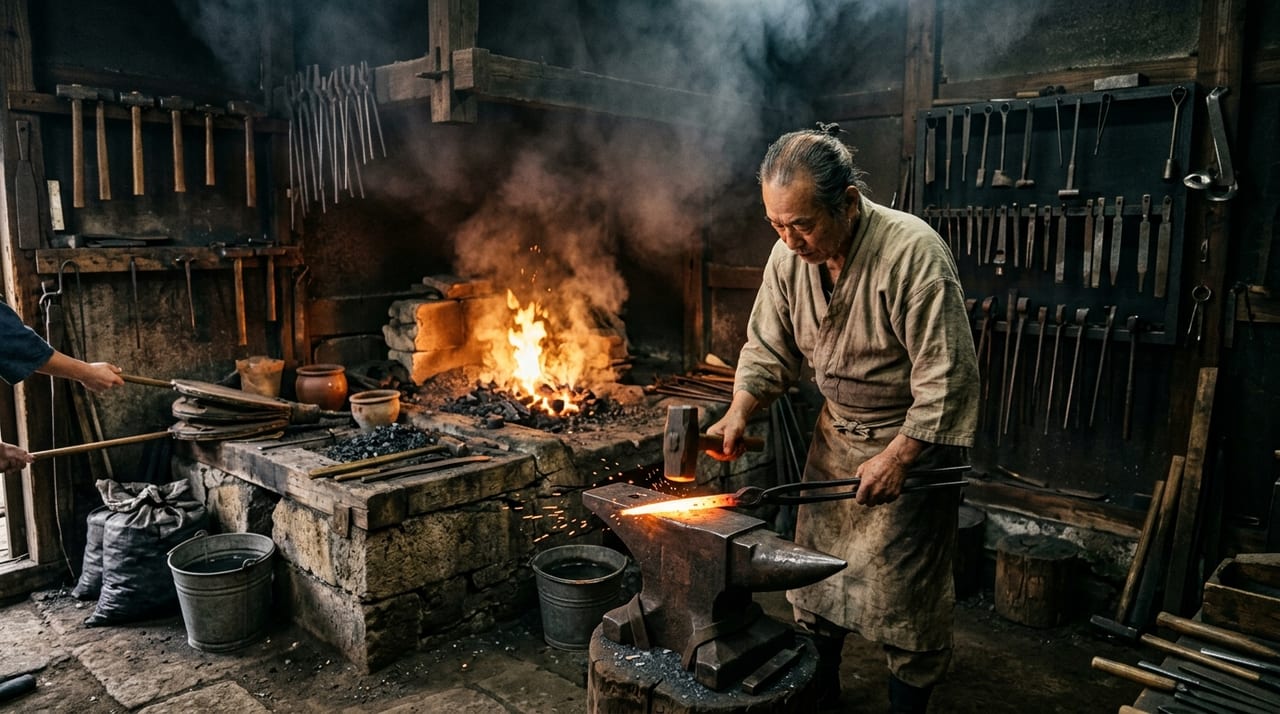
 * Image is for illustrative purposes only.
Hosho Sadakiyo
保昌貞清
Description
Background of Hosho Sadakiyo and His Position in the Hōshō-ha
Hosho Sadakiyo was a swordsmith active in Takechi District, Yamato Province, from the late Kamakura period into the early Nanboku-chō period (the Genkō to Kenmu eras, c. 1321–1338). He was one of the important swordsmiths of the Hōshō-ha, one of the five schools of Yamato. Sadakiyo is recorded as one of the core swordsmiths of the Hōshō-ha, alongside Hōshō Sadayoshi and Hōshō Sadamune. His period of activity is said to be around the Genkō era (1321–1324).
The Hōshō-ha was a group of swordsmiths who lived in Takechi District, Yamato Province, in the late Kamakura period. Its ancestor was Hōshō Gorō Kunimitsu, and "Hōshō Gorō Sadamune" is regarded as its de facto founder. Among the Yamato Goha, it is distinguished by its strength in the tradition of its own masame-jigane and suguha. Its style is characterized by a refined and precise workmanship that differs from the luxurious chōji-midare and intense nie of Bizen and Sōshū. In older genealogical records, Sadakiyo is described as a son of Kunimitsu and a brother of Sadamune and Sadayoshi (various theories exist). He is counted among the swordsmiths who carried on the tradition of the Hōshō-ha.
Style and Characteristics of the Hōshō-ha
Sadakiyo's blades display the orthodox style of the Hōshō-ha. The jigane is mainly masame-hada, characterized by a densely and finely forged steel surface. The masame jigane common to the Yamato-den is the most conspicuous feature of the Hōshō-ha as well, and it is clearly distinct from the itame and nagare-hada of Bizen works. The ji-nie is evenly distributed, and a full shinogi-suji with "hiraniku" is said to be a characteristic of the school.
The hamon is mostly suguha with nie-hon'i, and nijūba and kuichigaiba are sometimes mixed in. Some boshi are yakizume in a hakikake style. Tanto were also made in large numbers, and the Sue-Hōshō group of swordsmiths continued into the Muromachi period.
Evaluation
The masame jigane and nie-based suguha that embody the tradition of the Hōshō-ha show the essence of the Yamato-den, distinct from the luxurious Bizen chōji-midare, and they are still valued in modern sword research.
In research on the Yamato-den and the Hōshō-ha, Sadayoshi and Sadamune are the best known, but Sadakiyo also leaves his name in the Hōshō-ha lineage as a swordsmith of the same school alongside them. As a swordsmith who upheld the masame jigane tradition in Yamato during the turbulent era of the late Kamakura to early Nanboku-chō, he has earned a place in the history of Japanese swords.