Swords of the Tensho Era: Late Koto Period Innovation Before the Shinto Age
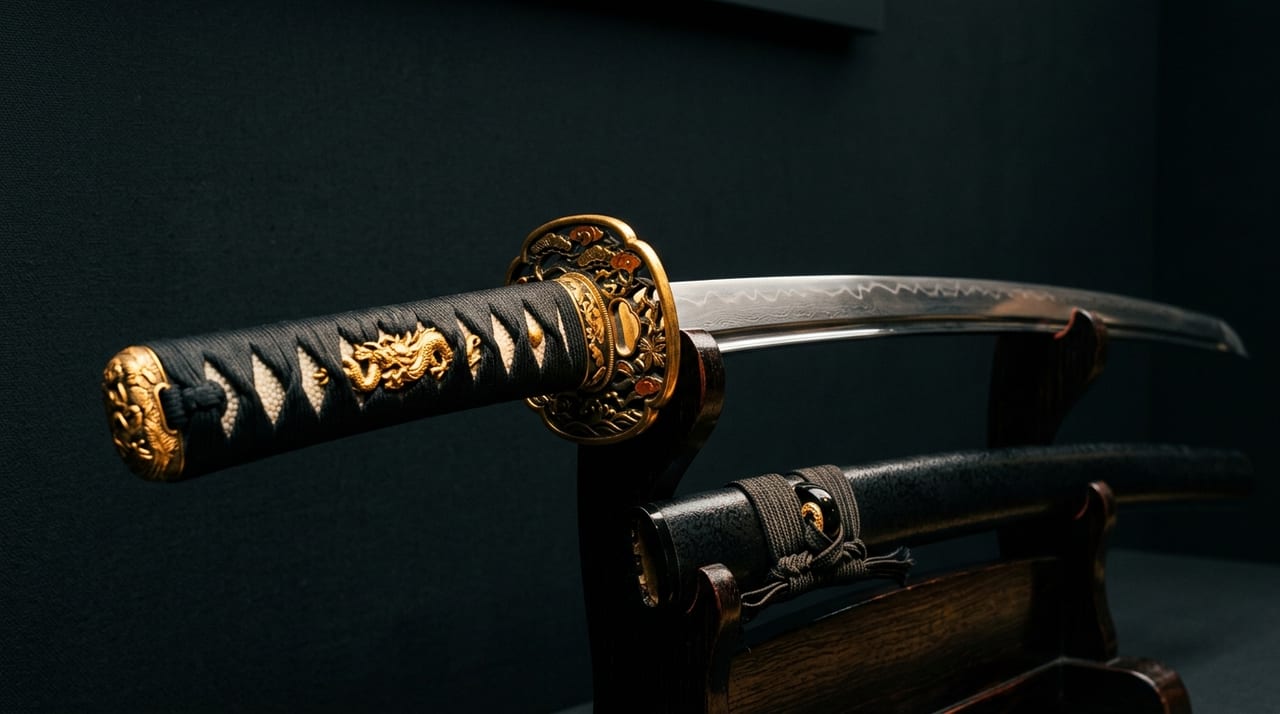 * Image is for illustrative purposes only.
Table of Contents
The Tenshō Period—A Turning Point in Japanese Sword History
The Tenshō period (1573–1593) was one of the most tumultuous eras in Japanese history and formed an important turning point in the history of Japanese swords. These twenty years are positioned as a "transitional period" that overlaps the end of the Koto period (ancient sword era) and the beginning of the Shintō period (new swords), a time when the form, manufacturing methods, and distribution of blades underwent dramatic transformation.
The Koto period refers to the era of sword production from the late Heian period through the late Muromachi period. The Keichō era (from 1596 onward) and beyond is called the Shintō period, while the Tenshō years occupy the space between them—in other words, the "late Koto period." The swords of this age, while retaining the aesthetics of pure Koto swords, possessed distinctive characteristics shaped by the pragmatism of the Sengoku warfare era.
Tenshō-period Blade Forms—How the Reality of Warfare Changed Sword Shapes
Essential to discussing Tenshō-period blades is the change in combat tactics. The mass introduction of firearms, epitomized by the Battle of Nagashino (1575), heightened emphasis on the defensive capabilities of armor. As a result, the primary use of blades began to shift from "thrusting and striking armored warriors" to "mobile slashing in close-quarters combat."
The uchigatana produced during this period showed a tendency toward shorter blade lengths compared to the longer swords of the mid-Muromachi period. The difference between base width and point width narrowed, and the gently curved "koshi-zori" (base-curved) form gradually gave way to shapes closer to a "point-curved" configuration with thicker base and higher point-ward balance. This can be interpreted as a response to the decline of mounted combat and the rise of foot warfare as the dominant form of battle.
The Tenshō period was also an era when mass-produced blades called kazuuchi were distributed in large quantities. Due to Hideyoshi's large-scale military campaigns (such as the Chūgoku Ōgaeshi, the forced march back from the Chūgoku region in Tenshō 10) and nationwide unification wars, large quantities of practical swords were needed, leading to the production of standardized mass-produced blades that contrasted sharply with the carefully finished custom-made swords crafted by individual smiths.
The Sword Policies of Nobunaga and Hideyoshi and the Reorganization of Sword Smiths
The establishment of the Oda-Toyotomi regime had a direct impact on the sword industry. Oda Nobunaga is known as a daimyo who actively utilized sword diplomacy, presenting fine swords as gifts to his retainers and allies to demonstrate loyalty and hierarchy. This practice elevated the political value of famous swords and increased orders to renowned smiths. It was during this period too that the concept of the "meibutsu" (famous sword) was established, and records of numerous swords lost in the Honnō-ji Incident (1582)—such as Fudō Yukimitsu—later influenced sword evaluation.
Toyotomi Hideyoshi issued the "Sword Confiscation Edict" in Tenshō 16 (1588). This policy confiscated weapons from peasants and temples and restricted sword possession to the samurai class. The large quantity of swords confiscated through the sword hunt were reportedly ultimately used for the construction of the Great Buddha statue at Hōkōji Temple in Kyoto, but on the other hand, it brought fluctuations to the workload of sword smiths. While demand in rural areas decreased, it is also said that focus shifted increasingly toward high-quality custom-made blades for samurai and daimyo.
Principal Sword Smiths of the Tenshō Period—The Final Brilliance of the Koto Era
From the Tenshō period through the early Keichō era, there were several notable sword smiths representing the final generation of the Koto period. The most prominent was Horikawa Kunihiro, also called the progenitor of Shintō swords. A native of Aya in Hyūga Province (present-day Miyazaki Prefecture), Kunihiro began his work during the Tenshō period and later moved to Horikawa in Kyoto to establish his own school. He is also evaluated as a "symbol of the transitional period" who inherited the techniques of Koto swords while creating new forms.
In Bizen and Osafune, sword smiths who were predecessors to Yokoyama Sukesada were active, maintaining the lineage of the Bizen tradition. However, a great flood in Tenshō 18 (1590) dealt a devastating blow to the Osafune district, resulting in the tragic disappearance of the residential community of Bizen sword smiths that had continued since the Kamakura period. This event is inscribed in sword history as a symbolic occurrence marking the late Koto era.
In Yamato, sword smiths of the Yamato tradition such as Kanabō Masatsugu continued their work, but this was also a period when the upheavals of the Sengoku era weakened connections with temples and shrines, causing the traditional patronage base of Yamato smithing to begin wavering.
Points to Appreciate in Tenshō Swords—A Perspective on the Space Between Koto and Shintō
Several points should be noted when appreciating or authenticating Tenshō-period swords.
- Nakago (tang): When the "ubu nakago" (original unmodified tang), a characteristic of the Koto period, remains intact, it indicates that the blade retains its original condition. However, many Tenshō-period swords were heavily shortened (ō-suriage) in later eras.
- Hamon (blade pattern): In swords of the Bizen tradition, gentle chōji-midare patterns may be preserved, but reflecting the pragmatic focus of the era, there is a tendency for suguha (straight) or notare (gently undulating) patterns to increase.
- Jigane (steel surface): Itame skin typical of the late Koto period remains predominant, but high-precision forging was beginning to be lost, and mass-produced pieces sometimes exhibit rough, chaotic surfaces.
Tenshō-period blades possess a "contradictory beauty" where the aesthetics of Koto swords intersect with the pragmatism of Shintō swords. This was an era when the quality gap between swords made by master smiths and mass-produced kazuuchi was most pronounced, and understanding this disparity is key to deeply appreciating Tenshō swords.
A Bridge to the Shintō Era—Continuity into the Keichō Period
With the Tenshō period as a dividing line, the world of Japanese swords entered a new phase. After the Battle of Sekigahara in Keichō 5 (1600) and the establishment of the Tokugawa shogunate, an era of peace arrived, and swords underwent a repositioning from "tools of warfare" to "spiritual symbols of the samurai."
However, the innovations attempted by Tenshō-period smiths—the rationalization of form, the reorganization of production centers, and the expansion of distribution networks—were surely passed on to the next generation. The new aesthetic sense established by Horikawa Kunihiro influenced many smiths of the early Edo period. The dispersal of smiths from the Bizen region during its recovery from the great flood, who subsequently became active in various locations, brought about a geographic expansion of sword culture.
Rather than viewing the Tenshō period solely as "the end of the Koto era," reinterpreting it as "the beginning of an age" when Japanese sword culture became nationalized and diversified reveals that the blades of this turbulent era acquire a richer, more profound meaning.