Carbon Analysis of Tamahagane and the Sorting of Shingane and Kawagane: The Science Behind a Tōshō's Material Selection
 * Image is for illustrative purposes only.
Table of Contents
Why Tamahagane Is Not Uniform
Tamahagane produced by tatara (traditional smelting) is fundamentally different from uniform industrial products. Over the course of a three-day, three-night smelting process, variations in furnace temperature distribution, the timing of sand-iron additions, and the type and amount of charcoal used produce a mass of iron in which carbon content differs from part to part. The carbon content of tamahagane is distributed over a range of approximately 0.6 to 1.5%, and this spread means that tōshō have at their disposal a material suited to differentiated use.
High-carbon tamahagane (1.0–1.5%) is hard and brittle, making it suitable as the material for kawagane (jacket steel), which is used for the cutting edge. Low-carbon tamahagane (with a carbon content of roughly 0.2–0.5%) is tough and highly ductile, and is used for shingane (core steel), which forms the core of the blade. The 0.6–0.9% range overlaps with kawagane's carbon zone and constitutes a medium-to-high-carbon region, so it is not used for shingane. Properly sorting and combining these two types is the foundation for producing a nihontō that achieves both cutting sharpness and resistance to breakage.
It is precisely this distribution of carbon content that supports the distinctive character of the nihontō — not artificially mixing iron and steel together, but sorting the tamahagane produced from a single smelting furnace. A tōshō assesses the properties of the tamahagane before them and finds the most suitable use for each piece — it is a task of discerning the differences in a material's inherent properties, rather than creating new material from scratch.
How to Distinguish Carbon Content: Traditional Techniques
Without using scientific analysis instruments, tōshō possess empirical methods for distinguishing carbon content through sight, sound, and touch. Looking at the cross-section of fractured tamahagane, high-carbon pieces show a fine, bright fracture surface, while low-carbon pieces appear coarse-grained and dark. The sound when struck also differs: high-carbon pieces produce a hard metallic ring, while low-carbon pieces emit a muffled sound. Furthermore, carbon content can also be estimated from the way sparks fly when the steel is heated (spark testing). High-carbon steel scatters vigorous sparks, while low-carbon steel produces gentle sparks.
These sensory judgments are cultivated over decades of experience and are passed down from master to apprentice through oral instruction and practice. In recent years, some tōshō have begun using metal analysis instruments (such as X-ray fluorescence analysis) to quantitatively confirm carbon content, but these are most often used as a supplement to traditional empirical knowledge.
If carbon content is misjudged, a tōshō might use tough tamahagane for kawagane and fail to achieve the desired hardness, or conversely use tamahagane that is too hard for shingane, leaving the blade short on toughness. To avoid such failures, a tōshō takes time to carefully sort the tamahagane on hand before beginning work on a single blade. The accuracy of this judgment greatly influences the quality of the finished sword.
The Practice of Sorting: Breaking and Classifying
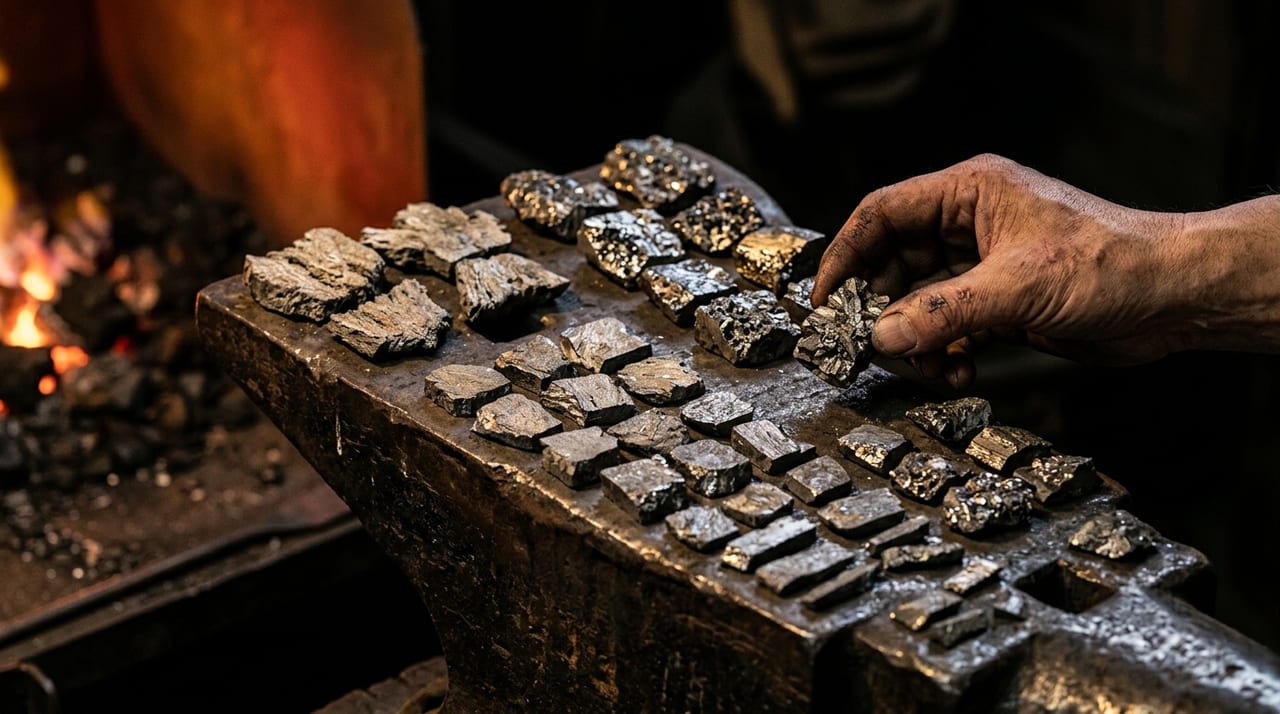
The sorting of tamahagane begins with splitting the tamahagane mass with a hammer. Splitting it allows the cross-section to be observed, and at the same time the way it fractures itself provides clues to the carbon content. High-carbon tamahagane breaks cleanly and crisply, while low-carbon tamahagane is tenacious and difficult to split. The broken fragments are matched in weight and size, then classified as "for shingane" or "for kawagane," and stacked respectively in preparation for tsumiwakashi.
The amount of tamahagane needed to make a single blade amounts to several times the finished weight. This is because impurities are removed during the tanren (forging) process and fall away as scale (iron oxide). It is not uncommon for the amount ultimately used to fall to less than one-third of the original.
The classified tamahagane for shingane and kawagane is not used as a single piece alone; multiple fragments of similar properties are often combined and stacked together. Since using tamahagane on its own tends to leave uneven carbon distribution, a method of gathering fragments of similar properties is employed to bring the jigane (steel of the blade surface) closer to uniformity after welding.
Tsumiwakashi and Forge-Welding of Shingane and Kawagane
The sorted shingane and kawagane are each heated in a furnace, and orikaeshi tanren (folding) is repeated to expel internal impurities and homogenize the carbon. The principle is that shingane undergoes fewer rounds of tanren (forging) (to avoid losing too much carbon), while kawagane undergoes more (to thoroughly remove impurities and raise the purity of the cutting edge). For the complete process of orikaeshi tanren (folding), see also From Tamahagane to Nihontō: The Complete Process and Scientific Significance of Orikaeshi Tanren.
Finally, a construction such as kobuse (in which the shingane is wrapped in kawagane) or honsan-mai is chosen and forge-welded. The judgment at this stage — in what proportions to combine the two types of iron — is the core of a tōshō's philosophy and skill, and is the most important choice in determining the jigane (steel of the blade surface) grain, hamon (temper line), and toughness of the finished sword.
Differences in construction such as kobuse and honsan-mai are reflected not only in the cross-sectional structure of the finished blade but also in the jihada (grain pattern of the steel) that emerges after togi (polishing). Even starting from the same tamahagane, a different jihada appears in each individual sword depending on the combination of sorting and forge-welding. This individuality is also one of the reasons nihontō are set apart from industrial products.
Dialogue with Modern Materials Science
From the perspective of modern materials science, the portion corresponding to kawagane in a nihontō is close to eutectoid to hypereutectoid steel with 0.7–1.0% carbon, and yaki-ire (quenching) forms a martensite microstructure to achieve high hardness. Shingane, on the other hand, corresponds to hypoeutectoid steel and secures toughness through a mixed ferrite-pearlite microstructure.
The sorting techniques that tōshō have accumulated as empirical knowledge over several centuries align remarkably well with modern steel microstructure theory, and the precision of that knowledge astonishes modern researchers. The essence of nihontō craft lies at the intersection of tradition and science.
Even from the perspective of those who appreciate and collect nihontō, the sorting and forge-welding of shingane and kawagane is an important process that determines the character of the jigane (steel of the blade surface) and hamon (temper line). Understanding the background of material sorting becomes a key to appreciating more deeply the character that a single sword possesses.
Frequently Asked Questions About Sorting Shingane and Kawagane
- Is all tamahagane used for the cutting edge?: No. As described above, high-carbon tamahagane is used as kawagane for the cutting edge, while low-carbon tamahagane is used as shingane for the core of the blade. Even within the same tamahagane, the role differs depending on the part.
- Do the sorting criteria differ from tōshō to tōshō?: The basic framework — high-carbon as kawagane and low-carbon as shingane — is shared, but specific judgments such as how finely to sort and in what proportions to combine vary according to the experience and philosophy of each school and tōshō.
- Is the sorting of shingane and kawagane still carried out with tamahagane today?: Modern tōshō also use tamahagane produced by tatara (traditional smelting) to perform the same sorting and orikaeshi tanren (folding).