Completion Inspection and the Tōshō's Quality Judgment — The Final Stages from Post-Forging Metōshi to Tameshigiri
 * Image is for illustrative purposes only.
Table of Contents
Where the Tōshō's Work Ends
The tōshō's work is often assumed to be "forging the blade in the smithy," but in reality important tasks remain even after the forging process is complete. Once yaki-ire (quenching) and yakimodoshi (tempering) are finished, the tōshō personally performs an initial polishing stage called aratogi, after which the blade is handed over to a specialist togishi. Before that handoff, however, the tōshō carries out one of the most important tasks: the metōshi.
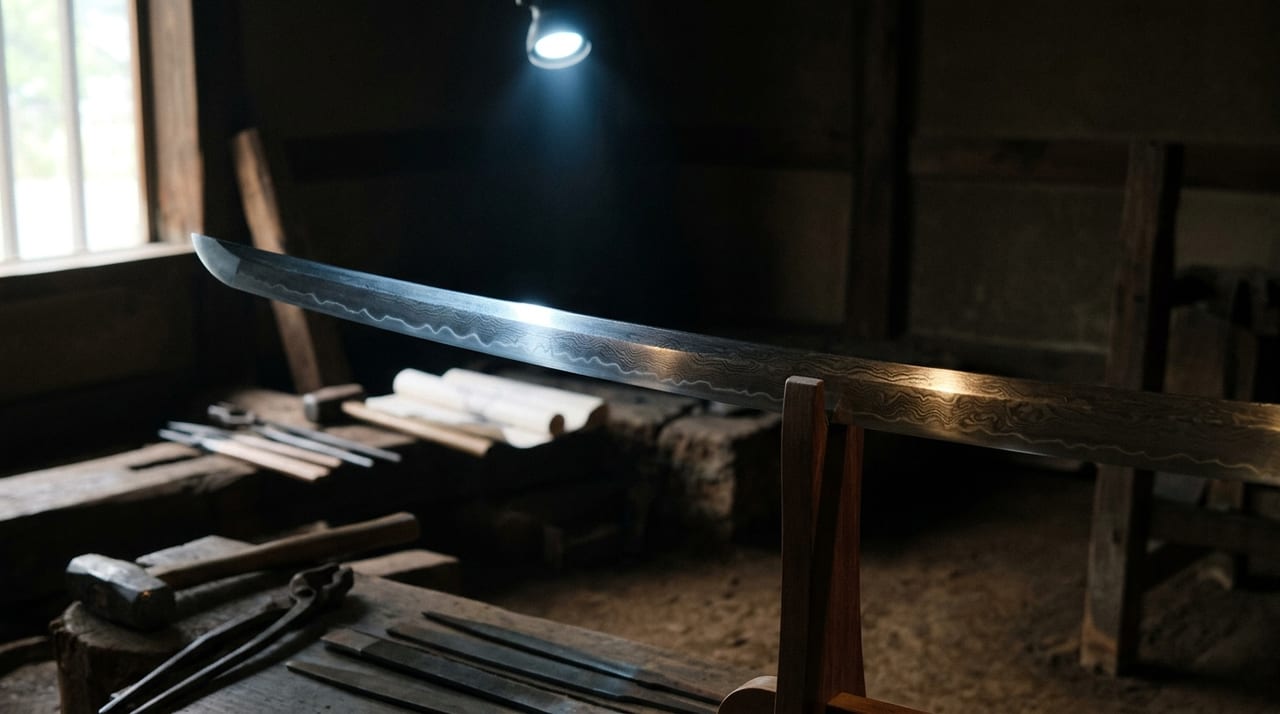
Metōshi is the practice of holding the completed blade up to light and inspecting every part of it thoroughly. Though it is a visual inspection by the naked eye, a skilled tōshō's eye can catch minute flaws that even X-ray examination might miss. This article explains in detail what the tōshō looks for and judges at this final inspection.
The Technique of Metōshi — Light and Angle Tell Everything
Metōshi generally involves holding the blade in hand and viewing it from various angles against a light source such as a window or electric lamp. The type of light source used determines which kinds of flaws can be detected.
| Light source | What can be confirmed |
|---|---|
| Fluorescent / LED lighting | Clearly reveals the boundary between the jigane's forging grain (kitae-me) and the hamon. Used to confirm whether the hamon has come out evenly and whether yaki-ire was achieved in the intended form. |
| Natural light (overcast sky outdoors) | Allows the texture of the jigane's hada — itame, masame, mokume, and so on — to be confirmed in the most natural state. Used to check whether the kitae-hada has developed evenly and whether forging unevenness or "iron-oxide streaks" are present. |
| Point light sources such as candles or incandescent bulbs | Used to check the blade's sori (curvature) and bowing (magari). Sighting straight down the blade while moving the point light source away makes slight bowing or left-right asymmetry visible. |
Using these light sources in combination, the tōshō examines the blade repeatedly from tip to base, from the front (omote) to the back (ura). The time this takes varies from five minutes to over an hour depending on the blade, and differs according to the tōshō's experience and the nature of the sword.
Types of Forging Flaws — The Ware the Tōshō Fears Most
There are several types of flaw that can be discovered during metōshi, each differing in severity and cause.
- Ware (cracking): Caused by failed temperature management during forging or by internal stress from rapid quenching during yaki-ire, the blade can develop minute cracks. Seen from the surface they appear as tiny lines no wider than a needle point, but they are a critical flaw that can lead to blade fracture in use. They are considered the most serious of the flaws found during metōshi.
- Hadaare (rough surface texture): Refers to a rough, deteriorated state of the jigane's kitae-hada caused by insufficient forging or uneven heating. It affects not only appearance but also strength.
- Hakobore (edge chipping): Minute chips in the edge arising during post-yaki-ire handling or during aratogi. The degree ranges from those correctable by the togishi during hon-togi (full polishing) to deep ones requiring repair by the tōshō.
- Sori no kurui (distorted curvature): One of the most common problems arising during yaki-ire. When the sori deviates from the intended amount, the tōshō corrects it immediately after yaki-ire, while the blade is still relatively flexible. This is a delicate process that depends on the craftsman's intuition and experience.
Aratogi and the Scope of the Tōshō's Responsibility
After metōshi, the tōshō often personally performs aratogi. Aratogi is the process of shaping the blade using coarse whetstones (toishi) and removing the surface irregularities from forging. At this stage no detailed finishing of the hamon is carried out; it remains strictly "groundwork before passing to the togishi." The full polishing process, which proceeds through finer stages to bring out the hamon, is covered in detail in Polishing Techniques for the Shinogi-ji and Hira-ji.
Through aratogi, the tōshō makes a final check that the blade's shape (sugata/nari) has been finished according to the design intent. The measured values of motohaba, sakihaba, and kasane are verified to confirm that the specifications match the order. From a quality-control (QC) perspective, this process amounts to a "final inspection."
Some tōshō follow the practice of passing the blade to the togishi in its straight-from-the-smithy (kaji-agari) state without performing aratogi. In that case the togishi takes on aratogi as well, but communication between the tōshō and the togishi becomes all the more important.
Tameshigiri — Confirming Final Practical Performance
Not every tōshō does it, but there is a practice of testing the completed blade (after polishing is finished) through tameshigiri. Tameshigiri is often performed by the togishi or sword dealer, but there are also cases where the tōshō personally conducts it to confirm the cutting performance and strength of their own work.
In modern tameshigiri, bundles of tatami-omote (tatami facing material), also called makiwara, and bone-in tatami-omote are primarily used. What is confirmed through tameshigiri is the blade's "kire" — the low resistance during cutting — and the blade's "rigidity" (gōsei) — the strength that prevents deformation or fracture under impact.
If cutting performance is insufficient, this leads to additional requests to the togishi or a review of the steel composition by the tōkō; if there is a problem with strength (particularly if cracking or deformation occurs), the blade is discarded as a failure. For a modern tōshō, discarding a blade represents a significant economic loss, but putting a defective piece on the market is treated as a matter of craftsman's honor and is strictly self-regulated.
The Craftsman's Philosophy That Metōshi Conveys
The process of metōshi and quality inspection is not merely the work of finding flaws. It is also a philosophical time for the tōshō — a moment in which they answer for themselves the question: "Is this blade worthy of entering the world?"
In the traditional view of swords, a flawed blade is described as "not alive as a sword." The philosophy holds that only when every stage — the tamahagane material, the skill of forging, the temperature management of yaki-ire — is stacked together perfectly is life breathed into "a single sword." Metōshi is the act of confirming that life, the solitary and solemn final chapter in which the tōshō confronts their own skill.