The Income and Business Reality of Tōshō: The Financial, Subsidy, and Side-Income Realities of Continuing to Forge Swords in Contemporary Japan
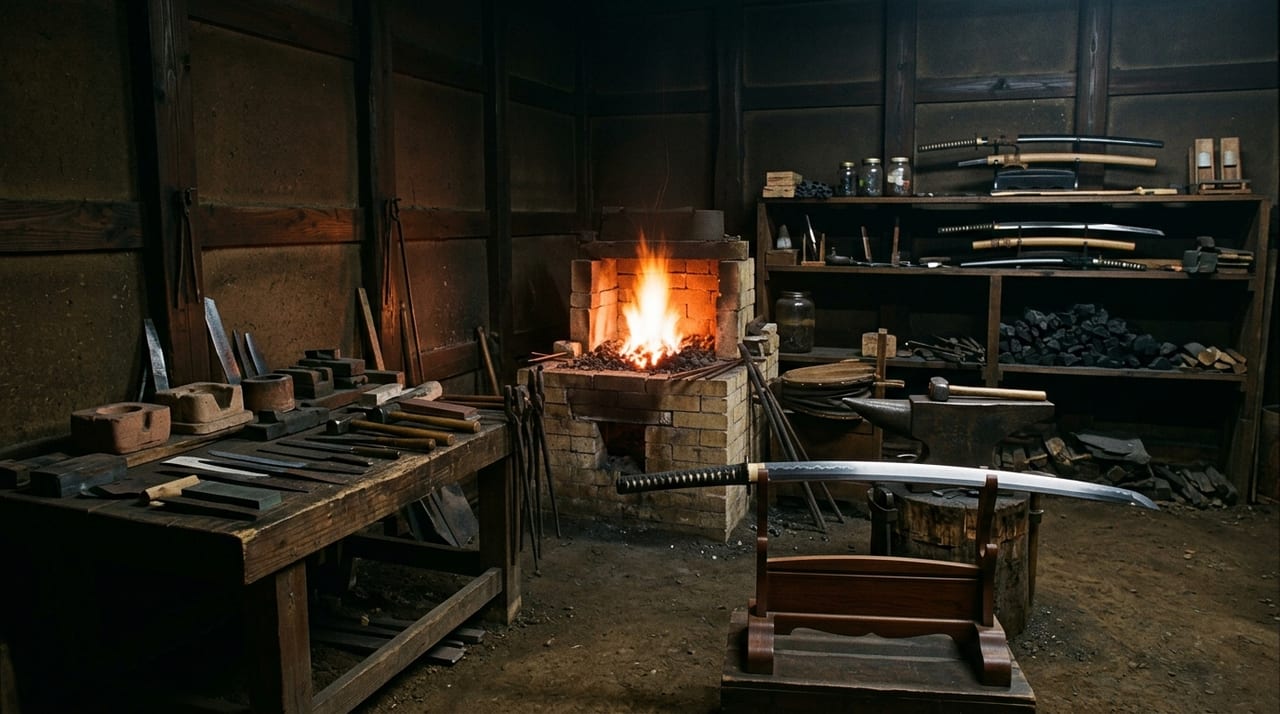 * Image is for illustrative purposes only.
Table of Contents
Living as a Tōshō: The Economic Reality of Contemporary Japan
The craftsmen who forge nihontō — that is, tōshō (tōkō) — find themselves in an exceptionally harsh economic environment, even among the world of handicrafts. Although the Regulation on Approval for the Production of Art Swords contains no annual cap on the number of pieces (Regulation on Approval for the Production of Art Swords (e-Gov Laws Search)), prefectural review standards specify the minimum number of tanren days per piece (15 days or more for tachi, katana, and naginata; 10 days or more for wakizashi, tantō, and similar) (Aomori Prefecture, "Approval for the Production of Art Swords" Review Standards), and the practical annual production volume is naturally limited, a structural factor that determines the ceiling on income.
What, then, do annual earnings actually look like? For renowned tōshō or tōkō of Living National Treasure caliber, works priced at 1,000,000 yen to several million yen per piece are not uncommon, but for the majority of tōshō the reality is far harsher. After deducting the cost of materials required for sword-making (tamahagane, charcoal, whetstones, etc.) and equipment maintenance costs, take-home income of around 200,000 yen per month is frequently reported. Among those in the sword industry, the saying "fewer than one in ten tōshō can survive on swords alone" has been passed down, and the reality is that side work and supplementary income underpin many livelihoods.
National and Local Government Subsidy and Support Programs
The public support available to tōshō is limited. Those certified as holders of important intangible cultural properties (individually certified — the so-called Living National Treasures) receive a special grant from the national government (2,000,000 yen per year) (Agency for Cultural Affairs, "Intangible Cultural Properties"). However, certification is limited to only a small number of tōshō.
In addition, some local governments have programs to support the development of successors in traditional crafts and the introduction of workshop equipment. Eligibility and requirements vary by municipality, so it is advisable to check with the local government where the workshop is located. When using subsidies, the preparation of application documents also takes time, so one should keep in mind how this balances against time spent forging.
Monetizing Hands-On Forging and Workshop Visit Programs
In recent years, "hands-on forging" and "workshop visit programs" have spread as a means of diversifying income. In Seki City, Gifu Prefecture, Setouchi City, Okayama Prefecture (formerly Osafune-cho), Nara City, and other locations, the number of workshops offering 1–2 hour hands-on forging sessions for tourists and sword enthusiasts has been growing, with participation fees of around 5,000–15,000 yen per person as the going rate.
Riding the expansion of inbound demand (particularly the weak-yen period from 2024 onward), some tōshō have begun developing English-language programs aimed at foreign tourists. If group sessions of 3–5 people per day are conducted consistently on weekends, this can amount to supplementary income of around 200,000–300,000 yen per month, substantially complementing earnings from the primary work of sword-making.
However, the time and effort costs of experience programs are high, and they carry the dilemma of "reducing the time available to concentrate on actual forging." Some tōshō deliberately choose not to run experience programs and instead specialize exclusively in commissioned sword-making, and business strategies vary greatly among individuals.
Diversification of Sales Channels: Direct Sales, Sword Markets, and Online
Another important factor that determines a tōshō's income is the choice of sales channels. Traditionally, wholesale through sword dealers (traders and retailers) was the mainstream approach, and tōshō received the selling price minus the dealer's share. In recent years, however, a movement emphasizing direct sales has spread.
Exhibiting at the annually held Shinsaku Meitō Exhibition (organized by NBTHK) functions as a venue for tōshō to connect directly with sword enthusiasts. There has also been an increase in tōshō personally setting up stalls at sword markets and antique fairs across the country, and those seeking to improve earnings through direct sales that cut out middlemen's margins are conspicuous.
Information dissemination through social media and websites is also growing in importance. Some tōshō are raising their profiles by sharing the forging process on Instagram and YouTube, and accepting orders directly. Tōshō who leverage such digital strategies tend to develop a dedicated regular clientele more easily, and their pricing negotiation power also tends to improve.
Training Apprentices and Future Business Risks
One of the long-term challenges in managing a tōshō's business is the training of apprentices (live-in apprentices). Under the system, the requirements for receiving approval to produce swords for the first time include having devoted oneself continuously for five years or more to the refinement of technique under a tōshō who has already received such approval, and having completed training conducted by the Commissioner of the Agency for Cultural Affairs (Regulation on Approval for the Production of Art Swords (e-Gov Laws Search), Article 2). While taking on apprentices is also a duty of the master in terms of passing down techniques, it can also entail the economic burden of supporting apprentices' livelihoods to a certain extent.
Apprentice wages are reported at around 80,000–150,000 yen per month, and in many cases the master covers this from their own income. In a workshop with 3–4 apprentices, labor costs alone can amount to several million yen per year, making the business difficult for any but the most financially secure tōshō.
On the other hand, there is also the "human asset" dimension: if an independent apprentice builds a reputation as an outstanding tōshō, the profile of the master's school and workshop also rises. Training apprentices is a cost in the short term, but it can also be seen as an investment in the workshop's brand over the long term.
Challenges and Possibilities Facing the Modern Tōshō
The environment surrounding a tōshō's business remains harsh. The following compounding challenges overlap.
- Rising material costs (the price of tamahagane has shown an upward trend in recent years)
- Shortage of successors
- Aging
- Low public awareness
However, there are also tailwinds: a boom in nihontō among younger generations driven by sword games, films, and anime; synergies with inbound tourism; and growing international attention as a "Japanese intangible cultural heritage."
What is demanded of the modern tōshō may be not only the deepening of sword-making technique but also the adoption of a business owner's perspective. By combining multiple pillars such as the following, a quiet movement is spreading toward realizing the ideal of "a tōshō who can make a living from swords alone."
- Leveraging subsidies
- Developing experience programs
- Disseminating information through social media
- Directly approaching overseas markets