Two-Character and Long Inscriptions: Reading Mei Format, Position and Suriage
 * Image is for illustrative purposes only.
Table of Contents
What Are Mei, Nijimei, and Chōmei?
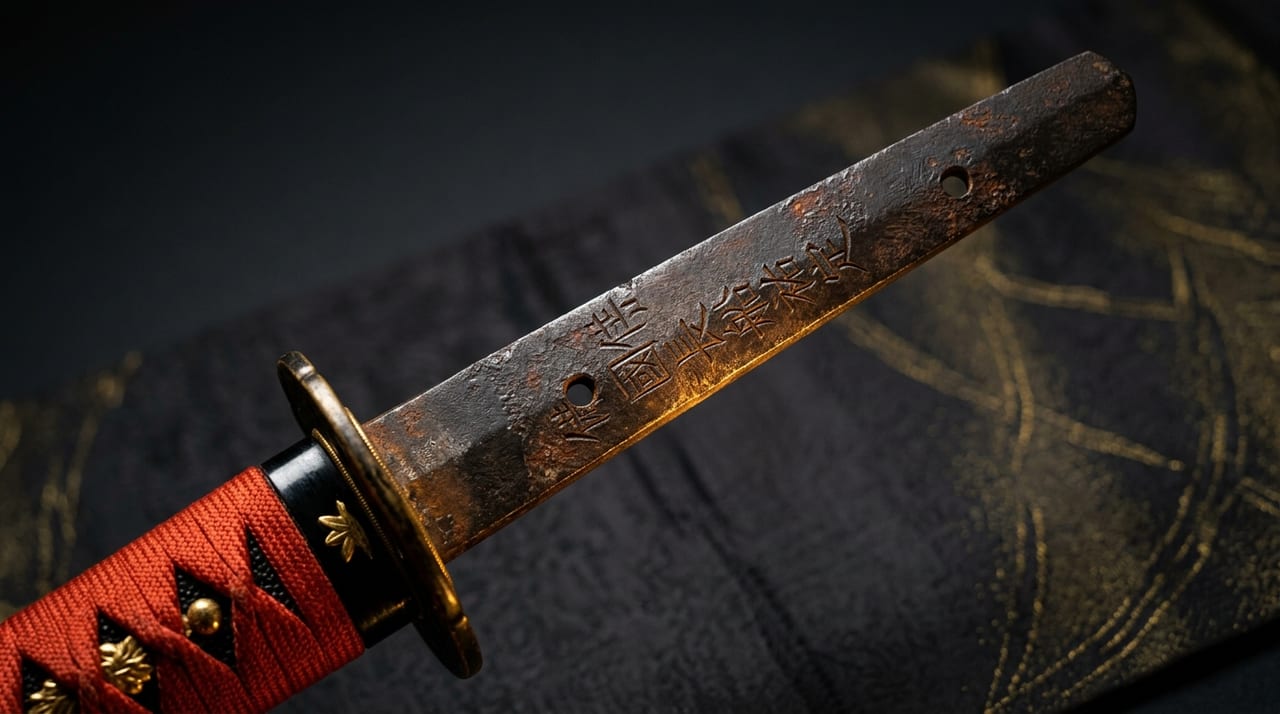
The nakago (tang) of a Japanese sword typically bears an inscription of the maker's name and other details carved with a chisel. This inscription is called a mei. A mei is a signature indicating that a swordsmith made the sword, and it is considered one of the most important clues in authentication and determining authenticity.
The way mei are inscribed varies depending on the swordsmith and era. Among these, those with the swordsmith's name carved in two characters are called nijimei, while those with longer inscriptions that include, in addition to the maker's name, his place of residence, dates, affiliations, and so forth, are called chōmei. However, these are not strictly defined official classifications, but rather practical terms used in appreciation and transactions.
- Nijimei: a mei with the swordsmith's name (maker's name) concisely carved in two characters
- Chōmei: a long mei that includes, in addition to the maker's name, such information as country, place of residence, official rank, date, and patron
- Mumei: a sword with no mei carved, or one whose mei has been lost
- Zarimei: a sword with its mei still present
Neither is superior; the form of mei reflects the habits of makers and their era, as well as the circumstances of commissions.
Characteristics of Nijimei
Nijimei, with only the maker's name carved briefly, conveys a clean impression. The chiseling work is visible at a glance in the limited space of the nakago, making it easier to compare the individual stylistic peculiarities of the maker, such as calligraphic style and the vigor of the chiseling.
In authentication, the character style of the mei itself becomes an important criterion for judgment. Even with the same swordsmith's mei, the shape of the characters can change depending on different periods, and examples are known where writing habits differ between late years and early career. Because nijimei have fewer characters, each stroke of each character determines the overall impression, making the task of discerning characteristics a delicate one.
Additionally, nijimei have the aspect of being easy to forge. Because there are few characters and short mei are easy to imitate, there are generally many examples of false mei being carved on the works of famous makers in later periods, and it is considered dangerous to judge authenticity based solely on mei. It is basic practice to also confirm whether the quality of the blade and the mei are in harmony.
Characteristics of Chōmei
With chōmei, various information is added in addition to the maker's name. Representative examples are as follows.
- Country name or place of residence (in what region it was made)
- Official rank or title (the names and titles claimed by the maker)
- Date (when it was made)
- Patron or commissioner (for whom it was made)
- Statements regarding the origin or purpose of the sword
Chōmei containing such information have high value as research materials, serving as clues to understanding the provenance of the sword. Swords whose mei reveal when, where, and by whom they were made are useful for comparison with other works by the same maker.
On the other hand, chōmei require more surface area on the nakago because they have more characters. On swords with short nakago or those whose nakago were shortened later, the chōmei may be cut off partway or may have lost some characters.
Position and Orientation of Mei
There are established customs regarding which face of the nakago the mei is carved on and in which direction. The basic principle is that the mei is carved on the face that would be on the outside when the sword is worn.
Different Faces for Tachi and Katana
Tachi are suspended from the waist with the edge downward (worn in this manner), so the mei is carved on the face that is on the outside when worn. This is called the haizura. Katana, on the other hand, are thrust edge-upward into the belt, so the mei is carved on the face that is on the outside when worn in this way. This is called the sashizura. Thus, when the same maker produced both tachi and katana, the face on which the mei is carved is reversed.
This custom can serve as a clue for inferring from the direction of the mei whether a sword was originally made as a tachi or as a katana. However, there are examples where a tachi was later remounted as a katana and the nakago was shortened (tosujōage), changing the position of the mei, so one cannot make a definitive judgment based on the mei's position alone.
Tosujōage and the Fate of Mei
Tosujōage, the adjustment to shorten a sword's length, is a process that shortens the nakago. If the mei is at the end of the nakago, it may be lost entirely. To preserve the original mei, methods such as folding back the portion with the mei to remain on the new nakago, or cutting out and affixing the mei to the new nakago, are sometimes employed.
- Folded-back mei: mei preserved on the nakago by folding back the original mei during tosujōage
- Gaku mei: mei created by cutting out the original mei section and fitting it into the new nakago
- Dai-tosujōage: extensive tosujōage in which the mei is completely lost, resulting in a mumei sword
Swords whose mei are lost may be given a kiwame (appraisal/attribution) by later experts. In such cases, the maker or school is inferred from a comprehensive judgment of features such as the jigane (ground steel), hamon, and overall form, rather than from the mei.
Points to Note When Viewing Mei During Purchase or Appreciation
When actually viewing the mei of a Japanese sword, it is helpful to pay attention to the following points.
- Confirm the presence or absence of the mei and its position, and determine whether it is a tachi mei or katana mei
- Examine the character style, chiseling technique, and character arrangement of the mei to check for any unnatural aspects
- In the case of chōmei, confirm the content of the country names and dates recorded
- Observe whether the mei and the quality of the blade are in harmony
- Verify whether the rust condition of the nakago and the way the mei chisel marks are naturally executed
Mei are information that greatly influences the value of a sword, but they do not determine everything. There are swords with mei that lack quality, just as there are mumei swords that are highly valued. It is important to cultivate an eye for viewing the blade itself, rather than regarding mei as absolute.
The Joy of Interpreting Mei
Nijimei have the appeal of concentrated simplicity, while chōmei have the appeal of abundant information, each with its own points of interest. When you consider that the nakago—a part usually hidden by the handle—embodies the maker's individuality, the customs of the era, and the circumstances of the commission, the enjoyment of viewing a sword expands.
When viewing a sword of interest in an online catalog of swords and blades, it is worthwhile to look not only at photographs of the blade but also at photographs of the nakago. As you compare the forms, positions, and character styles of mei, you gradually develop a sense for interpreting mei.