When the Registration Certificate Differs from the Actual Sword — Discrepancies in Length, Sori, Mekugi Holes, and Mei, and How to Think About Reporting
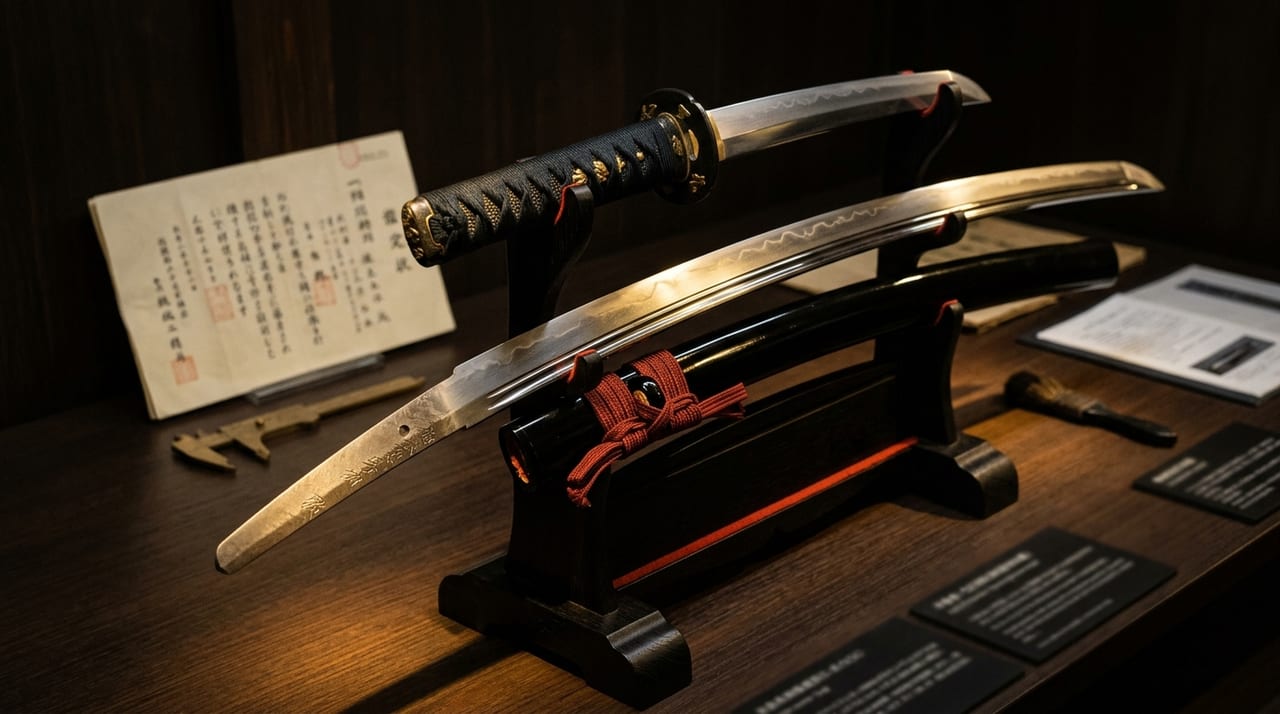 * Image is for illustrative purposes only.
Table of Contents
To possess a nihontō, you need a registration certificate under the Rules on the Registration of Firearms and Swords issued by a prefectural Board of Education. The certificate records the characteristics of the sword, and if those details do not match the actual sword in hand, the certificate cannot serve its purpose. Yet discrepancies such as "it got a little shorter after togi," "I think there are more mekugi holes now," or "the reading of the mei differs from what is written" are not uncommon in secondhand swords. This article organizes the approach to take when the registration certificate and the actual sword differ, drawing on guidance published by each prefecture.
What Does the Registration Certificate Certify?
The registration certificate is an official document certifying that the sword in question is a type of blade whose possession is permitted. Tokushima Prefecture's guidance also explains that it is not a document proving ownership (Tokushima Prefecture guidance (PDF)).
For this reason, it is important that the registration certificate and the actual sword correspond one-to-one. If the details on the certificate differ from the actual sword, it can no longer be said definitively that "this is the sword to which this certificate corresponds."
Main Items Recorded on the Certificate
Looking at each prefecture's guidance, the following items are recorded on a sword registration certificate.
- Type (katana, wakizashi, tantō, etc.)
- Length
- Sori
- Number of mekugi holes
- Mei
How to handle cases where these differ from the actual sword is addressed in prefectural guidance.
Guidance on Discrepancies from the Actual Sword
Hiroshima Prefecture states that if the details on the registration certificate (for swords: length, sori, mekugi holes, mei, etc.) differ from the actual sword, a physical inspection is required (Hiroshima Prefecture).
Shizuoka Prefecture advises that if length, sori, the number of mekugi holes, mei, or other details differ, the holder should report to the prefecture that issued the registration certificate (Shizuoka Prefecture).
Miyagi Prefecture also advises that if length, sori, mei, or other details differ from the actual sword, the holder should contact the Board of Education of the issuing prefecture (Miyagi Prefecture).
The wording differs slightly from prefecture to prefecture, but the following points are common to all.
- If you notice a discrepancy, do not leave it unaddressed
- The point of contact is the Board of Education (cultural property division) of the prefecture that issued the registration certificate
- Confirm the specific procedures and required documents through each municipality's guidance
Which documents are actually required, the schedule for physical inspections, and what to bring vary by municipality. Contacting the issuing office first is the safest approach.
Situations Where Discrepancies Are Likely to Occur
Discrepancies are likely to arise in the following situations.
- After togi or maintenance: togi can reduce the blade, causing slight changes in dimensions and sori
- Modifications such as suriage: the nakago is cut down, changing the length, the number of mekugi holes, and the mei. Suriage is explained in Suriage Techniques and Appraisal
- Differences in measurement method: how people measure length and sori can vary. Blade Thickness and Width Measurement Standards and Blade Dimension Measurement and Evaluation are also useful references for understanding where to measure
- Misreading of the mei: cursive characters or worn mei are prone to differing interpretations. Even when a kiwame attribution written in red ink is present, verifying the reading is necessary
With differences in measurement method, it is necessary to determine whether the discrepancy is an actual error or simply a difference in measurement convention. Even in the catalogue of the sword exhibition at the Kyoto National Museum, measurements are recorded separately under items such as overall length, nakago length, kissaki length, motohaba, sakihaba, and blade sori (Kyoto National Museum catalogue (PDF)). It is a prerequisite to align what was measured and where before making comparisons.
Things to Check Before Purchase
When acquiring a secondhand sword, comparing the registration certificate against the actual sword will give you peace of mind.
- The issuing prefecture and number on the registration certificate are legible
- The type, length, and sori on the registration certificate do not deviate significantly from the actual sword
- The number of mekugi holes matches what is recorded on the registration certificate
- The mei can be read as recorded on the registration certificate (if mumei, the mumei notation matches)
If you have concerns about a discrepancy, review the listing description and photographs, and check with the seller about anything unclear. After that, the process is to consult with the issuing municipality about any required reporting.
The basic workings of the registration certificate are summarized in Complete Guide to Registration Certificates and Complete Legal Guide to Nihontō. If a change of registered holder is involved, please also refer to Procedures for Inheritance and Estate Settlement.
What Has Not Been Confirmed
Specific standards — such as whether the "length" on the registration certificate is defined the same as nagasa (from the hamachi to the kissaki), or how much discrepancy is considered a mismatch — could not be confirmed in the statutory text or official guidance. Registration standards are set out in the Rules on the Registration of Firearms and Swords and can be traced from the Agency for Cultural Affairs' guidance page and each prefecture's guidance (Agency for Cultural Affairs guidance). If individual judgment is required, please confirm with the issuing Board of Education.
When Looking for a Sword
TOUKENZA is an online sword marketplace. Swords currently listed can be browsed at Sword Catalog. For inquiries about listed items, please contact us via the inquiry form.