Blade Thickness and Width Measurement Standards: Design Philosophy and Cutting Performance Across Eras
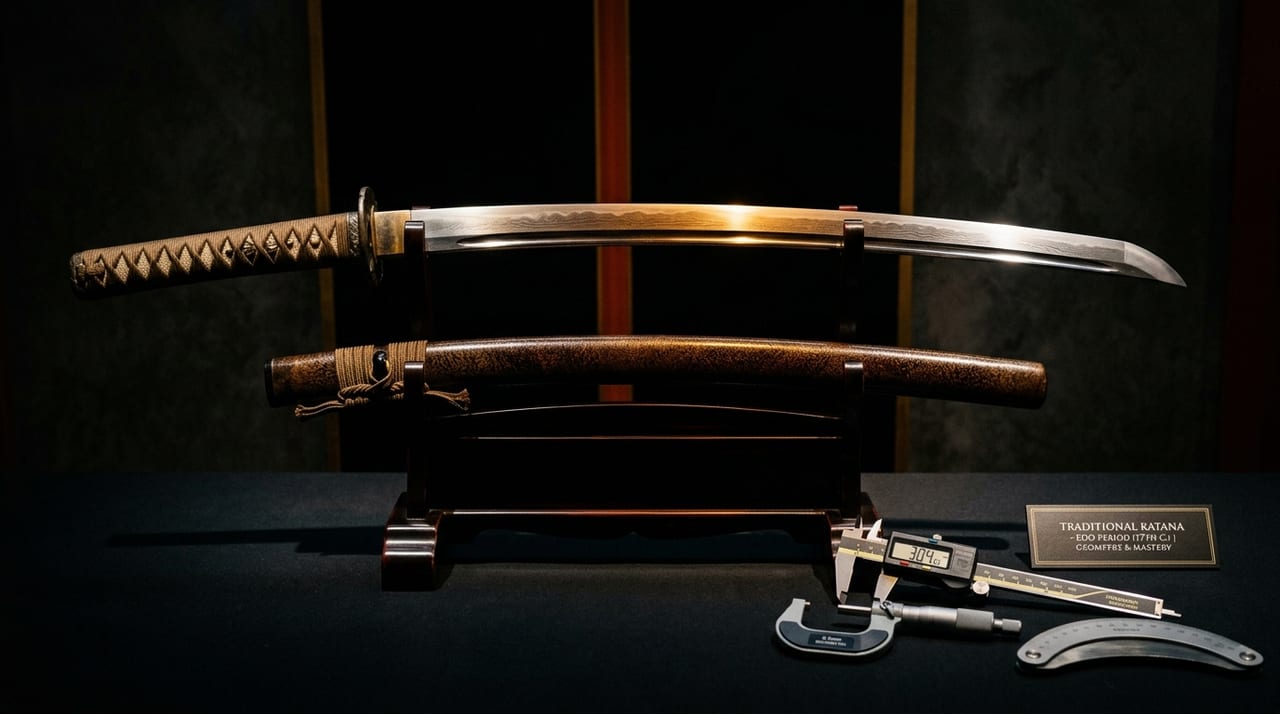 * Image is for illustrative purposes only.
Table of Contents
Introduction
The physical dimensions of the blade are the most objective indicator in accurately evaluating the performance and aesthetic value of Japanese swords. In particular, thickness (atsumi) and width (haba) are closely related to practical performance such as cutting edge, durability, and ease of handling. In this article, we will introduce evaluation points for sales and purchase by discussing the standards of measurement methods, characteristics by era, and the practical significance of dimensions.
Basics of Blade Measurement
Standard Measurement Points and Methods
When measuring blade thickness and width accurately, it is common to use calipers (digital calipers recommended) and a flat measurement surface. Measurements are taken at multiple points from the nakago-moto (base of the tang) toward the kissaki (tip).
- Thickness (atsumi): The perpendicular distance from the blade edge to the spine side. Since it changes before and after edge hardening, the thickness on the spine side (munegawa) is used as the standard
- Width (haba): The distance to both left and right edges in the blade direction. Since it differs between the grip and tip, the central part is often measured
- Measurement point guidelines: It is standard to take measurements at three points approximately 3cm, 15cm, and 30cm from the tang base toward the tip
Particularly in evaluation by collectors and during sales, there is a tendency to emphasize the values of the central part of the blade (the strongest part).
Dimensional Characteristics by Era
Koto (Old Swords) Trend: Thickness Prioritizing Combat Effectiveness
Koto (swords from the Kamakura period to the early Edo period) needed to withstand repeated slashing attacks in actual combat. Therefore, compared to modern shinto (new swords), they were generally thicker overall, with notably thick spines as a characteristic.
- Thickness: Average 8-12mm (central part). The jihada (surface pattern) was formed deeply, and ensuring strength through forging was prioritized
- Width: Average 30-35mm. Due to differences in fighting methods and technical systems, changes in width over time were not as pronounced as thickness
- Reason: Practical functionality as a weapon was the top priority. Resistance to repeated cuts was emphasized over the ability to cut
Shinto (New Swords) Trend: Balance Between Aesthetic Refinement and Practicality
Shinto (Edo period to early Meiji era) inherited the combat experience of koto while adapting to the aesthetic sensibilities of a peaceful age. Sword makers slightly reduced thickness while enhancing the texture of the edge and the overall beauty of the blade's form.
- Thickness: Average 7-10mm. Slightly thinner than koto, balancing cutting ability and durability
- Width: Average 28-33mm. This was a period when the individuality of sword makers became more pronounced
- Regional differences: Echizen school swords tend to be thicker and maintain robustness, while Seki school swords tend to be thinner and pursue elegance
Gendai-to (Modern Swords) Trend: Diverse Design Philosophy
Modern swords after the Meiji era evolved under the backdrop of increased use for appreciation and the enactment of laws prohibiting possession of swords (the Swords and Firearms Control Law). This was the period when the individuality of sword makers and purpose-based design were most pronounced.
- Thickness: 6-11mm wide distribution. Those for appreciation tend to be thinner, while those intended for practical use (such as iaito) tend to be thicker
- Width: 24-35mm. Diversity is at its maximum, ranging from narrow, elegant styles to wide, bold creation styles
- Design background: Since purposes diversified to include appreciation, research, and iaido practice, dimensions also reflect the philosophy of sword makers
Impact of Thickness and Width on Performance
Relationship with Cutting Ability
Generally, the sharper the edge angle, the higher the cutting ability. Since thinner blades allow for a sharper edge angle, some shinto and modern swords prioritizing cutting ability are seen with thinner designs. However, in the case of Japanese swords, not just simple thinness, but the hardening state of the hamon (temper line) and the structure of the jihada are factors that determine cutting ability.
Durability and Ease of Handling
The thickness of koto increases resistance to metal fatigue from repeated use. On the other hand, since thicker means heavier, sword makers have considered the balance with ease of handling. Wider width increases weight, while narrower width makes it easier to handle. In response to historical changes in combat techniques (establishment of swordsmanship), sword makers determined dimensions based on their accumulated knowledge.
Design Characteristics by Region
Differences Between Bizen School and Echizen School
- Bizen school: Overall elegant with narrow blade width. Thickness is relatively thin, characterized by refined creation style
- Echizen school: Stately boldness. Thickness is substantial, showing a design tendency prioritizing practical effectiveness
These regional differences in characteristics arose from differences in mineral resources, climate, and combat environments in each area. For modern collectors, dimensional data serves as an important clue for inferring a sword's provenance and lineage.
Checkpoints When Purchasing and Evaluating
When selecting a sword at toukenza, you can use dimensional information to find one suited to your needs.
- Appreciation-focused: Those with adequate blade width and thickness appropriate to the era (8-10mm for koto) appear most beautiful
- Practical use as iaito: Balance between adequate thickness and width is important. Since it should not be too heavy and durability is necessary, modern swords around 7-8mm are preferred
- Learning and research: To experience the characteristics of each era, we recommend comparing swords from different periods by cross-referencing with dimensional data
Product pages include details of such dimensional information. If you have any questions, please feel free to contact us via the contact form. The toukenza staff will provide advice to help guide your purchase.
Conclusion
Blade thickness and width are indicators that crystallize the technique of sword makers, the demands of the era, and regional characteristics. By understanding not merely the numbers, but the history and philosophy behind them, you can more deeply appreciate Japanese swords as works of art. Through the intersection of dimensions and history, we help you find your sword.