The Science of Utsuri: How Forging and Quenching Create the Faint Shadow in a Sword's Steel
 * Image is for illustrative purposes only.
Table of Contents
What is Utsuri
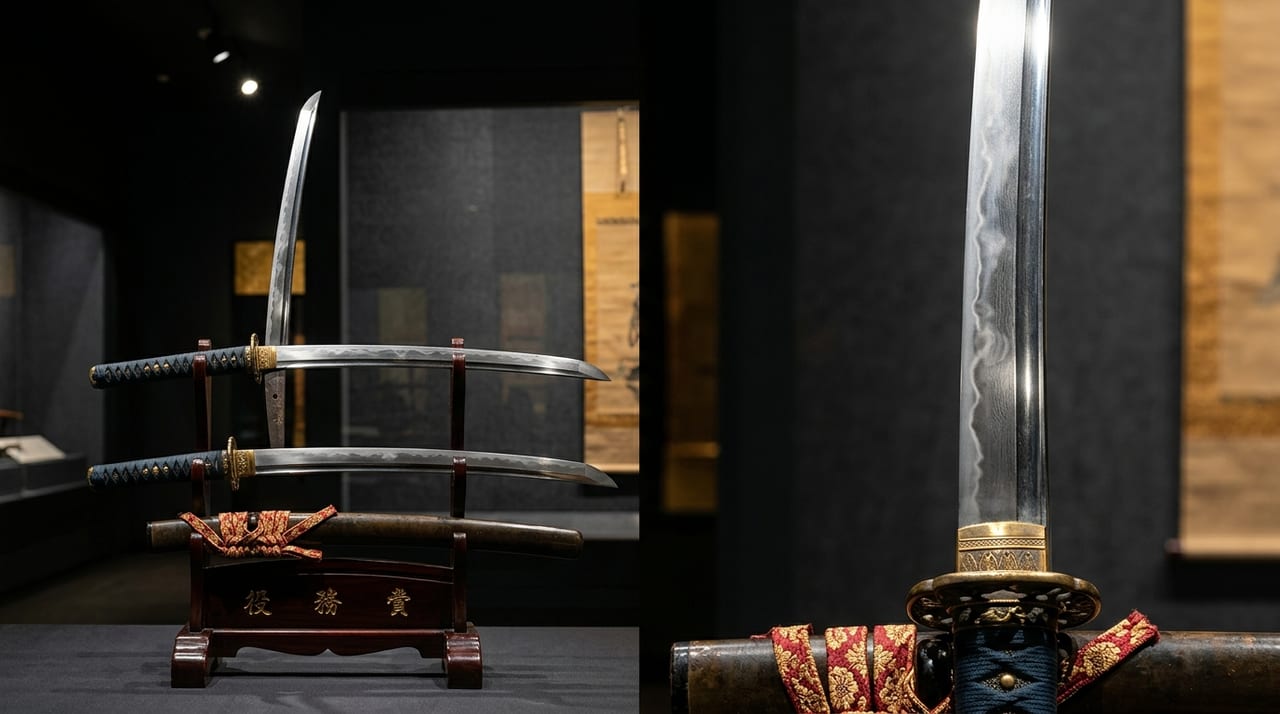
Utsuri (映り) refers to pale, shadow-like patterns that float up faintly within the jigane of a Japanese sword, distinct from the hamon. While the hamon appears as a clear line in the area near the edge, utsuri appears in the ji portion, often in the region closer to the spine than the hamon, in the form of a hazy, cloud-like shape with blurred contours. Because the appearance changes greatly depending on how light is applied and from what angle, an experienced polisher's or appraiser's eye is essential to discern the presence or absence and type of utsuri. It is known that utsuri is prominently seen in old swords of the Bizen tradition, especially in the work of Ko-Bizen and Ichimonji-ha, while it rarely appears in swords centered on the Soshu tradition, showing both regional and school-based differences. Because it is not as conspicuous as the hamon, it is an element easily overlooked by those handling a Japanese sword for the first time, but it is also a characteristic that becomes increasingly apparent as one accumulates experience in appreciation.
The Metallurgical Conditions for Utsuri Formation
Regarding how utsuri forms, there is widespread understanding that differences in the microstructure of the steel comprising the jigane are involved. The jigane of a Japanese sword develops a structure of thin layers with slight variations in carbon content, built up through repeated folding and forging of tamahagane. During quenching of the blade, the area near the edge is rapidly cooled to form a hard microstructure because the clay coating is thin, while the area near the spine remains in a different microstructure due to slower cooling because the clay coating is thick. The difference in microstructure that occurs near this boundary is thought to manifest as utsuri, appearing as subtle light and dark differences on the surface of the polished blade. In other words, utsuri is a phenomenon that emerges only when two factors overlap: the layered structure of the jigane from forging and the difference in cooling rates during quenching, neither of which alone is sufficient to produce it. Because the properties of tamahagane and carbon distribution vary by region and era, even when using the same clay-coating technique, the manifestation of utsuri is thought to reflect the individuality of each production area.
Types of Utsuri
Utsuri has several types, with names that differ according to how they appear.
- Midare-utsuri — utsuri that appears in an irregular wave pattern, corresponding to the activity of the hamon
- Suguha-cho-utsuri — a relatively straight, band-like utsuri seen in work where the hamon is close to suguha
- Jihan-utsuri — utsuri that appears as irregular spots throughout the jigane
- Bo-utsuri — utsuri that appears as a single band-like form near the spine, roughly following the shape of the hamon
All these types change expression subtly depending on the combination of the forging texture of the jigane (itame, mokume, masame, etc.) and the clay coating of the quenching, so even though they are grouped under the single term "utsuri," the appearance varies from blade to blade. Even among work from the same school, individual differences in the depth and intensity of utsuri arise due to differences in forging habits and thickness of clay coating.
The Difference Between Utsuri and Hamon
Both utsuri and hamon are phenomena resulting from quenching, but they differ in nature. The hamon is the boundary line of the hard microstructure (martensite) formed when the edge is rapidly cooled, and can be visually recognized through polishing as granular nie and nioi. In contrast, utsuri is not the hardened microstructure of the hamon itself, but rather a phenomenon visible as the difference in light reflection caused by microstructural changes in the jigane. Therefore, utsuri has fainter contours than the hamon and has the characteristic of appearing and disappearing depending on viewing angle and light source. The reason polishers employ techniques of edge-finishing and wiping in the final stage is both to make the hamon stand out clearly and to bring out the delicate expression of utsuri without diminishing it. The appearance of utsuri can change significantly depending on the skill of polishing, and whether the latent beauty of the jigane can be brought out depends greatly on the polisher's expertise.
Why Utsuri is Valued and Its Role in Authentication
While utsuri does not directly affect the practical performance of a Japanese sword, it has been valued in both authentication and appreciation. From the authentication perspective, the presence or absence and type of utsuri serves as one clue for estimating the era and school. While utsuri is frequently seen in Kamakura-period Bizen swords such as Ko-Bizen and Ichimonji-ha, it is said that work from the same Bizen tradition after the Nanboku-cho period and work from Soshu and Mino traditions tend to show sparse utsuri, serving as an indicator reflecting differences in jigane forging methods and quenching practices. From the appreciation perspective, utsuri has been valued by enthusiasts as an element that conveys the quiet depth of the jigane, in contrast to the dynamic beauty possessed by the hamon. Finding a pale shadow that suddenly emerges elsewhere when a blade is held up to the light, distinct from the hamon, is considered one of the pleasures of appreciating a Japanese sword. Contemporary research continues to attempt to clarify the conditions for utsuri formation from the perspective of metal microstructure, and efforts are underway to understand phenomena that have been handed down as empirical knowledge with scientific backing. Utsuri is said to have declined as a technique after the Shinto period, and the very existence of Shinto-period sword-making groups like the Sekido-ha that attempted to reproduce the utsuri of Ko-Bizen and Ichimonji testifies to how sensitive the manifestation of utsuri is to the delicate conditions of forging and quenching. Precisely because utsuri is a difficult phenomenon to reproduce intentionally, its beauty continues to be highly valued as a unique quality of the jigane in old swords.