Spring Hammer and Hand Forging — How Machines and Human Hands Are Used in Modern Tanren
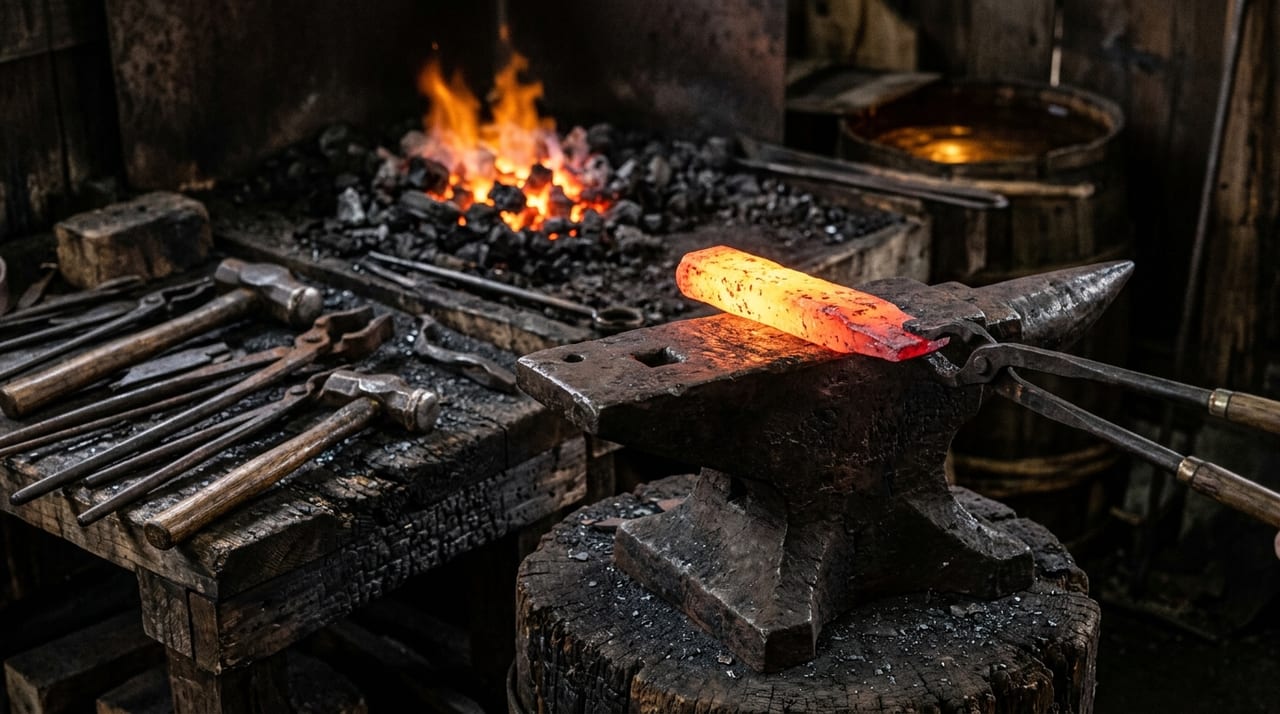 * Image is for illustrative purposes only.
Table of Contents
Spring Hammer and Hand Forging — How Machines and Human Hands Are Used in Modern Tanren
When we think of nihontō tanren, the image that comes to mind is of a master and apprentice standing before red-hot iron, swinging hammers in synchronized rhythm. Yet when visiting a modern kaji workshop, one may find a power hammer known as a spring hammer installed in one corner of the forge. Combining traditional hand forging with mechanical power is no longer unusual. This article examines the workings and characteristics of both, and considers how modern tōkō choose between them. Note that actual practice varies depending on the workshop and the tōkō's philosophy, so please read this as a general overview.
The Purpose of Tanren — What to Understand First
Tamahagane and modern steel used as raw material for nihontō contain uneven compositions in their natural state that must be refined before they can be finished into a blade. Orikaeshi tanren is the process of repeatedly folding heated material and hammering it; its main purposes are the following three:
- To expel impurities along with sparks during forge welding, bringing the iron closer to homogeneity
- To distribute carbon content throughout the material, building the foundation for the hardness the blade requires
- To refine the grain of the iron (kitae-hada), cultivating the character of the jigane that will emerge in later togi
Only when this process is carried out correctly will the desired hamon appear during yaki-ire, and the jihada shine in the togi. Too few folds leave the iron insufficiently homogenized; too many cause excess carbon loss, preventing the blade from achieving adequate hardness. Judging this balance is a matter of the tōkō's experience and discernment, and whether the method is hand forging or spring hammer, that judgment remains with the human.
The Workings and Characteristics of Hand Forging
In hand-forged tanren, the tōkō (master) indicates where to strike with a small hammer, while the apprentice or aizuchi brings down the large hammer with force. Since heated iron cools rapidly, each heat's work must be completed within a limited span of time. If master and apprentice are not in sync, the iron may cool and result in poor forge welding, or blows may land off-target. The tōkō's eye — reading the temperature of the forge hearth, judging the state of the material, and directing the next blow — determines the outcome.
The characteristics of hand forging include the following:
- The position, angle, and force of each blow can be adjusted on the spot in response to the temperature and deformation of the iron
- The tōkō's judgment is directly reflected in the movement of the hammer
- Because multiple people are involved, it has historically functioned as apprenticeship training
- Because it depends on human breath and stamina, the amount of work achievable in a single session has limits
This structure — in which humans judge and humans apply force — is precisely why hand forging has been deeply tied to traditional apprenticeship. The sensations that become ingrained in the body as an apprentice swings the large hammer were also part of the process of cultivating the next generation of tōkō. The division of roles in the forge workshop is covered in detail in Division of Roles in the Forge Workshop, and the training of the hammerman is covered in The Role and Training of the Uchiko.
The Workings and Characteristics of the Spring Hammer
A spring hammer is a power hammer that raises and lowers the hammer head using the recoil of a spring. The tōkō operates the speed and force of blows via a pedal or lever while moving the iron beneath the hammer head to adjust where it strikes. The image of the machine taking over the manual labor of bringing down the large hammer is close to the mark, but it is always the tōkō who determines the direction and angle in which the material is fed.
The characteristics of the spring hammer are as follows:
- It can strike continuously at a consistent rhythm and force, making it easier to maintain uniformity of blows
- Because it can be operated by one person, work can proceed even in the absence of an apprentice
- Because it does not rely on human arm strength, physical fatigue is reduced even during extended work sessions
- By concentrating on pedal operation and feeding the material, it is easier to maintain consistent accuracy in the striking position
Power hammers come in several varieties, including air hammers and hydraulic types, but in Japanese kaji workshops the spring hammer — relatively compact and easy to handle — is said to be the most commonly used. The adoption of machines coincided with a period when the decline of craftsmen and a shortage of successors began to be recognized, and the spring hammer has received attention from the standpoint of workshop sustainability as well.
The Logic of Choosing Between Them — Process and Role
In most workshops, hand forging and the spring hammer are not opposing choices but are used according to the stage of the process. The following divisions are generally observed:
- Tsumiwakashi to ara-nobe: The early process of greatly deforming and folding the material requires many blows and considerable force. Having the spring hammer handle this conserves the tōkō's stamina.
- Su-nobe to katazuke: The stage at which the blade's outline emerges requires fine adjustments of sori and thickness. Work often proceeds with the supplementary use of a hand hammer.
- Finishing tanren: For the thin area near the cutting edge and fine shaping of details, the precision of hand forging comes into its own.
However, this division varies greatly depending on each tōkō's philosophy and the equipment of the workshop. Some tōkō insist on hand forging throughout with little use of the spring hammer, while other workshops cover most of the process with a power hammer. There is no single correct answer; each tōkō makes choices according to their own skills and the blade they are aiming to create. Temperature judgment based on the color of the forge fire is explained in detail in Temperature Judgment by Fire Color.
Can You Tell Hand Forging from Machine Forging in a Finished Blade?
Among sword enthusiasts, it is sometimes said that "the jigane of a hand-forged sword is different." Yet when standing before a finished blade, it is difficult to state with certainty — based on the forging method alone — whether it was made by hand or by machine.
The character of a blade's jigane — the kitae-hada such as itame, masame, and mokume — emerges as the combined result of material selection, the number of folds, fire temperature management, the precision of forge welding, yaki-ire, and the polisher's work. Even if a spring hammer is used for part of the process, if the subsequent hand work and the quality of the yaki-ire are high, the result can be a blade with superb jigane. Conversely, even if the entire process is done by hand, inadequate management of forge-welding temperature can cause unevenness in the jigane.
The assessment of a blade is determined by the overall combination of jigane quality, the clarity of the hamon, the balance of the form, and the polish. Knowing what was used at each stage of production is worth understanding as an expression of the maker's philosophy, but keeping in mind that this alone does not determine superiority or inferiority will broaden your perspective when viewing a blade.
A Perspective for Viewing Swords
Knowing how a tōkō uses hand forging and the spring hammer provides a key to understanding the background of a single blade. Most tōkō who run their own workshops speak of their creative approach as inseparable from their work. Their choice of tools is also part of that approach. Confronting the question of what choices a modern tōkō makes in order to uphold traditional techniques, sustain the workshop, and pass skills to the next generation becomes the starting point for reading a blade deeply.
Contemplating — while appreciating the jigane and hamon — what processes a single blade has passed through is one way of enjoying nihontō appreciation that adds depth to the experience. TOUKENZA's online catalog features works by a variety of modern tōkō. Browse works while comparing each maker's style and workshop approach, and take a look at any blade that catches your eye.