What is kaji-oshi (kaji-togi) — The first togi a tōshō performs after yaki-ire, and how it differs from the togishi's full togi
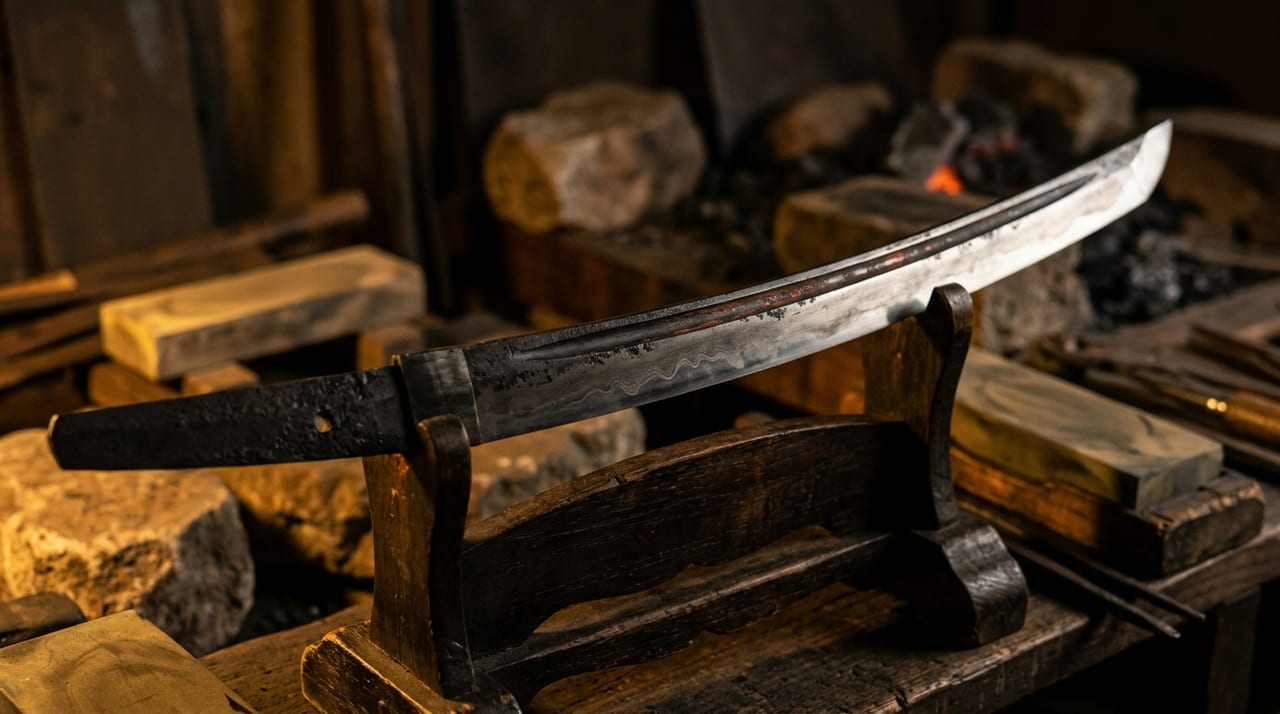 * Image is for illustrative purposes only.
Table of Contents
What is kaji-oshi — The first togi performed by the tōshō
Kaji-oshi (kajoshi) is the process in which the tōshō, after completing yaki-ire, applies a whetstone to the blade by hand to dress it. It is also called kaji-togi. It is distinguished from the full-scale polishing performed by the togishi who finishes the sword as a completed work, and is understood as a preparatory togi carried out in the tōshō's own workshop.
A blade that has just completed tanren and yaki-ire retains an oxidized black skin on its surface along with unevenness left by fire-forging, and neither the hamon nor the texture of the jigane is visible from the outside. Since there is no way to judge the quality of the work in that state, the tōshō first removes the surface with a coarse whetstone and checks the form. The togi at this stage is kaji-oshi.
Its place within the sword-making sequence is roughly as follows.
- Selection and tanren of the steel (orikaeshi tanren, steel composition)
- Shaping by fire-forging (rough drawing-out, formation of the kissaki)
- Rough finishing (shaping and dressing the form with scrapers and files)
- Tsuchioki and yaki-ire
- Kaji-oshi
- Then, after finishing work such as cutting the mei, to the togishi
The exact order of steps varies by school and by tōshō, but the key point is that kaji-oshi is the togi the tōshō performs personally after yaki-ire.
Why it is performed — Fixing the form and checking the result
Kaji-oshi serves two main purposes. One is to dress the form of the sword, and the other is to check the outcome of yaki-ire.
In terms of dressing the form, the flat of the blade, the shinogi ridge, and the shape of the kissaki are refined with the whetstone. For a shinogi-zukuri sword, it is at this stage that details such as whether the shinogi ridge runs straight the full length of the blade and whether the fullness on either side of the mune and the edge is equal are determined. Because the togishi in the subsequent process works using the form the tōshō has created as the baseline, the precision of kaji-oshi becomes the foundation of the final form.
In terms of checking the result, even a rough togi allows the texture of the jigane and the outline of the hamon to become visible, so the tōshō can judge whether the yaki-ire came out as intended. If defects such as quench cracks or flaws in the tanren are found, this becomes the basis for deciding how to respond.
Tools and whetstones — From coarse to medium grit
In kaji-oshi, the work centers on coarse whetstones with strong cutting power rather than the finishing natural stones used by the togishi. Which whetstones a tōshō actually uses and in what combination varies by workshop; some use artificial stones, while others use natural coarse and medium stones. Since it is not possible to discuss specific stone names or grit numbers as a uniform standard, this section limits itself to the broad outline of "bringing out the form with coarse stones and progressing gradually to finer-grit stones."
The basic motion of the work is pressing the blade forward against the whetstone. The "oshi" (pressing) in the name is said to derive from this manner of working. If the blade is not held at a consistent angle and force is not applied evenly, the flat will undulate and the shinogi ridge will curve. This is a process in which togi technique manifests directly in the form of the sword, and it is for this reason that a certain level of polishing skill is required of the tōshō as well.
Differences from the togishi's full togi
Kaji-oshi and the togishi's togi differ in purpose and endpoint. A comparison is as follows.
| Item | Kaji-oshi | Togishi's togi |
|---|---|---|
| Practitioner | Tōshō | Togishi (specialist craftsman) |
| Purpose | To dress the form and check the outcome of yaki-ire | To draw out the beauty of the hamon and jigane and bring the sword to a state fit for appreciation |
| Whetstones | Centered on coarse stones | Used in stages from coarse stones through finishing stones such as uchigumori |
| Result | A state in which the hamon and jigane texture are broadly visible | A state possessing luster and clarity of the ji and ha |
The togishi's work is broadly divided into ground togi and finish togi, with the finish stage also including operations such as edge drawing and wiping. The full picture of these processes is covered in detail in The work of the togishi (polisher) — the togi process of the nihontō, its technical system, and qualification system and The polishing process of the nihontō. Kaji-oshi is the stage that precedes all of this, functioning as, so to speak, the bridging process between tōshō and togishi.
What to know when viewing a sword
Knowing of kaji-oshi adds depth to how one views a sword. The form of a sword is the result of the togishi inheriting and finishing the shape the tōshō determined in kaji-oshi, and in a single sword the work of two craftsmen is layered together.
In old swords that have undergone repeated togi, the mihaba and fullness may have changed from the original form. This is the result of togi being carried out many times over the years, and the perspective of comparing the form at the time of making with the current form is useful for appreciation and for assessing condition. For the yaki-ire process, please also refer to The techniques of tsuchioki in yaki-ire.
TOUKENZA is an online nihontō marketplace, and the swords listed for sale can be viewed in the online catalog. Reading the photographs and descriptions with an understanding of the sword-making process should make differences in form and jigane all the more apparent.