Division of Labor in the Forge — The System of Shared Roles Among the Teko, Uchiyaku, and Fuigoshi in Japanese Sword-Making, and the Transmission of Craft Knowledge
 * Image is for illustrative purposes only.
Table of Contents
The Forge Runs as a "Team"
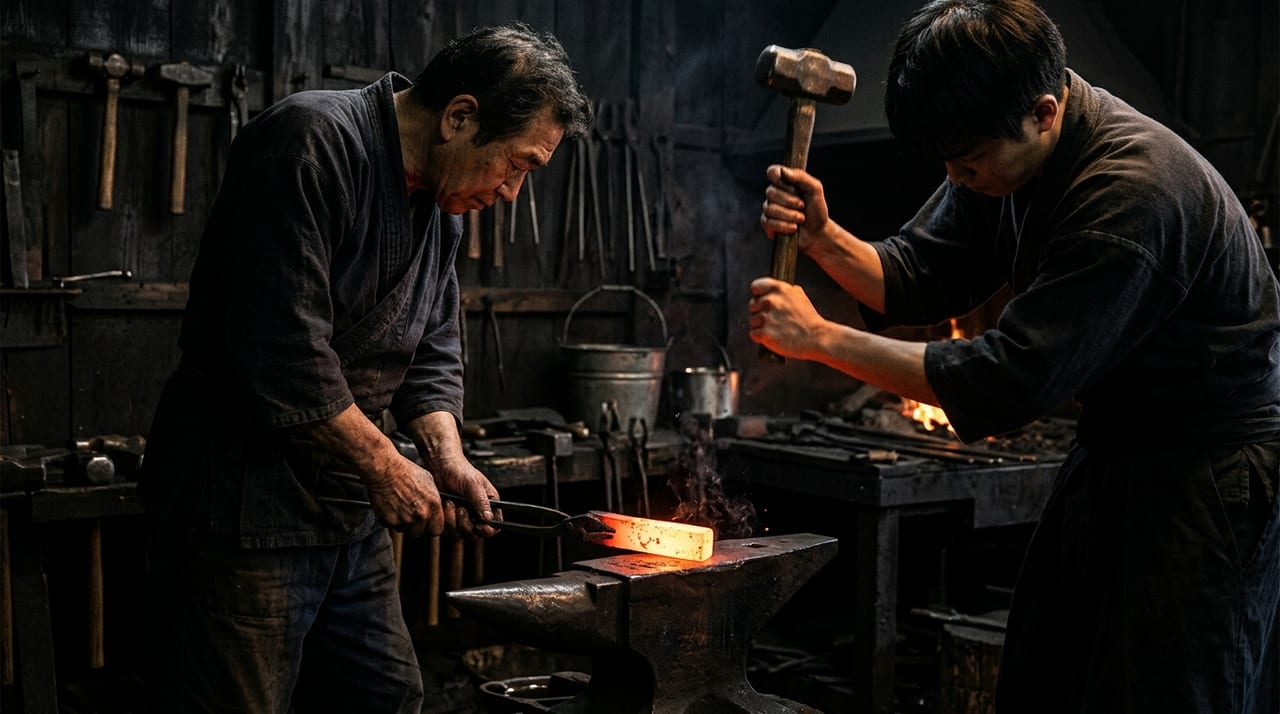
From the outside, Japanese sword forging calls to mind the image of a tōshō standing alone before the furnace, hammering steel without pause. In reality, however, a traditional forge operates through the coordinated efforts of craftsmen and apprentices fulfilling multiple distinct roles. It is both physically and technically impossible for a single tōshō to make a sword in complete isolation.
The principal roles in the forge can be grouped into the following four:
| Role | Primary duties |
|---|---|
| Tōshō (master) | Oversees the forge as a whole and leads the forging of the steel |
| Teko | Holds the steel with tongs (hasamikane) and continuously adjusts the angle and position of the material in time with the tōshō's hammer strikes |
| Sakite / mukōzuchi | Works with a large hammer (ōtsuchi) in coordination with the teko, handling large-scale deformation during orikaeshi tanren and the roughing-out phase |
| Fuigoshi | Operates the bellows (fuigo) to supply air to the furnace and manages the forging temperature (roughly 900–1,300 °C) |
Understanding how these roles function and how they are passed down is an indispensable perspective for gaining a deeper knowledge of Japanese sword production.
Teko — The Master's "Second Pair of Hands"
The teko is the person who assists the tōshō by holding the steel on the anvil (kanatoko). The teko's primary task is to grip the heated steel precisely with tongs (hasamikane) and to continuously reposition it to the correct angle and location in time with the tōshō's hammer blows. Whenever the tōshō gives a signal — a glance or the manner in which the hammer is applied — indicating "strike this side," the teko instantly reorients the steel. When the two fall out of sync, the precision of the forging drops sharply.
A skilled teko reaches a level at which they "read the master's intent through the body," and the intuitive rapport cultivated within the master-apprentice relationship directly affects the quality of the finished sword. In recent years it is common for apprentices to serve as teko, but there were once regions where specialist teko craftsmen existed as a distinct profession. The role of teko is assigned from the earliest stages of apprenticeship, making it an ideal opportunity to observe the master's hand movements at close range.
Sakite — The "Bearer of Force" Who Assists with the Large Hammer
The sakite, also called the mukōzuchi, strikes the steel with a large hammer (ōtsuchi) in coordination with the teko. While the tōshō applies precise blows with a small hammer (kozuchi), the sakite handles larger-scale deformation with the ōtsuchi.
In concrete terms, during the early stages of orikaeshi tanren and the roughing-out (sunobe) phase, the sakite's ōtsuchi drives the steel out with great force. Where the tōshō indicates with the kozuchi, "strike here," the sakite drives the ōtsuchi down with certainty. Because any lapse in timing produces uneven density in the steel or disorder in the folds, the sakite must possess not merely physical strength but also intense concentration and the ability to synchronize with the master.
In the present day, more workshops use power hammers to take over the sakite's work, but tōshō who uphold the tradition of hand-hammering still entrust the role of sakite to their apprentices. Through the training of wielding the ōtsuchi, apprentices can learn the "response of the steel" as a physical sensation in their own bodies.
Fuigoshi — The Specialist Who Commands the Fire
The fuigoshi operates the bellows (fuigo), the device that blows air into the forge hearth (fuigodoko). In a traditional forge the fuigo is operated by hand, requiring skill in delivering air at the right moment and with the right intensity.
The fuigoshi's foremost duty is managing the temperature of the furnace. In Japanese sword forging it is essential to keep the steel at the correct forging temperature (roughly 900–1,300 °C), and the furnace temperature is determined by the balance of three factors: the quantity of charcoal, the type of charcoal, and the volume of air supplied. Watching the master's hammering pace and the color of the steel, the fuigoshi adjusts the airflow to maintain the optimal "state of the fire" at all times.
An experienced fuigoshi intuitively judges the "temperature the steel needs" from the color of the flame and the luminescent color of the steel. This sense can only be acquired after years of standing before the furnace, and it is considered a classic example of tacit knowledge that is difficult to transmit in words.
Origins and Evolution of the Division of Labor
The system of divided labor in the forge is nearly as old as the history of the Japanese sword itself. It is recorded that in large workshops of the Kamakura period, multiple tōkō and craftsmen worked together in a single forge to produce swords in volume, and it is thought that numerous apprentices and specialist assistants existed there.
In the Edo period, a system centered on domain-retained tōkō took shape, and it became common to make swords together with apprentices and assistants provided by the domain. After the Meiji era, the drastic drop in demand for swords caused by the Sword Abolishment Edict (Haitōrei) of 1876 led to a contraction of forges, and the number of apprentices and assistants fell sharply. Since the postwar revival of the tōshō, the standard model for most tōshō has become the "small workshop with one or two apprentices."
The Significance of the Division of Labor in Transmitting Craft Knowledge
The system of divided labor holds important meaning not only for operational efficiency but also from the perspective of transmitting craft knowledge.
- Assisting the master as teko, the apprentice observes at close range the "movement of the master's hands," "the gradations of force in striking the steel," and "the timing of folding," committing them to the body.
- By actually wielding the ōtsuchi as sakite, the apprentice inscribes the "feel of the steel" into their own arms.
- By tending the furnace as fuigoshi, the apprentice develops an instinctive understanding of "the relationship between fire and steel."
Through this multifaceted learning process, the apprentice eventually grows into a tōshō capable of overseeing every stage. The division of labor is not mere streamlining but also an educational mechanism for "learning the master's work from every angle."
Conclusion — Unseen Roles That Support the Sword
A Japanese sword is not the creation of a single tōshō but the collective product of multiple roles working in concert in the forge. The teko, sakite (mukōzuchi), and fuigoshi each support the master from their respective posts, and the accumulation of their efforts determines the quality of each sword. Visiting a contemporary tōshō's workshop, one can feel the vitality of this division of labor firsthand. For those who wish to deepen their appreciation of the Japanese sword, it is well worth seeking an opportunity to observe the forge and turning one's attention to these "unseen roles."