Uchiko——The Role of the Hammer-Striking Assistant Supporting Traditional Sword Smithing, and the Reality of the Master-Apprentice Relationship
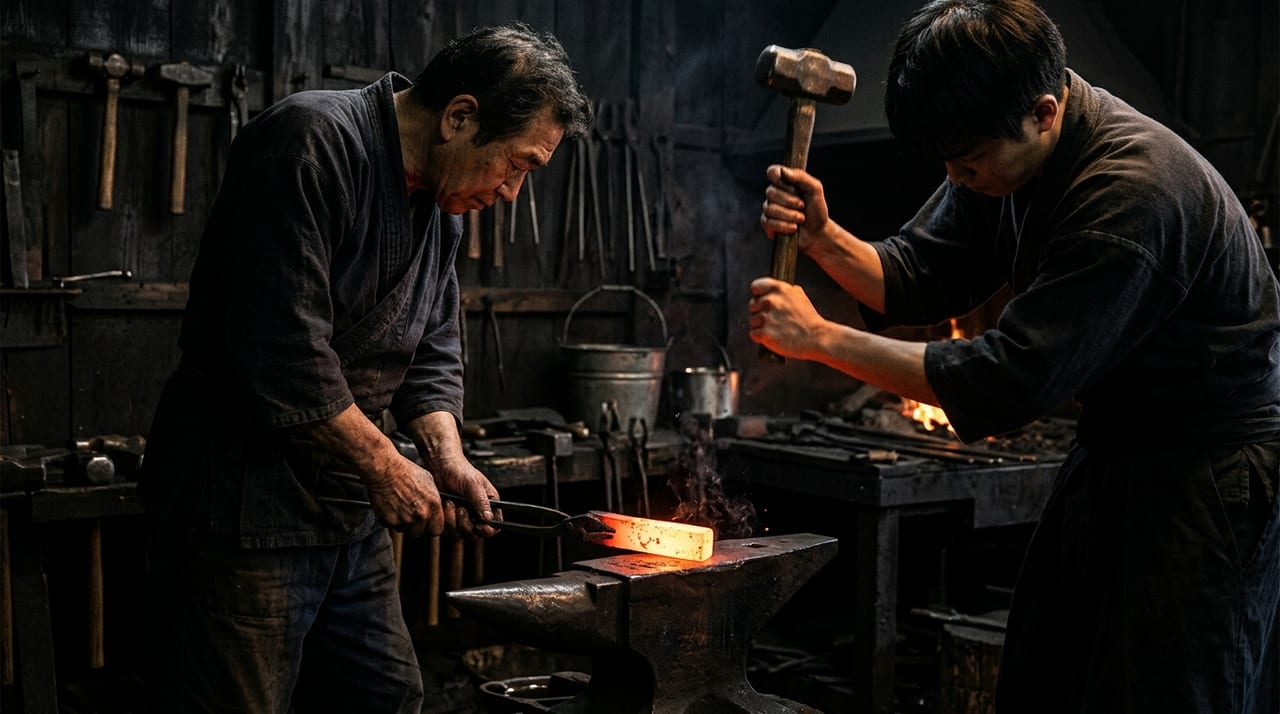 * Image is for illustrative purposes only.
Table of Contents
What Is an Uchiko? The Presence That Supports the "Team Work" of Sword Smithing
The forging of nihontō is often described as if the tōshō (master) alone handles every stage of the process independently. In actual traditional smithing workshops, however, an assistant craftsman called an "uchiko" or "deshi" (apprentice) has played an indispensable role. Particularly during the early stages of blade forging — tsumiwakashi, orikaeshi tanren, and sunobe — there has traditionally been a division of labor in which the tōshō signals direction and intensity with the kotetsu (small hammer), while the uchiko strikes powerfully with the ōtsuchi (large hammer).
The uchiko's role is not mere "physical labor." It demands an almost telepathic coordination in which the uchiko instantly reads the signals of where and how hard the tōshō strikes with the kotetsu, and brings the ōtsuchi down accurately on the same spot. This is a refined physical skill that cannot be acquired without several months to several years of training, and the presence of a skilled uchiko directly determines the quality of the blade. The Japanese idiom "aizuchi wo utsu" (to give agreeable responses in conversation) is said to derive from this synchronized exchange of blows between the uchiko and the tōshō. The act of striking in rhythm with one's partner's hammer (aizuchi, literally "accompanying hammer") came to refer, by extension, to keeping in step with a conversational partner's remarks.
Traditional Master-Apprentice System and Training as an Uchiko
For a disciple who has entered the world of sword smithing, spending the first several years as an uchiko is the traditional pattern of training. There is a gradual progression: first serving as a sumibaban (charcoal keeper), managing the charcoal and adjusting the temperature of the furnace; then learning to operate the bellows as a fuigobaban; and finally taking on the central assisting role in forging as an uchiko.
During the uchiko period, the apprentice observes the tōshō's every move at close range, learning through the body "why this spot is struck with this force." Cultivating sensitivity to the "breathing," the "judgment of the eye," and the "color of the flame" — those aspects of technique that lie behind what can be explained in writing or words — is the true purpose of uchiko training.
Daily Life as a Live-In Apprentice
The life of an "uchi-deshi" who enters the traditional smithing workshop as a live-in apprentice is not confined solely to the forging work itself. As in the apprenticeship system common to craftsmen in general, the following peripheral tasks have traditionally been considered an important part of the uchiko's training:
- Cleaning and maintaining the smithing workshop and its tools
- Preparing charcoal and managing the furnace
- Attending to the personal needs of the tōshō and senior apprentices
- Receiving guests and handling the miscellaneous duties of the workshop
The accumulated experience of such seemingly unglamorous work is believed to cultivate the attitude toward tools and the sensitivity for reading the atmosphere of the workshop, forming the foundation for when the apprentice eventually advances to the stage of wielding the hammer.
Changes to the Uchiko in the Modern Era: Mechanization and the Successor Problem
In modern smithing workshops, an increasing number of tōkō have introduced large mechanical hammers (spring hammers, air hammers), and part of the physical striking work that the uchiko once performed is being replaced by machines.
The advance of mechanization also has complex effects from the standpoint of cultivating successors. Young people who in the past entered as uchiko acquired the feel for forging through their bodies via physical labor; in an environment where mechanical hammers are used extensively, opportunities for training as an uchiko decrease, and the chance to observe and learn from the tōshō's kan is also at risk of being relatively lost. On the other hand, there is also the positive aspect that mechanization has reduced the physical burden on young people, making it easier for more people to enter the field. Within the sword industry, how to cultivate new practitioners while taking into account these environmental changes continues to be discussed as an ongoing challenge.
The Uchiko's Technique: The Ma and "Force" of Wielding the Large Hammer
The most important technique the uchiko must master is the sense of ma (timing). From the moment the tōshō signals "begin," in the 0.3 to 0.5 seconds before the ōtsuchi touches the steel, the uchiko must make a comprehensive judgment of the steel's temperature, hardness, and position, and apply the appropriate force. The nature of this intuitive judgment shares the same root as the judgments of "hi-iro" and "sound" described in the tacit knowledge of the tōshō.
The ōtsuchi typically weighs 2 to 5 kg, and in a day of forging work, strikes are repeated several hundred to more than a thousand times. This cannot be managed by simple muscle strength; a "form for swinging the hammer" using whole-body balance and weight transfer becomes necessary. A skilled uchiko listens to the sound of the steel with each strike — whether it is a hard "clang" or a soft "thud" — and fine-tunes the force of the next blow. This continuous sensory adjustment is what elevates the uchiko from "simple assistant" to "craftsman."
The Uchiko's Presence and the Value of a Sword: What Is Recorded in the Kanteisho
From the perspective of someone purchasing or collecting nihontō, a frequent concern is "who actually struck this sword." The mei inscribed on the blade is, in principle, the name of the tōshō (master) who presides over the workshop; the individual name of the uchiko who assisted in the forging is not normally recorded on the blade or in the kanteisho. The kanteisho issued by NBTHK and similar bodies evaluate authenticity, period, and quality as the work of the named tōshō, and are not structured to individually evaluate or record the involvement of the uchiko.
That said, knowing that a fine sword was born not from the skill of the tōshō alone, but through the accumulated teamwork of a well-matched uchiko, deepens one's appreciation of the work. To reflect on the coordinated effort of the entire workshop behind the mei is itself one of the ways to savor nihontō.
Recording and Transmitting Uchiko Culture
In recent years, the number of documentary recordings of smithing workshops has grown, and the movements of the uchiko have begun to be preserved on film. However, the core of the uchiko's technique — the "silent dialogue" with the tōshō — cannot be fully recorded on film or in writing. Smithing workshops that maintain the rare traditional master-apprentice relationship position uchiko training as "the most direct path to acquiring the core of nihontō craftsmanship," and consciously continue human uchiko training even amid the wave of mechanization. The nature of this master-apprentice relationship connecting uchiko and tōshō overlaps with the social structure particular to smithing workshops depicted in the community culture of tōkō schools.
Accurately understanding and appreciating the role of the uchiko is indispensable for grasping the full picture of nihontō craftsmanship. It is not mere physical labor, but a place of technical dialogue exchanged between master and disciple through flame and steel — this is the essence of uchiko culture. When taking a sword in hand, one might also reflect on the sound of the hammers struck by the uchiko who stand behind it.