Sword-Making Communities: Master-Apprentice Bonds, Annual Forge Rituals, and Village Social Structure
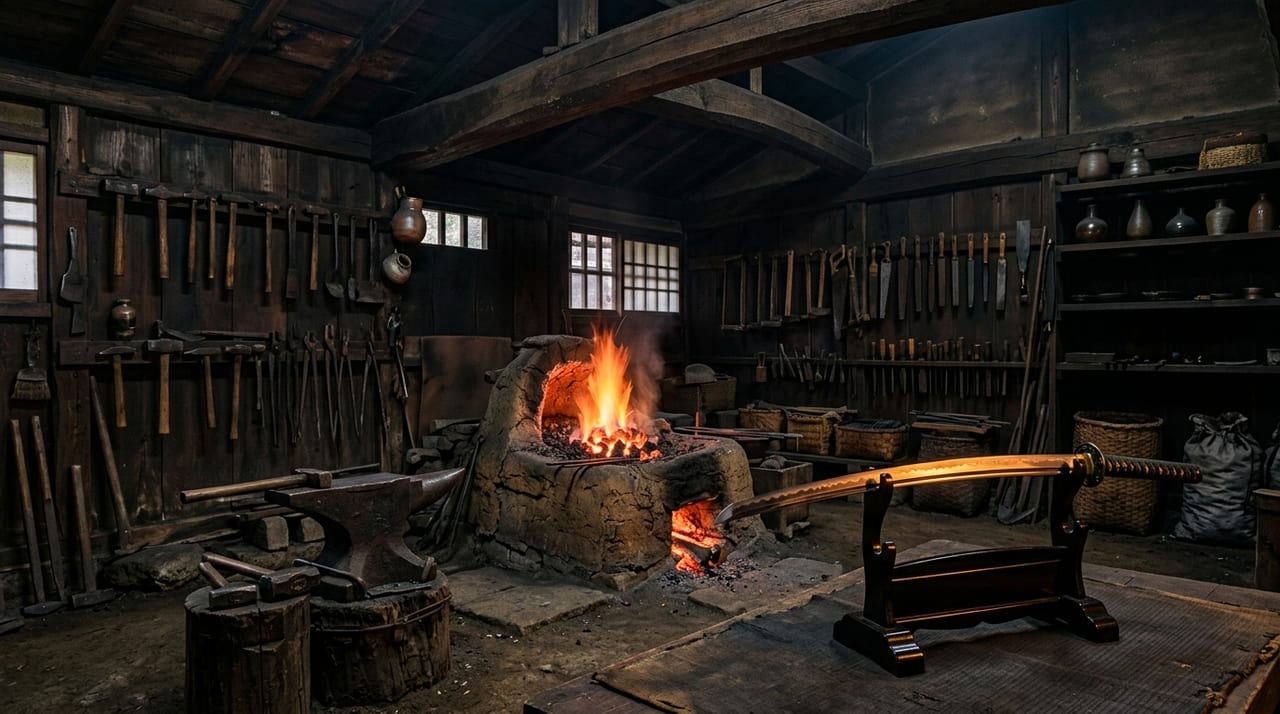 * Image is for illustrative purposes only.
Table of Contents
The "Ichimon" Community of Sword Makers
The production of Japanese swords was not carried out as solitary work by individual craftsmen, but rather by communities centered around a master called "ichimon." The basic unit of an ichimon was a small group consisting of a master (oyakata) and multiple apprentices (deshi), which formed a hierarchical organization connecting to the broader sword maker communities of a region.
The characteristic feature of the ichimon community was that it was a living community that transcended mere "professional master-apprentice relationships." Apprentices lived in their master's house (or established residences nearby) and were placed under their master's supervision from daily life to production activities. The master served as the apprentice's "parent as a craftsman," and it was not uncommon for apprentices to be treated as members of the master's family.
From Entry to Independence — Stages of Training
Becoming an apprentice to a sword maker involved an incredibly strict process, beyond what modern sensibilities could imagine.
- Pre-Entry Preparation: To become an apprentice to a sword maker, connections or referrals were first necessary to introduce one to a master. It was practically difficult for an unknown young person to suddenly visit asking to become an apprentice, and referrals through the regional sword industry network were the standard practice.
- Apprenticeship Period: Upon initial entry, apprentices served as "minarai" (apprentices), taking on general chores such as cleaning the forging hall, managing charcoal, and maintaining tools. This period could last several months to several years, and in some cases all requests for instruction were prohibited. "Learning by observation" was established as the basic principle.
- Permission to Wield the Hammer: Once permission was granted to hold a hammer (tsuchiツチ) after completing chores, the apprentice would begin striking iron as "sennte" (front striker) in coordination with the master's "atete" (back striker). From this stage, genuine technical training would begin.
- Beginning Full-Scale Production: After gaining several years of experience, the apprentice would begin handling some processes at their own discretion. However, the most critical processes such as "quenching" (yakiire) remained the master's exclusive domain for a long time, and only after the apprentice became independent could they handle all processes alone.
- Independence (renju): An apprentice who received certification from their master would become independent and gain the right to use their own signature (mei). In most cases, they inherited one character from their master's signature (for example: if the master was "Masamune," the apprentice might be "Masa-[character]" or "[character]-mune"). Even in modern times, the work of independent sword makers often retains the characteristics passed down from their masters, and this is one reason collectors prioritize lineage in their collections.
Yearly Observances at the Forging Hall — Sacred Rites Related to "Fire"
At the forging hall (kajiba), religious ceremonies related to "fire" were conducted alongside production activities. The professional identity of blacksmiths working with iron and fire was deeply connected to faith in the deity dwelling in the furnace fire (tatara-kami, the guardian deity of iron forging).
- Furnace Opening (robira): A ceremony in which fire was first lit in the furnace at the beginning of the year. Ritual salt for purification, sakaki branches, sacred sake, and other offerings were made, and the entire ichimon would pray for the safe production activities of the new year and the completion of fine works. Even today, many sword makers perform the furnace opening on New Year's Day or during the first days of the new year.
- First Forging (hatsu-tataki): Following the furnace opening, a ceremony in which the year's first forging was performed. The master would choose an "auspicious" date, and the entire ichimon would gather to perform the first iron striking. Iron forged on this day was said to hold special significance as "first forging iron" and was sometimes carefully preserved.
- Hammer Awakening (tsuchiokoshi): A ceremony with ritual significance in "awakening" hammers that had not been used during long breaks or other work. By carefully cleaning the hammer and reapplying oil, respect for the tool was demonstrated.
- Furnace Closing (rojime): A ceremony in which the furnace fire was extinguished at year's end. The year's production activities were reflected upon, and gratitude was offered to the furnace deity. It sometimes had the character of "sending off the fire deity."
- Tamahagane Purification (tamahaganae-harai): A custom of purifying materials when new tamahagane was received. It was a prayer for the safe use of iron blessed by the tatara-kami of the production region.
The Social Structure of Sword Maker Villages — Community Formation at Production Centers
From the Kamakura to the Edo period, "sword maker villages" or "sword maker towns" were formed in major sword-making production centers where multiple sword maker ichimon settled together. Osafune in Bizen Province is the most typical example, and at its peak, dozens of sword maker ichimon concentrated in one region, forming an industrial cluster for sword manufacturing.
The following characteristics of the social structure of sword maker villages can be noted:
- Selective Sharing of Technical Information: When multiple schools existed in the same production center, the boundary between information shared among schools and information kept secret was subtle. While the broad techniques of the "Bizen tradition" were shared across the entire production center, each school's "differentiating techniques" were kept strictly within the school.
- Technical Solidarity Through Marriage: Marriage between different sword maker ichimon transcended mere personal marriage and held meaning as technical partnerships. In many cases, the technical relationship between both families was strengthened by arranging for a daughter to marry the heir of another school.
- Joint Procurement of Materials and Tools: Materials such as tamahagane, charcoal, and whetstones were often procured collectively at the production center level. This not only allowed for better terms than individual procurement but also contributed to standardizing the quality level across the entire production center.
- Production Center Grading: Production center names such as "Bizen Osafune," "Yamashiro Awata-guchi," and "Soshu Kamakura" functioned as "brands" that took precedence over individual sword maker names. Because the reputation of a production center was closely linked to the credit of individual sword makers, coordination beyond individual ichimon was undertaken for quality control across the entire production center.
Modernization and Changes to the Ichimon System
The sword abolition edict (1876) following the Meiji Restoration dealt a devastating blow to sword maker ichimon communities. As demand for swords plummeted, many ichimon were forced to disband, and the economic foundation for supporting apprentices was lost.
The military sword manufacturing boom of the Showa period temporarily recovered demand for sword makers, but when production was again prohibited following postwar purges of public office and weapons bans, the thread of transmission was again severed.
Contemporary sword maker ichimon have changed greatly in both scale and form from their traditional appearance. Small-scale master-apprentice relationships consisting of one master and one or two apprentices have become the mainstream, and live-in training has become exceptional. However, the consciousness of "ichimon" — sense of belonging to the master's technical lineage, mutual aid within the ichimon, and continuation of yearly observances — is still inherited by contemporary sword makers and remains a core mechanism for technical transmission. Understanding the historical background of the ichimon should be a great help in grasping the cultural context behind sword making.
Conclusion — The Community Protects Technology
The technical skill of Japanese sword making has been transmitted not through individual genius but through the collective endeavor of the community known as the "ichimon." Yearly observances were not mere customs but held ritual function in confirming community cohesion and renewing commitment to technical transmission. This mechanism of communal technical transmission can be said to be the fundamental force that sustained the continuity of Japanese sword culture spanning over a thousand years.