Oral Transmission and Secret Texts of the Tōshō: A History of Techniques Written Down and Left Unwritten
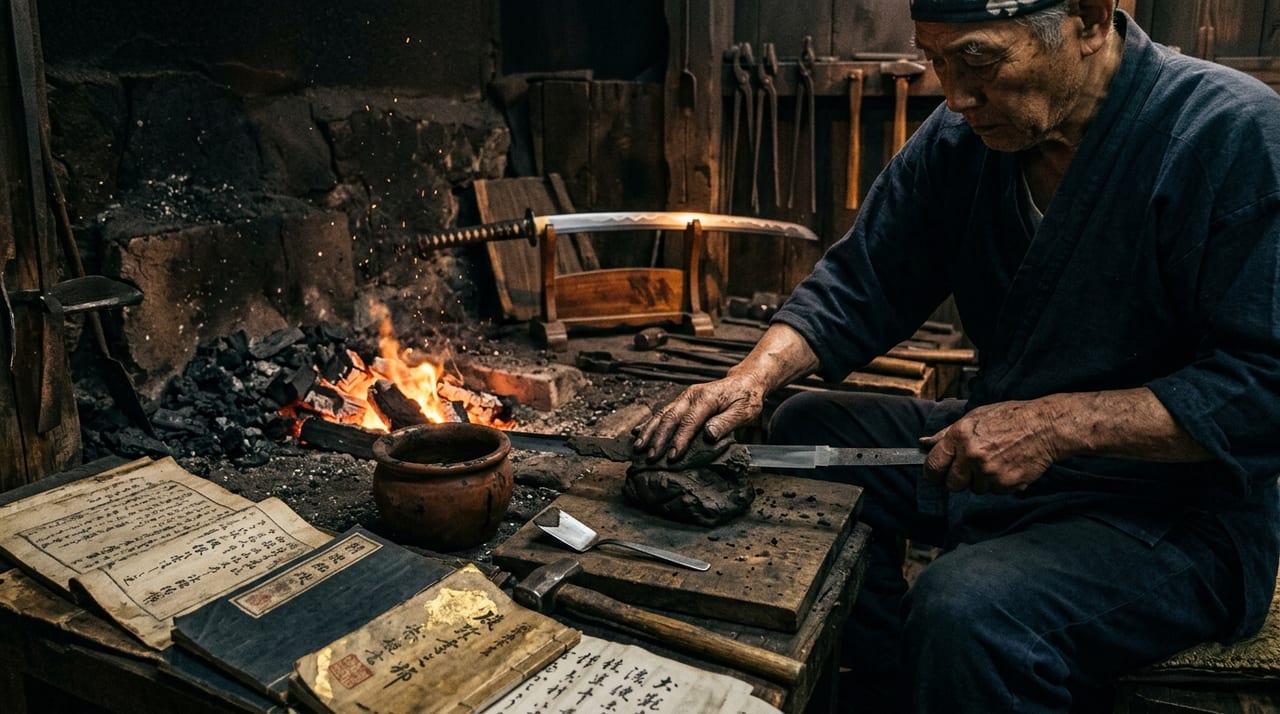 * Image is for illustrative purposes only.
Table of Contents
Whether to "Write" or "Speak" a Technique: Two Paths of Transmission
The craft techniques of nihontō have been passed down from master to disciple over many generations, but the methods of transmission fall broadly into two categories. The first is "kuden" — direct oral instruction — and the second is "hidensho" — technical documents preserved in writing.
There is a deep philosophical background to how these two methods were used. The choice of what to write and what not to write was not accidental; it was a "knowledge management strategy" that each school and each tōkō deliberately designed.
Hidensho: The World of Written Techniques
Various types of technical documents have been left behind by tōkō. The best known are documents related to yaki-ire (quenching) such as "Kirihagaki" and "Yakiba Hidensho." These describe the "clay composition," "methods of gauging fire temperature," and "technique of entering the blade into water" for yaki-ire, the most critical process in determining the shape of the hamon.
The following are among the extant representative hidensho known to researchers.
- Hon'ami-ke Densho: A collection of multiple documents left by the Hon'ami family, the foremost authority on nihontō appraisal, covering appraisal techniques and the history of nihontō. The documents contain practical appraisal information such as the shape of hamon, the characteristics of jigane, and standards for evaluating polishing. However, it is said that "core secrets" were reserved as kuden and were not written down.
- Shintō Kaji Hiden (Secret Transmissions of shintō Swordsmithing) type documents: A general term for technical texts written during the shintō period of the Edo era. These do not belong to any single school but are an accumulation of individual technical notebooks left by various tōkō and tōshō families. They describe methods for selecting iron, the procedure for tsuchioki, and precautions for yaki-ire.
- Yamashiro-den and Bizen-den Forging Records: Notebooks of the manufacturing process recorded by tōkō communities in each production region from the Muromachi to Edo periods. These are closer in character to "school official documents" than to individual hidensho, and were intended to transmit technical information necessary for the continuation of the school to successor generations.
Unwritten Techniques: What Kuden Protects
What is important is the existence of techniques that were "not written" in hidensho.
In Japanese traditional crafts, the philosophy that "the most important techniques are not committed to writing" is widely shared. In the case of tōkō, the following techniques in particular were transmitted only from master to disciple through kuden and were intentionally kept from being documented.
- The proportions of the clay mixture: The specific composition of the clay used in yaki-ire — the proportions of whetstone powder, charcoal powder, clay, and other additives — is the greatest secret of each school. A hidensho may state the fact that "clay is used to create the hamon," but will never state "what to mix in what proportion." This stems from the view that "even if you know the recipe, it is useless without a feel for the heat, the water temperature, and the way of entering the blade."
- Gauging the temperature of the fire: The judgment of whether a blade has reached the temperature suitable for yaki-ire is made by the tōkō through a compound sense of "the color of the fire," "the glow of the blade," and "the sound of the metal." This is not to say it cannot be verbalized, but because verbalized information cannot be transmitted precisely enough to be useful in an actual working situation, the form of kuden — "making the disciple learn it through the body" — is adopted.
- Selecting iron by "feel": The technique of judging carbon content by touching the cross-section of split tamahagane can only be acquired through an accumulation of sensory experience. A verbal description such as "high-carbon tamahagane is hard and has a fine cross-section" is possible, but one cannot reach the level of truly "knowing" without having touched it thousands of times.
The Social Function of Hidensho: For Whom Were They Written?
Considering for whom hidensho were written is important for understanding the nature of their content.
- Notebooks for successors: Personal records written by elderly tōkō to leave their techniques to a successor. These may contain relatively detailed technical information.
- "Formal records" of a school: Documents created to prove the legitimacy of a school, in which the main purpose may be to record the lineage of "who transmitted to whom" rather than technical details.
- Misinformation against rival schools: It is also said that "hidensho containing deliberately false information" existed historically. These were works in which some information was intentionally altered so as to be useless to competing schools if they obtained them.
- A tool for conferring authority: In some cases, hidensho themselves functioned as tools for creating the impression that "this school has deep secrets." Possession of a hidensho was proof of a school's authority, and its very existence was more important than its contents.
Post-Meiji Documentation: Recovering Lost Techniques
The dramatic decline in the tōkō population following the Sword Abolishment Edict (Haitōrei) (1876) and the dispersal of techniques caused by the guntō production boom of the early Shōwa period had a serious impact on the transmission of both hidensho and kuden.
In the postwar revival of nihontō culture, the NBTHK undertook a project to document techniques. Efforts were made to gather technical information from elderly tōkō and record it in video, photographs, and documents. In this process, some techniques that had previously been regarded as "kuden only" were for the first time committed to writing.
In modern times, a format known as "video kuden" has also appeared. This is a method in which the master's actual work is filmed and the disciple watches it repeatedly to acquire techniques. Among young tōkō, it is used as a way for video to supplement and extend the traditional master-disciple form of "learning by watching." The techniques preserved through such documentation efforts are carried on by today's tōkō and flow into the making of swords.
Conclusion: The Philosophy of Transmission and Modern Challenges
The most important aspect of technical transmission in nihontō making is the philosophy of choosing "what to verbalize and what to have learned through the body." Hidensho are records of "techniques that can be verbalized," while kuden are a device for prompting the embodied acquisition of "techniques that cannot be verbalized." It is this two-layered structure that was the knowledge management system that maintained and developed the techniques of tōkō over hundreds of years.
The modern challenge is the simple fact that "if there are no successors, kuden will be severed." No matter how detailed a hidensho may be, true technique cannot be transmitted without the experience of actually watching the master's hands, hearing the master's words, and striking iron at the master's side. The essence of technical transmission lies not in documents but in the relationship between people — this fact is the fundamental starting point for thinking about modern policies to protect tōkō.