Nihontō Nagasa and Function — Why the Dimensions of ōdachi, uchigatana, wakizashi, and tantō Changed with Era and Tactics
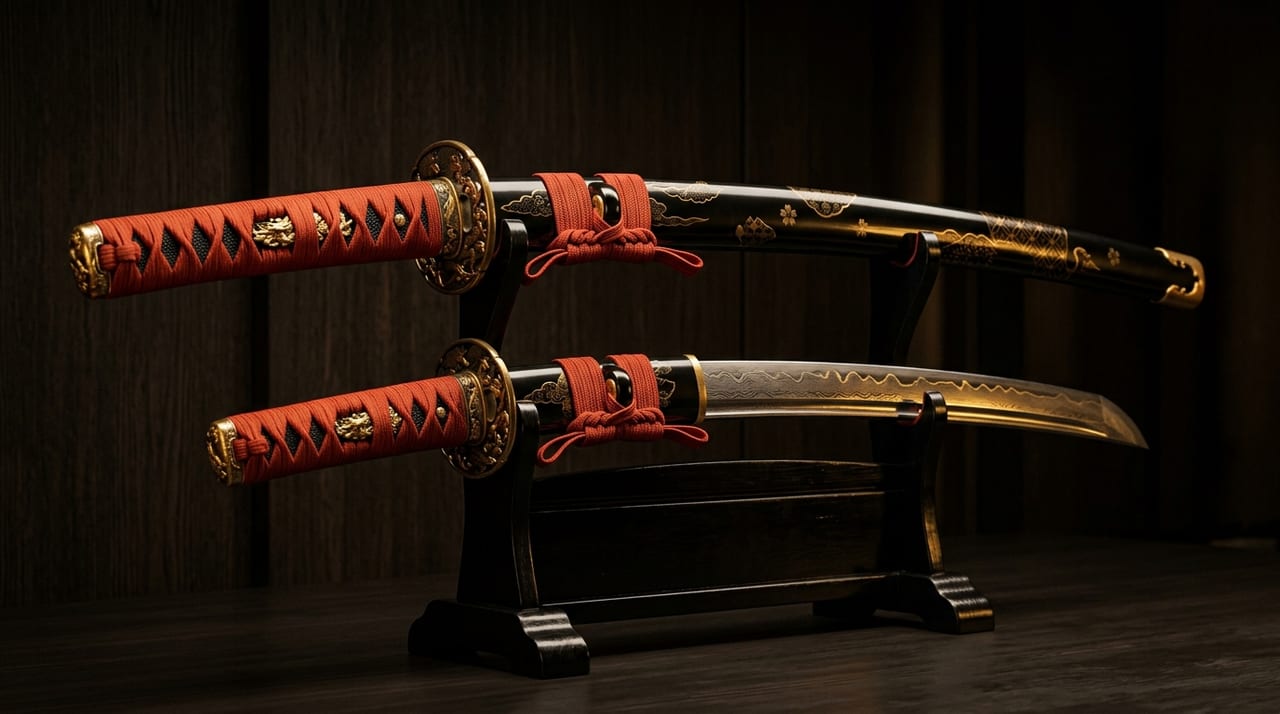 * Image is for illustrative purposes only.
"Longer swords are stronger" is too simplistic — sword dimensions are the optimal answer for each situation
When discussing the nagasa (blade length) of a nihontō, the idea that "longer is always stronger" is mistaken. The terrain of the battlefield, fighting style, method of carry, ceremonial requirements, and the school of iai — all of these determined the "optimal nagasa."
Throughout the history of the nihontō, the choice of nagasa was always "the pursuit of the optimal answer for that era and that situation." This article systematically explains how nagasa evolved across different periods and uses, and offers a perspective for reading why each length was chosen.
Measurement in the shakkanhō system
The nagasa of a nihontō is traditionally expressed in shaku and sun.
- 1 shaku = approx. 30.3 cm
- 1 sun = 1/10 of a shaku = approx. 3.03 cm
Modern sword registration certificates may list both centimeters and sun.
Classification by nagasa
| Category | Nagasa | Main type |
|---|---|---|
| ōdachi / nodachi | 3 shaku or more (90 cm and up) | Mainly ceremonial and special-purpose use |
| tachi / uchigatana (long) | 2 shaku 5 sun – 3 shaku (75–90 cm) | Mounted combat, custom-ordered pieces |
| uchigatana (standard) | 2 shaku 2 sun – 2 shaku 5 sun (66–75 cm) | Standard sword of the warrior class |
| uchigatana (short) | 2 shaku – 2 shaku 2 sun (60–66 cm) | For smaller-framed individuals, indoor use |
| wakizashi (long) | 1 shaku 6 sun – 2 shaku (48–60 cm) | Large wakizashi, used similarly to uchigatana |
| wakizashi (standard) | 1 shaku 3 sun – 1 shaku 6 sun (39–48 cm) | Standard wakizashi |
| wakizashi (short) | 1 shaku – 1 shaku 3 sun (30–39 cm) | Short wakizashi |
| tantō | Under 1 shaku (30 cm and under) | Self-defense, assassination, seppuku |
Late Heian to early Kamakura: tachi optimization for mounted combat
From the late Heian period through the early Kamakura period, warfare was centered on single combat between mounted warriors. The tachi of this era had a standard nagasa of approximately 2 shaku 5 sun to 3 shaku (75–90 cm) and a form specialized for mounted combat.
In mounted combat, the following conditions were important.
- A longer blade was advantageous for cutting down enemies on the ground
- Placing the center of gravity toward the tip made downward cuts using centrifugal force effective
- Because the sword was worn suspended from the hip ("haku" style) rather than thrust through the belt, a long nagasa posed no difficulty in handling
Tachi by master swordsmiths of Yamashiro, Bizen, and Yamato embody the combination of nagasa, center of gravity, and sori suited to these demands of mounted combat.
Late Kamakura to the Nanbokuchō period: the era of grand swords and ōdachi
From the late Kamakura period through the Nanbokuchō period (14th century), following the Mongol invasions (1274 and 1281), swords rapidly grew larger and more imposing. The Nanbokuchō period saw a distinctive era in which ōdachi and nodachi — swords of over 3 shaku — were mass-produced.
Multiple factors converged behind the popularity of these extraordinarily long swords in this period.
- Warfare shifted toward mass combat mixing mounted and foot soldiers, and long swords were suited to wide swings on open battlefields
- Advances in armor increased the effectiveness of attacks from a distance
- Their role as "swords to be displayed" for their intimidating effect cannot be denied
However, handling an ōdachi of over 3 shaku on the battlefield required considerable physical strength and skill. This is why "ōdachi wielders" were remembered as exceptional warriors.
The Muromachi period: the rise of the uchigatana and the shortening of nagasa
The greatest change of the Muromachi period (15th–16th centuries) was the shift from tachi to uchigatana. The uchigatana is carried thrust edge-upward through the belt in the "sashiyō" style. This transition was not a mere fashion but a response to a fundamental change in combat style.
The battlefield environment of the Muromachi and Sengoku periods changed as follows.
- Ashigaru (foot soldiers) became the main force, and mass combat became established
- Fighting in confined spaces — castle interiors, streets, and indoors — increased
- Situations in which drawing speed determined the outcome became more frequent
The nagasa of the uchigatana was standardized at 2 shaku 2 sun to 2 shaku 5 sun (66–75 cm). The reason it became shorter than the tachi is clear: it was the combined result of ease of handling indoors and in confined spaces, and the constraint that an overly long sword in the sashiyō carry would strike the ground.
The Edo period: the establishment of the standard length and the sword as ceremonial dress
Throughout the peaceful Edo period (1603–1868), the emphasis of the sword shifted from a tool of "practical use" to a symbol of "ceremonial dress" and the dignity of the warrior class.
Standardization at 2 shaku 3 sun (approx. 69 cm): During the Edo period, the standard nagasa of the uchigatana tended to converge around "2 shaku 3 sun." This became established as the customary benchmark for the sword a samurai wore on formal occasions.
That said, variation in nagasa still existed during the Edo period.
- Long-nagasa swords (2 shaku 5 sun and above): Made for well-built warriors or as custom-ordered pieces
- Standard-nagasa swords (2 shaku 2–4 sun): The standard uchigatana of the warrior class
- Short-nagasa swords (around 2 shaku): For samurai who frequently served at castle offices or worked indoors, or for smaller-framed individuals
For the wakizashi worn as the "daishō" pair, 1 shaku 6 sun to 1 shaku 9 sun was the Edo-period standard, but many samurai also wore a "large wakizashi" (around 2 shaku).
Nagasa optimized for the nukitsuke
Iai is the technique of "cutting while drawing the sword," a swordsmanship that condenses everything into the instant of the nukitsuke. The thinking about "optimal nagasa" differs greatly from school to school.
Schools that prefer longer swords (such as Shintō Munen-ryū) hold the philosophy of taking the initiative over an opponent through the cutting power of the nukitsuke and the long reach.
Schools that prefer shorter-to-standard swords (such as Musō Shinden-ryū and Musō Jikiden Eishin-ryū) use a standard sword of 2 shaku 3–4 sun as their benchmark, prioritizing drawing speed above all. This is a choice that values the balance between ease of draw and maneuverability.
The kata (forms) of iai are designed with a specific nagasa in mind, and the length of the school's "sadame-katana" (prescribed sword) becomes the standard for all practice. The design of the kata and the nagasa are inseparable.
Physique and nagasa — the concept of a "fitted sword"
In modern iai and kendo, the idea of "choosing a sword length suited to one's physique" is well established. As a general guideline, a nagasa at which the tip of the sword lightly touches the floor when the arm hangs naturally at one's side is considered standard.
Edo-period samurai had similar awareness, but the customs of "using a sword handed down in the family" and "using the same sword as one's teacher" were also strong, and swords were not always chosen purely on the basis of fitting one's physique. Uniformity among master and disciples or within a household was also one of the practical factors in choosing nagasa.
Wakizashi — the many roles of the "small" in the daishō pair
The wakizashi worn as the "daishō" pair was the formal equipment of Edo-period samurai, but its actual uses were not limited to a simple backup weapon.
- Backup weapon: Used in situations where the uchigatana was difficult to wield indoors or in confined spaces
- Tome-gatana (finishing sword): For delivering the finishing blow to a fallen opponent
- Self-defense: Used for self-defense during travel
- Seppuku: Used in the ritual of self-disembowelment (the kaishaku sword is prepared separately)
During the Sengoku period, the "large wakizashi" often functioned in effect as a backup uchigatana, and the nagasa of the wakizashi was directly linked to fighting style.
Tantō — self-defense, ceremony, and women's use
The tantō (under 1 shaku) was limited in its uses to specific contexts.
- Self-defense and assassination: Its shortness, allowing it to be hidden in a sleeve, was its greatest advantage
- Kaiken: Used at seppuku and in ceremonial settings
- The self-defense sword of women of the warrior class: The kaiken became customary as part of a bride's trousseau and became one of the items of wedding furnishings
The tantō is not "weak because it is small" but rather "a length optimized for that situation." In the limited conditions of close quarters and enclosed spaces, a longer blade would in fact be an obstacle.
Summary — nagasa is "the answer for the situation"
The choice of nagasa for a nihontō cannot be explained by the simple logic that "the longest sword is the strongest." The era, combat style, method of carry, school, physique, and intended use — these factors intertwined in complex ways to determine "the length at which that sword was meant to be born."
When appreciating a sword, checking the nagasa is the first clue for inferring "what situation this sword was made for." Whether it is a 2-shaku-3-sun uchigatana, an ōdachi exceeding 3 shaku, or a 1-shaku-5-sun wakizashi — the perspective of reading the era's demands and the craftsman's judgment behind that choice deepens the appreciation of nihontō still further.
Nagasa data for uchigatana, wakizashi, and tantō can be checked alongside images of actual pieces, so please take a look.