Samegawa Underlayer Technique: How Traditional Craftsmen Prevent Handle Slipping
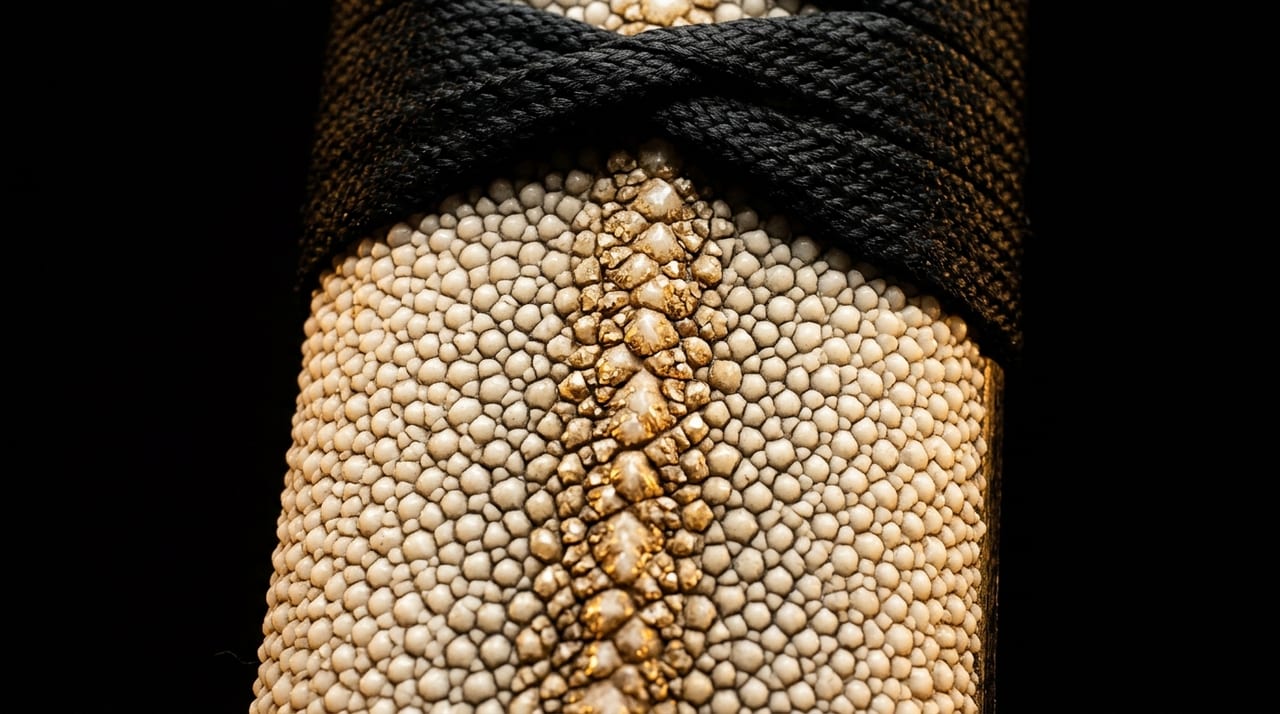 * Image is for illustrative purposes only.
Table of Contents
What is Samegawa—The Lime Granules Coating Ray Skin
When you hold the grip (tsuka) of a Japanese sword and carefully remove the wrappings of cord and leather, a single white, granular sheet appears covering the surface of the wood base. This is the substrate material called "samegawa" (ray skin). Although the character for "shark" (鮫) in the name may lead one to think it is shark skin, in reality, the skin traditionally used in the world of sword fittings has mostly been ray (ei) skin.
Ray skin has tiny limestone particles densely covering the entire surface. When magnified under a microscope, each particle has a distinctive hemispherical protrusion, and though arranged orderly, they are positioned so as to touch one another. When these particles dry, they become hardened, creating a sandpaper-like surface. The "friction" and "grip" needed when holding a sword hilt are due to the physical properties created by the arrangement of these limestone particles.
There are various types of rays, and those traditionally used in sword fittings are primarily individuals in which the particles on the back develop uniformly. In the central area of the skin, in the region corresponding to the backbone, there is a part where slightly larger limestone particles line up vertically, and this is called the "parent particle" (oyatsubu). The existence of this parent particle has been one of the major reasons samegawa has been valued not merely as a functional material but also as a decorative one.
Three Functions of Samegawa as Grip Substrate
Samegawa has been chosen as a grip substrate not only for decorative reasons. It fulfills three major roles in terms of function.
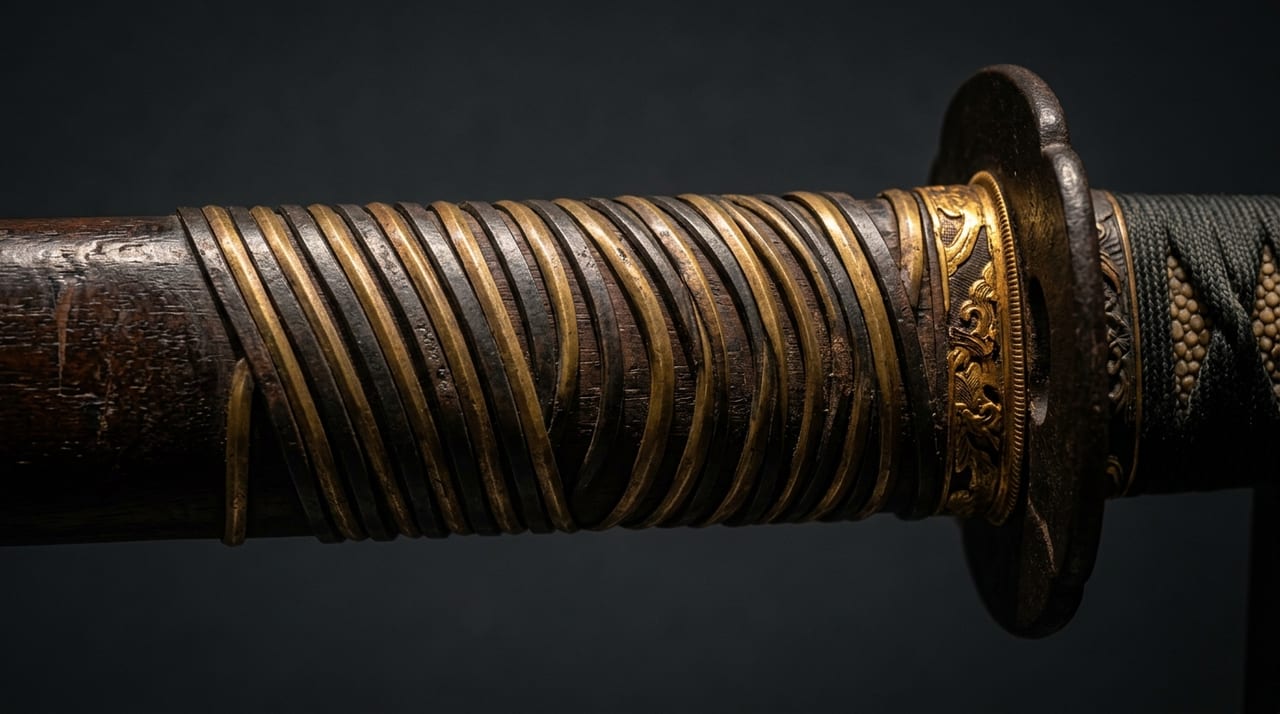
- Function as a friction layer—The final step in grip construction involves wrapping cord or deer leather tightly around the surface to create both the appearance and strength of the grip. However, if the surface of the grip wood (tsukagi) is smooth, these materials will gradually shift due to repeated gripping and accumulated impact. By placing a single sheet of granular samegawa between them, the back surface of the cord or leather catches on the particles, preventing overall slippage and loosening.
- Protection of the grip wood—Wood repeatedly expands and contracts through drying, moisture absorption, and temperature changes. The skin of samegawa has high density due to its lime particles and functions as a physical barrier that mitigates the penetration of moisture. Additionally, it can be expected to absorb impacts during use as a buffer.
- Auxiliary non-slip after grip cord wear—Even after the surface of the grip cord becomes smooth from years of use, if the samegawa beneath remains, the holding force of the grip is maintained to some degree. This is a practical reason craftsmen have paid attention to the quality of samegawa on hilts of swords that have been heavily used as functional blades.
Substrate Processing Steps—A Process Beginning with Water
Samegawa circulates in a dried state, and in this condition, it is as rigid as a board and cannot conform to the three-dimensional shape of the grip wood. The substrate processing generally proceeds in the following steps.
- Immersion in water—Soak in cold or warm water for a set time, and wait until the skin portion filling the spaces between the lime particles regains sufficient flexibility. Rushing this stage can cause the skin to crack or particles to chip during shaping.
- Back surface treatment—The back side of ray skin retains excess muscle tissue, fascia, and fat, which are carefully shaved away with a specialized blade. If the thickness is not uniform, gaps and lifting will occur after attachment, appearing as unevenness on the surface of the cord wound from above. Some craftsmen include a step in which they homogenize the overall thickness while measuring with calipers.
- Cutting and pasting—A hilt is a three-dimensional shape with a cavity to accommodate the tang (nakago), and the curvature of each side, spine side, and belly side differs subtly. To make a single flat sheet of skin adhere closely to this three-dimensional form, incisions are made at critical points while stretching, and force is applied cautiously to avoid crushing the lime particles. Glue (nikawa) has traditionally been used for adhesion. Nikawa is an adhesive derived from animal protein, exhibits high hardness after drying, and shows high adhesion to both wood and skin.
- Drying and finishing—After pasting is complete, sufficient drying time is allowed, and then excess protrusions and gaps on the surface are smoothed to complete the substrate for cord wrapping.
Arrangement of Parent Particles—Aesthetic Judgment Where Craftsmen Invest Effort
In the processing of samegawa, the arrangement of parent particles strongly reflects both technical difficulty and the craftsman's aesthetic sense. These large particles lined up vertically at the position of the backbone are also a landmark showing the only directionality within a single sheet of skin.
In traditional sword fittings, when gripping the hilt, the orientation and cutting position of the skin are determined so that the parent particle is positioned in the center of the side visible to the eye from the front. Since the size and density of parent particles differ from individual to individual, selecting the optimal part from a single sheet of skin requires experiential judgment. The higher quality the fitting, the more careful consideration has been given to this arrangement.
Furthermore, depending on the design of the grip wrapping, some craftsmanship is calculated so that the particles of the samegawa are visible through gaps in the wrapping. In such craftsmanship, not only the method of cord wrapping but also the expression of the skin—the alignment of particles, the presence of parent particles, the quality of whiteness—becomes a subject of appreciation. If the grip wrapping is the outer face, samegawa is a layer in which the craftsman's judgment accumulated beneath the surface is concentrated.
Rarity of Materials in Modern Times and Their Transmission
The ray skin used in samegawa relies heavily on imports from Southeast Asia and South Asia within Japan, and stable procurement becomes difficult during periods of fluctuation in catch volumes, export regulations, and distribution. In particular, quality skin with large, uniform parent particles and densely packed particles throughout is limited in production per sheet, so the number reaching the market is small.
Depending on particle size, density, and the development of parent particles, there is a range in price and rarity, and the highest-grade materials have corresponding value in themselves. For this reason, in the world of traditional sword fittings, the eye for discerning the quality of skin has also been considered part of a craftsman's skill.
In recent years, from the perspective of availability, cost, and stable supply, alternative materials replacing natural samegawa are being used in more situations. However, among craftsmen who preserve traditional techniques and in the demand for high-quality fittings, natural samegawa is still often the first choice. There is a continuing evaluation that alternative materials have not yet succeeded in reproducing all aspects of natural materials in the hardness of limestone particles, friction force, and the aesthetic dignity of appearance.
The processing of samegawa is a step that is hidden beneath cord after the completion of the grip and hardly comes into contact with the eye. However, the processing of that single sheet of skin influences the stability of the grip, the protection of the grip wood, the durability of the wrapping, and the completeness of the design—all of it. As an invisible craftsman's technique behind the beauty of the grip wrapping, the processing technique of samegawa has supported the tradition of Japanese sword fittings. When viewing the TOUKENZA catalog, please pay attention to the craftsmanship of the grip and reflect on the existence of the samegawa that forms its substrate.