Hirumaki: The Traditional Technique of Reinforcing Scabbards and Hilts with Metal Bands
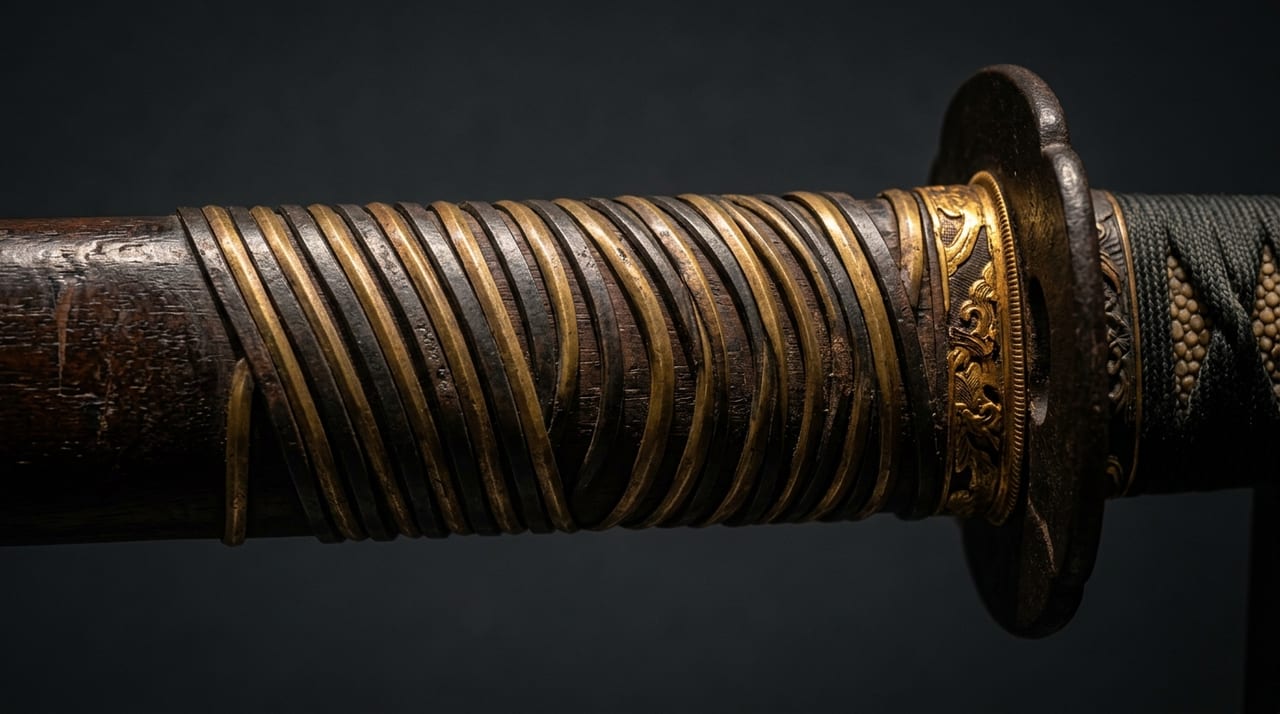 * Image is for illustrative purposes only.
Table of Contents
What is Hirumaki?
Hirumaki is a technique for reinforcing the surface of a sword's saya (scabbard) or tsuka (hilt) by wrapping a thinly shaped metal band around it in a spiral. The name is said to derive from the appearance of the continuous lines of wrapped metal, which resemble the shape of a leech as it contracts and extends its body while crawling. Unlike conventional sayas and tsukas finished with lacquer coating on the wooden base, hirumaki is characterized by wrapping metal around the entire surface or key areas, thereby increasing strength and durability.
Why Wrap with Metal — Practical Demands of Combat
The background for the use of hirumaki is thought to reflect a demand to increase durability in actual combat. Sayas and tsukas that only have lacquer applied to the wooden base have a vulnerable aspect against impact and friction; however, by wrapping metal bands around them, the surface strength increases, making them more capable of withstanding intense battle and long-term use. In particular, in swords such as odachi and notachi, which have long blade lengths and are prone to experiencing heavy stress on the saya and tsuka during handling, hirumaki is believed to have been chosen as a reinforcement method with practical significance.
Manufacturing Process — Shaping Metal Bands and Wrapping
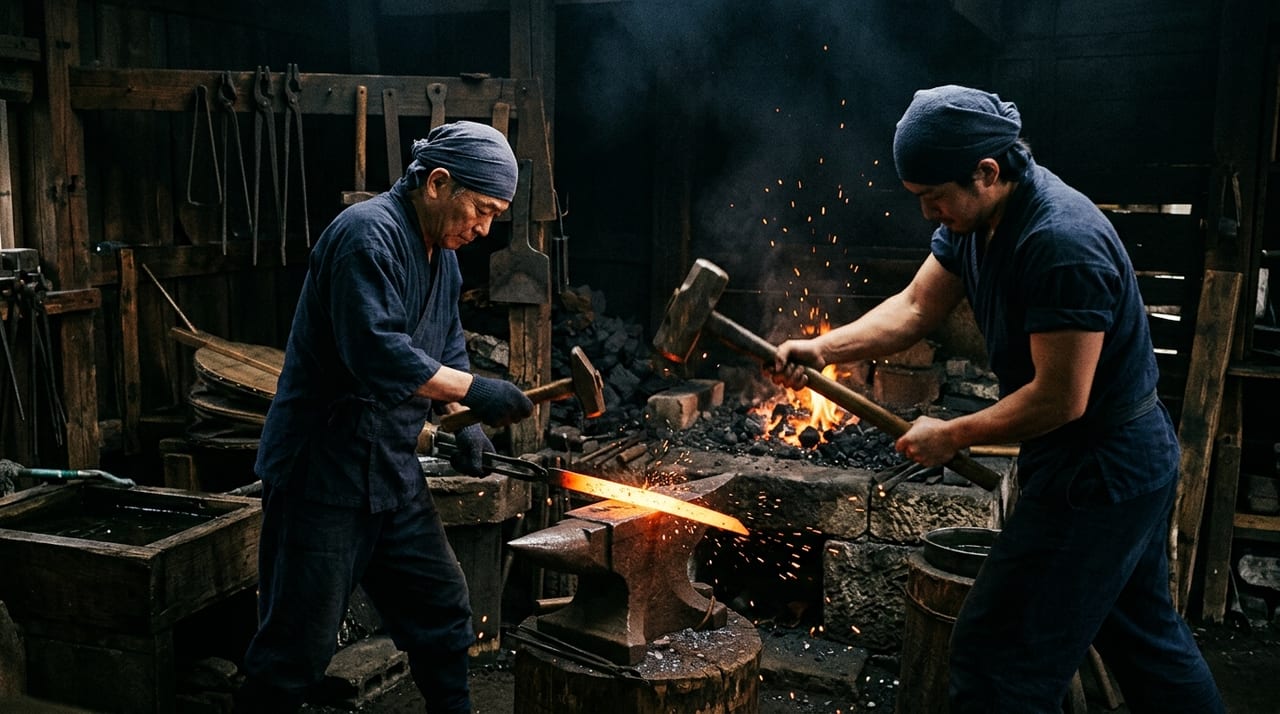
In the production of hirumaki, thin metal plates are first processed into band-like shapes and formed so that they can be wrapped at equal intervals along the contours of the wooden base. The width of the metal band and the pitch (spacing) of the wrapping are adjusted according to design and purpose; some construction methods densely pack the gaps to cover the entire surface, while others wrap only key areas for reinforcement. When organizing the flow of the process, it generally proceeds as follows:
- Hammer out thin metal plates into band-like forms and shape them to the necessary width and thickness
- Determine the wrapping interval (pitch) according to the dimensions of the wooden base
- Wrap the bands spirally around the wooden base while securing them firmly
- Carefully finish the ends where wrapping begins and ends, and complete the work with lacquer or plating as needed
This is labor-intensive work that is only possible when both woodworking and metalworking techniques are combined.
From Combat Specification to Ritual Specification
Although hirumaki is believed to have originally been a technique intended for combat reinforcement, as time progressed, its aspect as a design element also appears to have strengthened. Through techniques such as applying patterns to the metal bands or finishing them brilliantly with gold or silver, examples can be seen of development into koshirae that combined both practicality and decorative quality. This kind of change is a tendency commonly seen in other sword mounting techniques, demonstrating a process in which ingenuity born as a tool of combat, through the passage of time, becomes refined into artistic expression.
Points of Appreciation
When appreciating koshirae with hirumaki applied to it, by paying attention to the following points, the subtlety of the technique can be understood more deeply:
- Whether the width and spacing of the metal bands are kept uniform
- Whether the processing at the beginning and end of wrapping is finished carefully
- How the materials (differentiation in the use of iron, copper, and gold/silver) correspond to the design and purpose
- The sense of integration with the wooden base and the certainty of securing
Hirumaki is one of the techniques that teaches us that the koshirae of Japanese swords is not merely a storage implement, but a craft object that reflects both practical combat and aesthetic sensibility. By coming to know the ingenuity of craftsmen that was poured into these accessories—the saya and tsuka—our understanding of the entire sword becomes increasingly three-dimensional.
Application Examples in the Hilts of Naginata and Odachi
Hirumaki was a technique employed not only for reinforcing the saya but also for reinforcing the tsuka. Particularly in naginata with long tsukas and odachi handled with both hands, the tsuka itself experiences significant stress, and ensuring the strength of the grip becomes an important issue. By wrapping metal bands around the tsuka, it is possible to prevent cracking and wear of the wooden base and to achieve a structure capable of withstanding long-term use. From these application examples as well, it can be understood that hirumaki was not merely decorative, but a practical ingenuity that supported the durability of the sword as a tool overall.
Differences from Other Reinforcement Techniques
In the koshirae of Japanese swords, in addition to hirumaki, there are several other techniques for protecting and reinforcing the saya and tsuka. While there are numerous techniques that employ metal in part, such as fukurin protecting the edges of metal fittings and ishizuki protecting the tip of the saya, hirumaki differs from these in that it is characterized by covering the entire surface or a wide area continuously with metal. The idea of securing strength as a surface rather than merely local reinforcement is an approach distinctive to hirumaki. By understanding these differences, it becomes possible to see what kind of purpose consciousness guided the selection of the various techniques applied to koshirae.
Differences Brought About by Material Selection
The metals used in hirumaki have multiple options including iron, copper, and brass, each with different weight, strength, and appearance of aging. While iron excels in strength, it is prone to rust; copper and brass are easier to work and develop distinctive color over time. Using these materials selectively according to purpose and desired design is believed to have been one of the important judgments for craftsmen engaged in hirumaki. The differentiation in usage—employing iron for rugged combat specifications and copper or brass with gold and silver plating for koshirae placing value on formality—demonstrates that the hirumaki technique responded to both practical and decorative demands.
Transmission in the Modern Era
Traditional techniques that are labor-intensive, like hirumaki, tend to have limited practitioners as demand decreases. In modern times, the technique is transmitted through limited opportunities such as restoration of museum collections and the production of koshirae that faithfully reproduces traditional styles. The work of shaping metal into uniform bands and wrapping them around the wooden base without gaps requires skill; the transmission of such detailed techniques to the next generation without loss is of significant importance in preserving Japanese sword koshirae culture as a whole.