The Uda School: Lineage and Style of a Swordsmith Community Rooted in Etchu Province
 * Image is for illustrative purposes only.
Table of Contents
From Yamato to Echū—The Birth of the Uda School
The Uda School is a group of swordsmiths that was born when swordsmiths originating from Uda County in Yamato Province (present-day areas around Uda City, Nara Prefecture) migrated to Echū Province (present-day Toyama Prefecture). Its founder is said to be Kunimitsu, with the migration occurring during the late Kamakura period through the Nanbokuchō period. The exact circumstances of the migration are uncertain due to limited historical records, but at that time many Yamato school swordsmiths were seen moving their bases to various locations away from their homeland, and the Uda School is recorded in the history of old blades as one of the most representative examples of this.
The dispersal of Yamato school swordsmiths to various regions can be attributed to multiple factors, including invitations from local warrior families, trade routes along thoroughfares, and voluntary migration to regions with high demand for swords. Echū Province was located along the Japan Sea coast and was known since ancient times as a crucial transportation hub. If there was a foundation for accepting external technical groups, then the migration from distant Yamato to Echū can be understood not as mere coincidence but as an inevitable consequence of the social movements surrounding sword production at that time. In any case, Kunimitsu's establishment of a foundation for swordmaking in Echū after leaving Yamato became the starting point for creating the unique lineage of the Uda School.
The Successive Lineage from Kunimitsu
The names of swordsmiths of the Uda School who carried on after Kunimitsu and advanced through generations in Echū are passed down as Kunifusa, Kunimune, Kunitsugu, and Tomoji. These swordsmiths are said to have been active from the Nanbokuchō period through the Muromachi period, and in particular, Kunimune is thought to have inherited the same name across multiple generations. The Uda name lineage is said to have been inherited through the Shintō period, making it particularly noteworthy that as a regional swordsmith group, it maintained a long and continuous genealogy.
The major swordsmiths can be summarized as follows.
- Kunimitsu: The founder of the Uda School. A swordsmith who migrated from Yamato to Echū and established the foundation of the school
- Kunifusa: Said to be the son of Kunimitsu. Continued swordmaking in Echū
- Kunimune: Also said to be the son of Kunimitsu and the brother of Kunifusa, known as a name transmitted across multiple generations
- Kunitsugu: Said to have been active from the Nanbokuchō period through the Muromachi period
- Tomoji: Passed down as one of the swordsmiths following the Uda School tradition
Although smaller in scale compared to major production centers like Yamashiro and Bizen, the fundamental strength of this group lay in its deep roots in Echū and its continued response to demand across generations. The continuity of the group of swordsmiths itself can be said to be one of the historical significances of the Uda School.
'Uda-hada'—The Distinctive Forging Completed in Echū
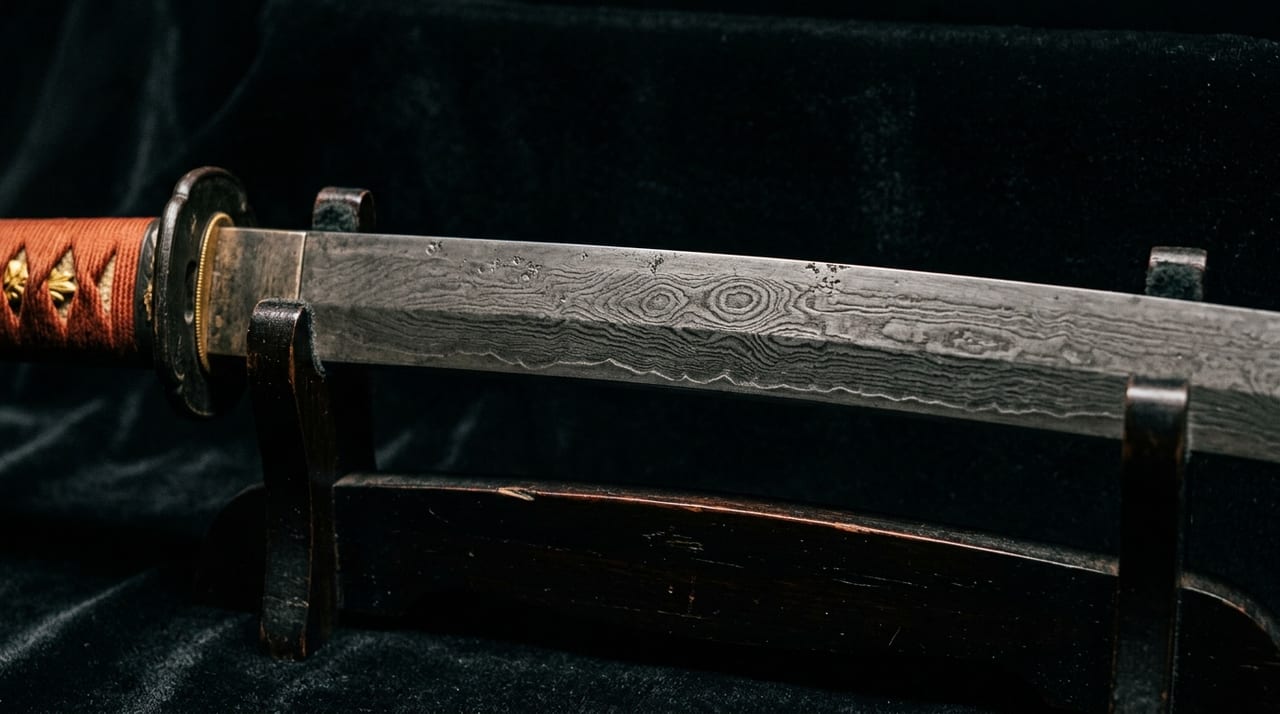
Essential to discussing the Uda School is the distinctive jihada surface known as 'uda-hada.' It is a forging surface in which itame hada is intricately mixed with mokume and masame, with thick jigane and well-developed ji-kei, creating a powerful impression with a somewhat rustic character. Compared to the jihada of other Yamato school swordsmiths, which are primarily composed of orderly masame, the distinctive feature of uda-hada is its sense of greater variation and rustic charm.
This surface, which inherited the Yamato school tradition while undergoing unique transformation within Echū, has long been recognized as the greatest individuality in the swordmaking of the Uda School. In authentication, the presence or absence of uda-hada is considered an important criterion and serves as a clue to distinguish it from other Yamato school schools. The distinctive luster created by the combination of thick jigane and the action of ji-kei is not merely a difference in materials but also a reflection of accumulated forging techniques.
The expression 'uda-hada' can be understood as having been established as a result of the refinement that occurred through the climate and material conditions of Echū and the demands of local warrior families, all while maintaining the practical qualities of the Yamato school. A prime example of how technique intersects with local conditions to produce a unique form can be seen in the jihada of the Uda School.
Characteristics of the Style Seen in Hamon, Sugata, and Kissaki
The hamon is primarily composed of ko-gunome patterns, and blades incorporating ko-gunome chōji or chigai-ba are also seen. Works with straight-hada characteristics reminiscent of the Yamato school are also preserved, and a practical style emphasizing durability and functionality over decorativeness permeates the whole. The kissaki often returns in a small rounded form, and characteristically shows a restrained finish typical of the Yamato school lineage.
The characteristics of works from the Uda School can be summarized as follows.
- Jihada: 'Uda-hada' where itame, mokume, and masame are mixed. Thick jigane with well-developed ji-kei
- Hamon: Primarily ko-gunome. Some works incorporate ko-gunome chōji or chigai-ba
- Kissaki: Often returns in small rounded forms
- Sugata: Changes according to the period; works from the Nanbokuchō period show magnificent construction
- Overall impression: Practical and sturdy. Creates a sense of robustness with practical combat in mind
The turbulent Nanbokuchō period was a time when demand for swords increased throughout the country, and the practical style of the Uda School aligned well with the demands of that era. In terms of sugata, works from the Nanbokuchō period also show impressive and magnificent construction reflecting the times, and the form and shape changed with the passage of time. Through the combination of these characteristics, works from the Uda School possess a distinctive individuality that can be recognized at a glance.
Relationship with the Yamato Five Schools and Technical Positioning
The lineage of swordsmiths that arose in Yamato Province is generally known as the 'Yamato Five Schools': the Senjuin School, Taima School, Tegai School, Hōshō School, and Shikkake School. All were active primarily in Nara and shared common technical characteristics based on masame jihada and straight hamon. The Uda School is not counted among these five schools because it was a swordsmith group that migrated to Echū after leaving its homeland of Yamato.
However, there is a deep connection to the Yamato school at the foundation of its technique. The practical forging methods characteristic of the Yamato school are also inherited by the Uda School, and although distinct from the lineage of the Yamato Five Schools, the style of the Uda School can be positioned within the broader framework of the Yamato school. The distinctive character of uda-hada, developed in Echū after migration, should be understood as the result of new changes added upon this Yamato school foundation.
The phenomenon of Yamato school swordsmiths dispersing to various regions is also interesting from the perspective of technical transmission in sword history. The example of the Uda School continues to have value today as a reference point showing how swordsmith groups distant from the center acquire and maintain their own distinctive character.
Significance as a Regional Swordsmith Group
It is true that the Five Schools of Sword-making (Yamashiro, Bizen, Sōshū, Yamato, and Mino) occupy the central position when discussing the history of the Japanese sword. However, the complete picture of Japanese sword culture cannot be described without the existence of groups that took root in various regions and continued swordmaking. As one such regional swordsmith group, the Uda School continued to be a bearer of sword culture in Echū.
Although it did not receive the brilliant reputation of prestigious schools from the central regions, and the number of extant works is limited compared to schools from the major production centers of the Five Schools, the fact that the Uda name lineage was inherited from the migration in the late Kamakura period through the Shintō period is evidence that this group maintained a solid presence rooted in local demand. The works of the Uda School add a unique depth to sword appreciation in that they allow us to trace the world of old blades from a different perspective than the great schools of Bizen and Yamashiro.
Encountering old blades with strong regional character brings another perspective to sword appreciation, which tends to focus exclusively on the prestigious schools of the central regions. The distinctive character of uda-hada, born from the intersection of the practical qualities of the Yamato school and the land of Echū, continues to serve today as a means to distinguish works of the Uda School from others. TOUKENZA's online catalog features works by various swordsmiths transcending periods and schools. We encourage you to explore the breadth of the Japanese sword world while also turning your attention to the works of regional swordsmiths such as the Uda School.