What is mizukage — the white shadow that enters diagonally from the hamachi, and the reasons it has long been discussed in connection with identifying yaki-naoshi
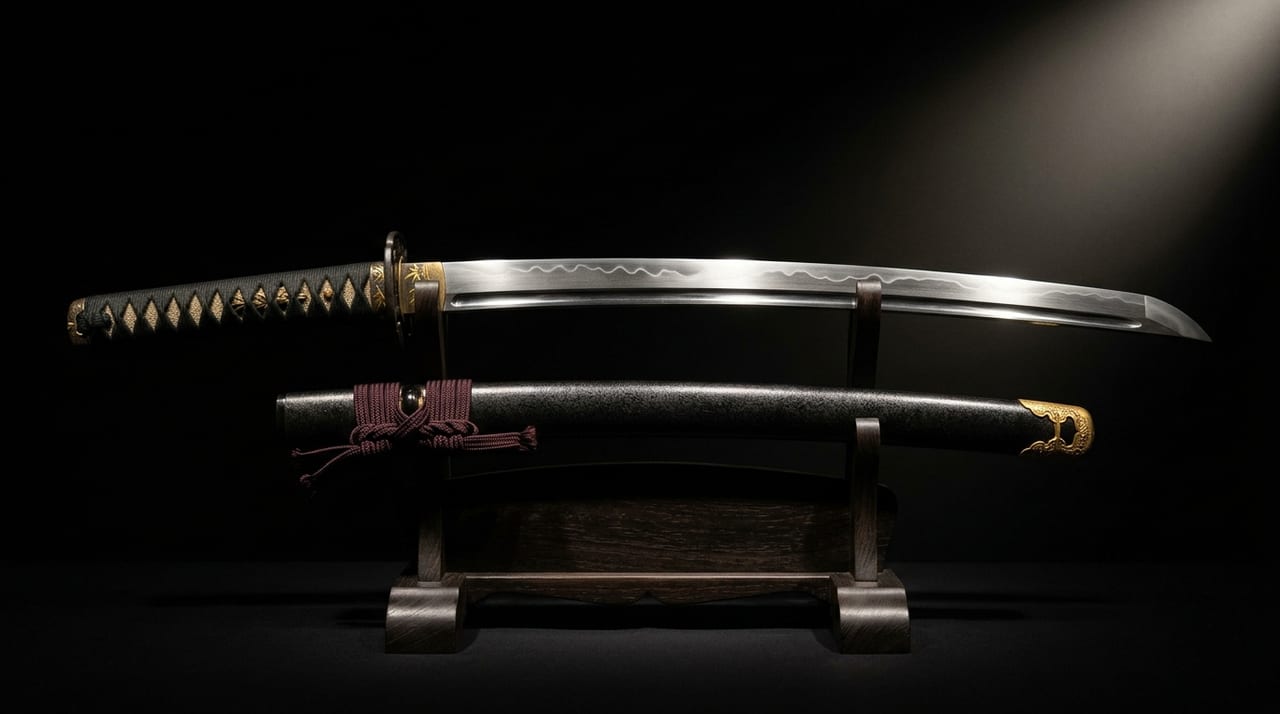 * Image is for illustrative purposes only.
Table of Contents
What is mizukage?
When you hold a blade up to the light, a faintly white, haze-like streak can sometimes be seen running diagonally from the vicinity of the hamachi toward the mune — a pale band of shadow resembling the mist left by a breath. In the world of Japanese swords, this phenomenon is called "mizukage."
Because it resembles the utsuri that floats around the center of the jigane, it is easily confused with that feature; and for a long time it has been discussed as "evidence of re-quenching." In practice, however, many hold cautious views about treating mizukage as conclusive proof of yaki-naoshi, and its appraisal is not straightforward. Here, we first organize how the phenomenon arises, then consider its position in appraisal.
The boundary between yaki-ire and water
To understand mizukage, it helps to begin with the process of yaki-ire (quenching the yakiba). In yaki-ire, the blade with tsuchioki applied is heated in a furnace and quickly plunged into a water trough for rapid cooling. At this "depth of immersion in water" — that is, at the boundary between the water surface and the blade — an abrupt temperature differential arises. The change in jigane color that appears at this boundary is believed to be mizukage.
The characteristic direction of rising diagonally from the hamachi corresponds to the angle at which the blade is inserted into the water trough. When the kissaki is plunged in first, the area near the hamachi is the last to cross the water surface, so that line runs diagonally from the hamachi toward the mune. The reason it appears white and hazy is said to be that the structure of the jigane behaves differently at the boundary than in other areas, but detailed metallurgical analysis is left to specialist literature.
What is important here is that mizukage is a process-related trace marking "the boundary at which the blade entered the water during yaki-ire." This is fundamentally different in its underlying premise from utsuri, which appears with relative uniformity near the center of the blade width.
Why it has been cited as "evidence of re-quenching"
Yaki-naoshi refers to the operation of re-quenching a blade that has already been made, for some reason such as damage or loss of the yakiba. In this yaki-naoshi, if the craftsman heats only up to the vicinity of the hamachi and immerses only that area in the water, mizukage tends to remain.
Thus the formula of "mizukage present = re-quenched near the hamachi" and "the greatest evidence of yaki-naoshi" came to be discussed. A blade that has undergone yaki-naoshi has been altered after leaving the hands of its original maker, affecting its appraisal value and market price. That is why the presence or absence of mizukage has long attracted attention as an important point of observation in appraisal.
Today's view, however, is more complex. It is premature to conclude yaki-naoshi simply because mizukage is present, and conversely there are cases where mizukage is not distinct even when yaki-naoshi has been performed. Mizukage is ultimately a "trace appearing near the boundary where the blade entered the water," and whether it dates from the original yaki-ire or from later yaki-naoshi cannot be determined from mizukage alone.
Practical judgment in yaki-naoshi appraisal
Organizing the elements that are comprehensively referenced when determining whether yaki-naoshi has occurred, including mizukage, the following observation points can roughly be cited.
- Condition of the nakago rust ── Whether age-appropriate black rust covers the entire surface uniformly. If the nakago is also newly re-finished after yaki-naoshi, the rust may become shallow
- Re-filing of the yasurime ── Whether the pitch or direction of the yasurime changes unnaturally before and after the mei
- Shape and blade width ── Whether the soundness of the edge and the balance of kasane from base to tip are consistent with the swordsmith's style
- Position, density, and direction of the mizukage ── Whether the angle from the hamachi and the character of its activity are consistent with that tōkō's practiced yaki-ire
- Appearance of utsuri and chikei ── Whether the natural activity of the jigane is interrupted only near the hamachi
None of these elements, taken alone, constitutes conclusive evidence. Appraisal is a process of cross-referencing multiple circumstantial indicators, and it is considered appropriate to position mizukage as one of them.
Distinguishing mizukage from utsuri
Utsuri is a phenomenon represented primarily in kotō-period Bizen-den, in which a whitish, hazy band floats parallel to the edge across the entire jigane. It is considered a visualization of the layered structure of the jigane and the differential in quenching depth, and is regarded as an important element of jigane observation alongside sunagashi and chikei.
The reason mizukage and utsuri are easily confused lies in their visual resemblance as "whitish, hazy color changes." However, as observational distinctions, the following points are helpful.
- Utsuri appears at a position away from the hamachi, roughly in the middle of the jigane, spreading in a band along the length of the blade
- Mizukage runs diagonally upward from a point of origin near the hamachi toward the mune
However, the boundary between the two involves definitional variation, and the phenomenon being referred to can differ subtly depending on the literature or commentary. Some writers use the term "yakidashi utsuri" to describe a phenomenon close to mizukage. When consulting multiple sources, it is essential to read with attention to the range of meaning the author assigns to the term "mizukage."
The Horikawa School and mizukage
Among shintō-period tōkō, it is said that in works by Horikawa Kunihiro and his disciples, examples where mizukage is prominent from the time of manufacture are numerous. Kunihiro was a tōkō active from the Azuchi-Momoyama period through the early Edo period, and his style is considered one of the benchmarks of the shintō period. The tendency for mizukage to appear readily in work by the Horikawa School is thought to be related to the yaki-ire techniques and tsuchioki practices of the time, but publicly available resources that delve into detailed metallurgical analysis are not numerous.
In any case, when mizukage is seen on a blade attributed to Horikawa Kunihiro, it does not constitute evidence of yaki-naoshi on its own. Because the appearance of mizukage is regarded as a characteristic present from the time of manufacture, in appraisal too the premise of "whether this is a tōkō whose style includes mizukage" is established first, before cross-referencing with other elements.
As a guide to appreciation
Mizukage can present a truly striking appearance when a blade is examined carefully under light. If a white shadow running diagonally appears near the hamachi, first confirm its position and direction. What you thought was utsuri may turn out to be mizukage, and vice versa. What matters is not so much naming the phenomenon you see, but developing the habit of carefully putting into words where in the jigane, in what direction, and at what density something is visible.
Also, bearing in mind the connection between mizukage and yaki-naoshi as "one possibility," look at things comprehensively together with the condition of the nakago and the overall shape of the blade. Accumulating such composite observations leads to the ability to read a blade's history.
In TOUKENZA's online catalog, the jigane character of blades currently listed can be viewed in photographs. We recommend comparing the white shadow near the hamachi with the utsuri floating in the center of the blade using actual images.