What Is Seppa? The Role and Materials of the Thin Metal Fittings Sandwiched on Both Sides of the Tsuba
 * Image is for illustrative purposes only.
Table of Contents
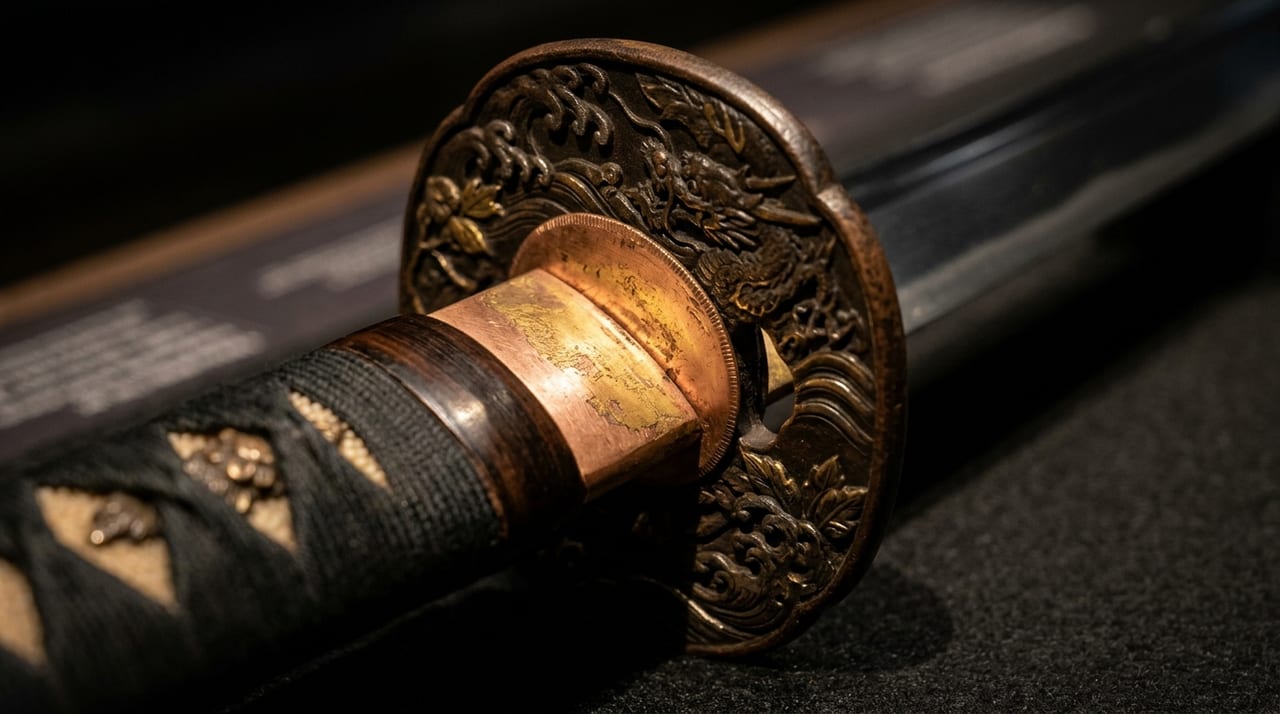
When the koshirae of a sword is disassembled, one thin metal plate is found sandwiched on each side of the tsuba — front and back. These small fittings are called seppa. They attract less attention than the tsuba or habaki, and they rarely take center stage as objects of appreciation. Even so, the presence or absence of these thin plates makes a significant difference in how the area around the tsuba fits together. This article, drawing on dictionaries and expert explanations, examines what seppa are and what they do.
What Is Seppa? Starting from Dictionary Definitions
Regarding seppa, the Dejitaru Daijisen describes them as thin metal fittings applied to the areas of the front and back of the tsuba that make contact with the tsuka and saya, respectively. The Seisen-ban Nihon Kokugo Daijiten defines them as receiving fittings for the habaki, and states that they are generally made in an oval (koban-shaped) form following the outer contour of the tsuka or saya, with notches cut into the edges. It also notes that larger versions made to fit the larger tsuba of a tachi are called ō-seppa. The source is the Kotobank entry on seppa.
Three key points can be drawn from this:
- Position: on both sides of the tsuba — present on both the tsuka side and the saya side
- Shape: the basic form is oval (koban-shaped), following the cross-section of the tsuka or saya
- Function: to reinforce the surface where the tsuba makes contact and to fill the gaps between the tsuba and other components
The characters in the name may look alarming, but seppa have no connection to the cutting edge of the blade. Within the koshirae, they are unassuming fittings that bear the points of contact between components.
Position Relative to the Tsuba and Habaki, and the Function of Eliminating Play
Tracing the assembly order on the blade in reverse — that is, working from the disassembly sequence — the layers run, from the blade side outward: habaki, seppa, tsuba, seppa, tsuka, with the mekugi securing the tsuka. This arrangement is based on personal disassembly accounts and has not been confirmed against an official assembly guide, but it is consistent with the dictionary definition (applied to the front and back of the tsuba).
Seppa function by filling the space on both sides of the tsuba with as many plates as needed to prevent the tsuba from rattling. The Into the Japanwaraku explanation notes that they are normally oval in shape, and that tachi from the Heian period and similar eras have ō-seppa with an inome pattern.
The tsuba is a plate of metal. If it were to press directly and repeatedly against the koiguchi of the tsuka or saya, friction and noise would develop easily. By inserting a thin plate of comparatively soft metal in between, the contact is cushioned. This is the fundamental idea behind seppa.
The Asahi Tōken explanation provides somewhat more specific detail:
- The seppa on the habaki side and the one on the fuchi side differ in size
- Only the portions of the nakago hole that bear against the mune side and the edge side of the nakago are staked with a chisel, so that the seppa does not move too freely
- A groove runs between the fuchi and the nakago hole to stabilize the habaki, tsuba, and seppa; this groove is also said to absorb and soften the aftershock of impacts transmitted from the habaki
In other words, seppa are not simply sandwiched in place. They are fittings made to measure for each individual sword, taking into account the shape of the nakago and the contact points with the surrounding fittings.
Materials — Suaka and Kingiese
The Asahi Tōken explanation is again informative regarding materials. The material is suaka (pure copper); in earlier times sheet material was apparently unavailable, so it is thought that copper was heated and hammered to achieve the desired thickness. The outer face is then wrapped in gold — a technique called kingiese — which is said to serve as the cushioning layer.
Copper is one of the softer metals and is relatively easy to work and shape by forging. As a component that makes contact with the tsuba and habaki, it is well suited to serve as a buffer against harder iron fittings.
The materials and workmanship of seppa are related to the overall quality of the koshirae, but it is the tsuba, fuchi-kashira, and menuki that are generally appreciated as objects of beauty. Seppa sit closer to the category of "components that are not meant to be seen." Precisely because of this, deterioration often goes unnoticed.
What Happens When Seppa Become Loose?
With an understanding of what seppa do, the kinds of problems that arise when they fail become easy to imagine:
- The tsuba wobbles at the koiguchi of the tsuka or saya
- Friction or small noises develop where metal meets metal
- The fit around the tsuka loosens, and the assembly rattles as a whole
These symptoms can also occur when the thickness or shape of the seppa does not match the sword. Adjustment is work for a craftsman versed in koshirae and sword fittings, carried out to the precise dimensions of each individual sword. Before adding or removing thin shims yourself, it is important to observe the condition calmly first and not to force anything apart. For swords listed on TOUKENZA with koshirae, please examine the photographs and descriptions to check the condition of the tsuba area before making a decision.
The Word Seppa-habaki
The word "seppa" survives in everyday Japanese. There is a compound, seppa-habaki, which refers to the seppa and habaki fittings at the base of the tsuba; dictionaries note that from this the word came to mean a face-to-face, pressed negotiation conducted at close quarters (see the entry on seppa-habaki).
Both seppa and habaki are fittings that fit together without gaps at the base of the tsuba. That they serve as a metaphor for being pressed to the limit seems entirely natural when one pictures the arrangement. There are other idioms connected to swords, covered in the article on sword idioms.
For a Broader View of the Fittings Around the Tsuba
Seppa work as a set together with the surrounding fittings — the tsuba, habaki, and fuchi-kashira. Articles on each individual component are also available; reading them together makes it easier to grasp the whole picture.
- The work and history of the habaki are explained in the article on shiraganeshi and habaki
- The fittings around the habaki and koiguchi are covered in the article on habaki, koiguchi, and fittings craftsmen
- For the fuchi-kashira, the tsuka-side fittings, see the article on matching fuchi-kashira
- For the tsuba itself, refer to the article on the world of tsuba
Seppa are small, and they are rarely discussed on their own. Yet the reason the tsuba sits stably in place on a sword is precisely that these thin plates are there, filling the gaps. If you ever have the chance to handle a koshirae, take a look at both sides of the tsuba.