The Yoshii River Floods and the Tōkō of Bizen Osafune — The Legend of the Great Tenshō Flood and What Can Be Confirmed from Historical Sources
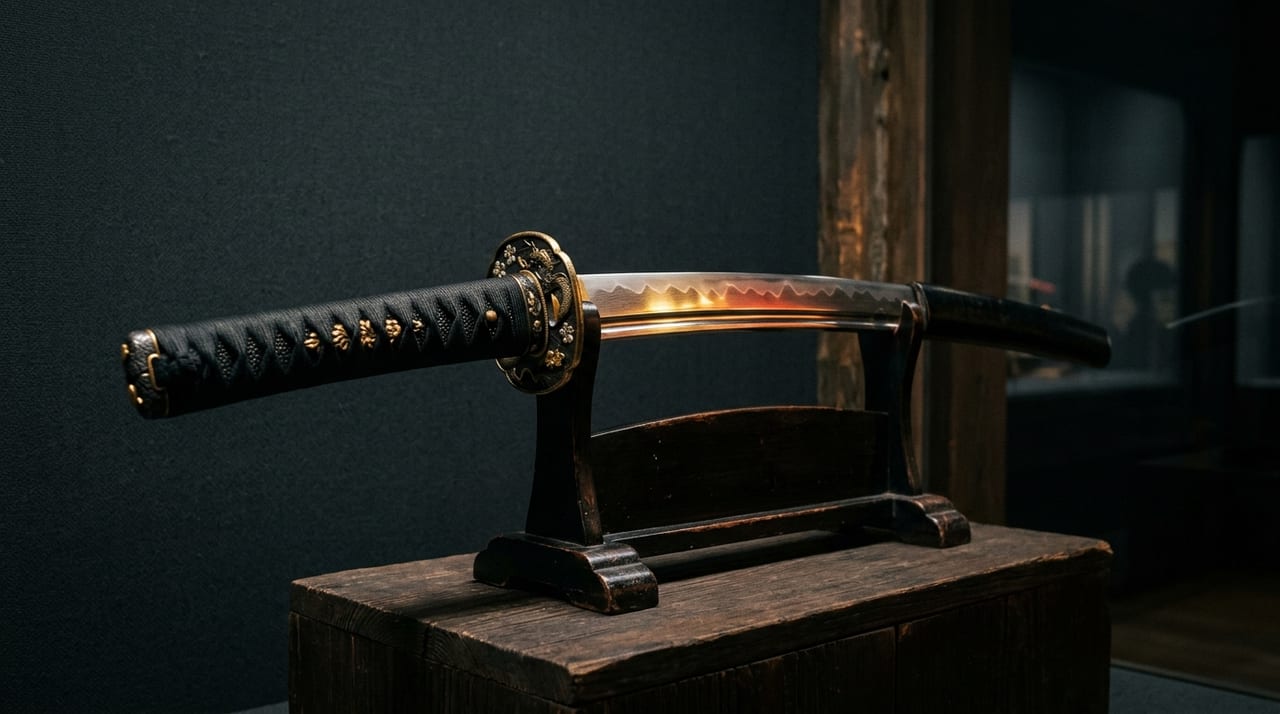 * Image is for illustrative purposes only.
Table of Contents
Bizen Osafune is known as one of the great production centers of Japanese swords. The account that Osafune suffered devastating damage from a great flood of the Yoshii River is a story often encountered in books on swords and tourism guides. Yet when one traces this flood in detail, it becomes clear that both the dates and the extent of the damage vary depending on the source. This article organizes the flood tradition and follows, to the extent that can be confirmed, how the kaji of Osafune fared afterward.
The Dates of the Flood Vary Across Historical Sources
The most commonly cited date for the flood is Tenshō 18 (1590). This is the theory based on the Tōbi Gunsonshi of Tenpō 8 (1837), and there are also sources that give Tenshō 19 (1591). On the other hand, the Biyō Kokushi of Genbun 4 (1739) places the event in the Daiei era (1521–1528).
While the event is now often considered to have occurred around 1590–91, it is not easy to demonstrate the basis for this from primary sources. It is reasonable to read the situation as follows.
- The flood itself is widely transmitted as a tradition about the area around Osafune and Fukuoka
- The date is divided among the Tenshō 18 theory, the Tenshō 19 theory, and the Daiei theory
- The sources are gazetteers compiled in the early modern period, not contemporary records
What Damage Is Said to Have Occurred
According to secondary sources, the cause was not ordinary flooding but rather a debris flow from a landslide that breached the embankments and struck the area around Osafune, Hatada, and Fukuoka. Tourism guides and similar sources introduce it as being "said" that after the flood Fukuoka declined, the kaji of Osafune also suffered a great blow, and many of the surviving tōkō scattered.
However, these do not go beyond introducing legend. The original text of the gazetteers, which are the primary sources, could not be confirmed in this investigation.
The Possibility That It Was Not "Total Annihilation"
What is interesting is that there are materials at odds with the understanding that Osafune was completely wiped out by the flood.
- The Biyō Kokushi and the Tōbi Gunsonshi are said to record that the only family to survive in Osafune was that of Yokoyama Tōshirō Sukesada
- The Kōbi Tōkenkō states that two families remained in Osafune and one in Hatada
- A tōkō of the Harumitsu line left dated works from Tenshō 19 onward
- Sukesada's younger brother, Yosanbei Sukesada, is also said to have been active after the flood
- There is also an explanation that in the Daiei flood (1521–1528), Osafune village was not destroyed but merely saw a change in the course of the river
In other words, the simple narrative that "Bizen swords ended with the flood" cannot, at least on the basis of historical sources, be stated with certainty.
Osafune and the Sukesada Family after the Flood
It is said that Tōshirō Sukesada built a new smithy on high ground about 200–300 meters south of the former center. It is said that for the following ten or so years, making a living was all he could manage.
He was later taken into service by Kobayakawa Hideaki, lord of the Okayama domain, and after Hideaki's death is said to have served the Ikeda family. When a branch of the Ikeda family moved to Tottori in 1632, the Sukesada clan followed, and it is said that they were returned to Osafune during the time of Ikeda Mitsumasa. However, the specific names of tōkō who relocated to other provinces after the flood and the timing of such moves could not be found within the confirmable range.
Sources from Okayama Prefecture state that Sukesada left a significant mark on the revival of sword production at Bizen Osafune, which had declined at the end of the medieval period.
The Flood Was Not the Only Reason for the Decline
Even before the flood, sword production in Bizen was at a turning point. It is known that from the Ōnin War onward, a mass-production system developed in response to growing demand. For more detail, please see the following articles.
- The Ōnin War and the Sword Industry — How Warfare Transformed the Sword-Forging Systems of Bizen and Mino
- Sue-Bizen Sukesada — The Mass-Production Tōkō Group That Sustained Bizen Osafune after the Ōnin War
- Swords of the Tenshō Era — The Conflicts of the Oda-Toyotomi Period and the Eve of the Shintō Birth
When the Edo period began, the kaji of Bizen are said to have fallen behind the times, pushed aside by rising production centers such as Osaka and Edo. Some are said to have shifted to gun smithing or farm-tool smithing, while others relied on mass-produced kazuuchimono. In other words, it is natural to view the decline as the combined result of the flood and the changes of the era.
Notes When Viewing Swords
The phrase "records of old Bizen swords were lost in the great Tenshō flood" is often used as an explanation for the state of preservation. However, the provenance and transmission history of individual swords are, regardless of the flood, matters to be verified through the mei, nakago, kanteisho, and so on.
- Appreciate the flood story as a tradition recounting the history of Osafune
- Understand that dates and the scale of damage are matters with various theories, not to be stated as definitive fact
- Judge actual swords by their mei, jigane, hamon, condition, and kanteisho
Summary
The Yoshii River flood is an indispensable event in recounting the history of Bizen Osafune. However, the dates are divided across sources, and the view of total annihilation also has room for revision. Distinguishing between tradition and confirmable fact is the first step toward an accurate understanding of sword history.
To browse and purchase Bizen swords, visit the sword catalog; for any questions, please contact us via the inquiry form.