Views on Nihontō in Song-Dynasty China as Seen in "Nihontō Ka" — How Were Swords Received in the Era of Sino-Japanese Trade?
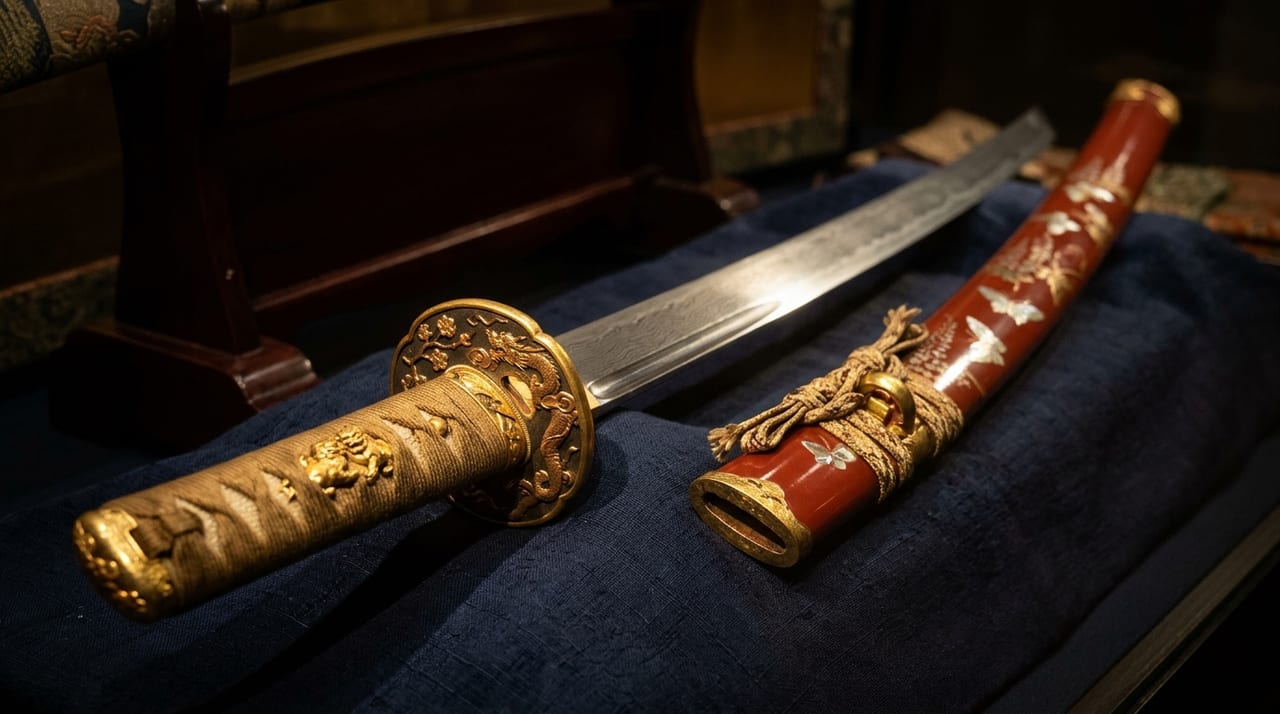 * Image is for illustrative purposes only.
Table of Contents
Japanese swords being appreciated across the sea did not begin with modern overseas collectors. Already in the eleventh century, in the middle of the Heian period, when merchant ships traveled back and forth between Japan and Song China, "Japanese swords" were already being celebrated in the poetry of Chinese literati. The foremost example is the ancient poem "Nihontō Ka" by a Northern Song literatus. Using this poem as a guide, this article examines how nihontō appeared to Song-dynasty China.
What Kind of Poem Is "Nihontō Ka"?
"Nihontō Ka" is an ancient poem in seven-character lines with a treasured sword brought from Japan as its subject, and it is collected in the commonly circulated anthology of Ouyang Xiu. A broad summary of its content runs as follows.
- A Japanese sword was brought to China through the hands of merchants who crossed the sea.
- The saya (scabbard) was decorated with fish skin (shagreen), made with fragrant wood, and fittings of yellow-white metal and copper were used.
- It changed hands to a connoisseur at a high price, and was said to ward off evil when worn.
Rather than discussing the sword's sharpness or hamon (temper line), the poem centers on wonder at a rare treasure from far across the sea. The fact that the poem leans toward describing the "koshirae (mounting)" rather than the blade itself is interesting as an indication of what caught the Chinese eye at the time.
The Debate over Authorship
There is also a theory that the poem's author is not Ouyang Xiu but Sima Guang, and the question has not been settled. Watanabe Hiroaki's 1997 paper on the "Nihontō Ka" in the Bulletin of the Faculty of Liberal Arts, Hosei University, citing Ishihara Michihiro's "Seven Nihontō Ka", likewise lists it as a work of the Song poet Ouyang Xiu (or, as some say, of Sima Guang). The wording of the poem also varies across different editions.
Therefore, it is more honest to avoid asserting that "Ouyang Xiu composed it" and instead to write that "it is included in Ouyang Xiu's collected works, and the authorship is disputed." For the lineage of "Nihontō Ka" poems written in China from the Song through the Ming and Qing, the paper in the Bulletin of the Faculty of Liberal Arts, Hosei University (PDF) is a useful reference.
The Background: Sino-Japanese Trade
In the trade connecting Japan and Song China at the time, Hakata was known as one of the main gateways. It is commonly explained that sulfur, timber, and craft goods were sent from Japan, and this poem provides corroboration that swords were among them. The pattern of merchants acting as intermediaries and transporting rare goods from across the sea is a framework that carries through to overseas trade in later eras as well. In later ages, as the article on Wako and Japanese Swords covers, nihontō spread throughout East Asia through other routes as well.
The "Export" of Nihontō as Told by the Poem
The narrative in the poem of "a merchant obtaining it from east of the sea" presupposes that nihontō reached China as trade goods. That swords were among the goods exported from Japan in Sino-Japanese trade is frequently mentioned in the Japanese history of swordsmanship as well. However, reliable historical sources that can give figures such as annual export numbers or prices have not been confirmed, at least not for this article. Regarding quantities and prices, the correct position is to acknowledge that they are unknown.
By the Muromachi period, records of large quantities of swords being sent through the kangō trade with Ming China become known, but that is a matter of a different era. That topic is left to the article dealing with Muromachi and Sengoku-period exports; here the focus is narrowed to the entry point of "Song-dynasty literati receiving nihontō as treasures."
What Did Nihontō Look Like at the Time?
In Japan around the time the poem was composed, it was precisely the period when the form of the curved tachi was taking shape. This development is treated in detail in the article on sword culture of the mid-to-late Heian period. While there were eye-catching features in the koshirae (mounting), sources that speak directly to how the forging of the blade and the hamon (temper line) were evaluated in China are not visible within the scope of this poem.
Why Was the Koshirae Described?
Judging the quality of a blade requires an eye for jigane and hamon (temper line). By contrast, the material of the saya (scabbard) and the brilliance of the fittings convey their rareness at a glance even to someone unfamiliar with swords. It is natural to suppose that a literatus encountering goods from a distant country for the first time would first marvel at the koshirae (mounting). This is an inference from the poem's descriptions, and records showing how many blades actually crossed over have not been confirmed here.
A Perspective for Reading It Today
The significance of reading "Nihontō Ka" lies in the fact that it is one of the oldest surviving outside perspectives by which the value of nihontō was measured.
- Nihontō were "goods treasured overseas" from an early stage.
- The entry point of appreciation was the beauty of the koshirae (mounting) — the saya (scabbard) and fittings.
- Because debates remain over the authorship and wording, care is required when using it as a historical source.
In modern sword collecting as well, the koshirae (mounting) and the blade are treated as separate axes of appreciation. The fact that a newcomer's eye first turned to the koshirae can be savored as an ancient precedent for that perspective.
TOUKENZA's online catalog allows browsing listed nihontō from the index. Browse with an eye for both the blade and the koshirae (mounting), and try to find the piece that catches your interest.