Yoshimoto Samonji (Sōza Samonji) — The Provenance of the Celebrated Blade That Passed to Nobunaga at Okehazama
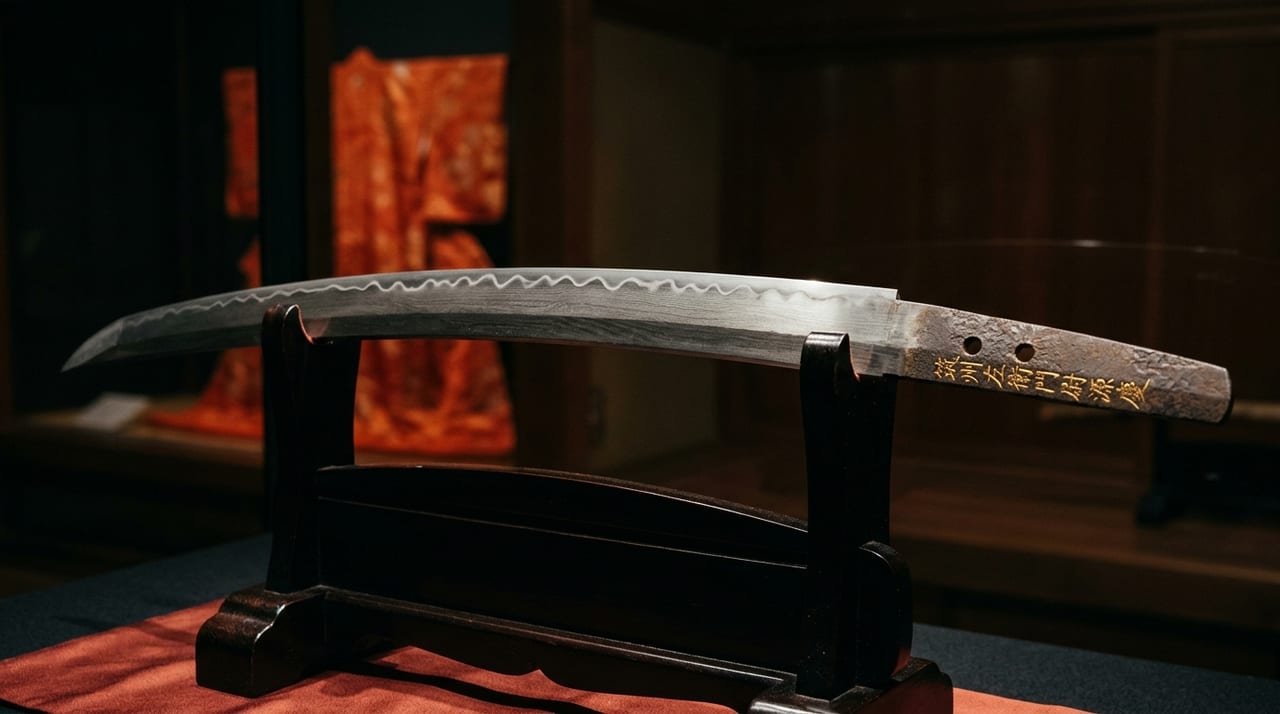 * Image is for illustrative purposes only.
Table of Contents
What Is the Yoshimoto Samonji — The Identity of a Celebrated Blade with Three Names
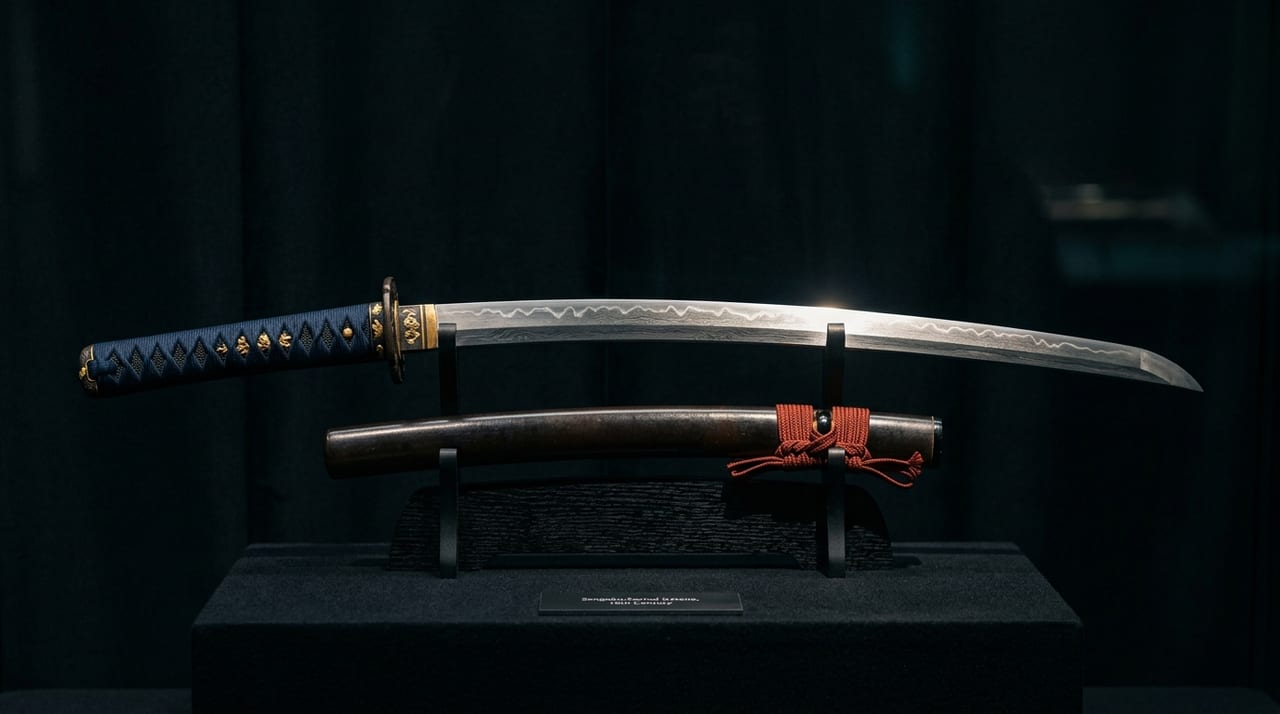
The Yoshimoto Samonji is a tachi attributed to the Nanbokuchō-period tōkō (swordsmith) Samonji, and has been designated a jūyō bunkazai (Important Cultural Property). It is owned by Kenkun-jinja Shrine in Kita Ward, Kyoto, and is on deposit at the Kyoto National Museum. Further details on the designation can also be found in the Cultural Heritage Database.
The name "Yoshimoto Samonji" is merely a label that captures one episode in this sword's extraordinary provenance. The same blade has been called "Miyoshi Samonji" and "Sōza Samonji" in different periods, each name derived from a successive owner. The very fact that a single blade carries multiple names eloquently attests to how many turning points of history it has passed through. The provenance of a celebrated sword can sometimes serve as a mirror reflecting the lives of its owners.
The Tōkō Samonji — Sōshū-den Technique Rooted in Chikuzen
The Samonji who forged this blade was a tōkō (swordsmith) active in Chikuzen Province (present-day Fukuoka Prefecture) from the late Kamakura period through the early Nanbokuchō period. He is considered one of the tōkō strongly influenced by Masamune, and is recognized in sword history as the figure who established the Sōshū-den tradition in Kyushu.
The principal characteristics seen in works by Samonji are as follows.
- The jigane (steel of the blade surface) shows flowing itame with mokume mixed in
- The hamon (temper line) is a varied composition of notare mixed with gunome
- The bōshi (temper line in the point) tends to be brushed and has a deep turn-back
This style, while rooted in the techniques of the senior Sōshū-den masters, possesses a distinctiveness born from the fusion of Kyushu's own materials and craftsmanship. As one of Samonji's representative works, the Yoshimoto Samonji has continued to transmit the tōkō's reputation to later generations. The fact that rulers from the Muromachi through the Sengoku periods eagerly sought works by this tōkō signifies not only excellence as weapons but also recognition of their high value as works of art and symbols of authority.
Provenance Before Okehazama — From Sōza to Yoshimoto's Hands
When discussing the Yoshimoto Samonji, it is necessary to set out the circumstances before Okehazama (1560). The blade is said to have originally been owned by Miyoshi Masanaga, a man known by the Buddhist name "Sōza," from which the name "Sōza Samonji" derives.
Multiple theories exist regarding how the blade subsequently passed to Imagawa Yoshimoto. Records indicating that it passed through Takeda Nobutora during the Tenbun era (the 1530s) coexist with records suggesting a more direct line of transmission, and at present there remain aspects that are difficult to determine conclusively. In any case, sources are in agreement that Imagawa Yoshimoto was in possession of it around the time of the Battle of Okehazama, and this is the background that gave rise to the name "Yoshimoto Samonji."
Imagawa Yoshimoto is known as the great daimyo of the Tōkai region, and it is thought that in his possession of swords he likewise assembled pieces befitting his status. The reality that rulers of the Muromachi and Sengoku periods owned celebrated swords in connection with political and cultural prestige is vividly reflected in this blade's provenance.
Okehazama — The Day the Sword Passed to Nobunaga
On the 19th day of the 5th month of Eiroku 3 (1560), Oda Nobunaga defeated and killed Imagawa Yoshimoto at the Battle of Okehazama. According to the Shinchō-kōki, Nobunaga then took possession of the sword that Yoshimoto had habitually worn. The identification of this blade — the greatest prize of the battle — as the "Yoshimoto Samonji" is based on this record.
The Battle of Okehazama was a historical turning point that made the name of the commander Oda Nobunaga resound throughout the land. As a symbol of this, Nobunaga chose not merely to store Yoshimoto's sword but to inscribe his own will into the blade itself. This took the form of two modifications: suriage (shortening) and a gold-inlaid mei (signature).
Suriage and the Gold-Inlaid Mei — What Nobunaga Inscribed into the Blade
The Yoshimoto Samonji, originally a tachi of approximately 2 shaku 6 sun (about 79 cm), is said to have been shortened by suriage by Nobunaga to 2 shaku 2 sun 1 bu (about 67 cm). Suriage is a technique in which the nakago (tang) of a tachi is trimmed to shorten the blade, a modification carried out according to the preferences of the era and user. The original mei inscribed on the nakago is often lost through suriage, and there is no shortage of tachi that have become works of unknown authorship as a result.
In the case of the Yoshimoto Samonji, however, a new mei was applied by gold inlay at the same time as the suriage. Its content is as follows.
- Obverse: "On the 19th day of the 5th month of Eiroku 3, having struck down Yoshimoto, [I] inscribe this sword of his possession"
- Reverse: "Oda Owari no Kami Nobunaga"
This mei carries an extremely political message: it explicitly records the date of Okehazama, the name of the man struck down, and the fact that the sword was his possession, before inscribing Nobunaga's own name. This mei, engraved into the blade as a monument to victory, conveys the atmosphere of an age when the possession of a celebrated sword was itself proof of authority.
There are various views as to whether the title "Oda Owari no Kami Nobunaga" in the reverse mei corresponds to Nobunaga's designation at the time of Okehazama, and the possibility that the mei was engraved in a later year has also been pointed out. This is not a question of the authenticity of the mei, but a discussion concerning the circumstances of its creation — when it was made and on whose instructions. The culture of gold-inlaid mei, which seals a sword's provenance as a narrative into the nakago, is also a distinctive mode of expression born of the Sengoku age.
After Honnōji — Nobunaga's Death and the Sword's Whereabouts
In Tenshō 10 (1582), Oda Nobunaga met a violent death in the Honnōji Incident. Many of the swords that Nobunaga had stored are said to have been lost in this incident, but the Yoshimoto Samonji is said to have survived and eventually passed to Toyotomi Hideyoshi. The detailed circumstances of how it traveled from Honnōji into Hideyoshi's hands vary among sources, and there is a tradition that it passed through a priest of Matsuo-taisha Shrine.
After passing through successive owners following Hideyoshi, the blade was dedicated to Kenkun-jinja Shrine, where it remains today. Kenkun-jinja Shrine is a shrine that venerates Oda Nobunaga as its enshrined deity, and the fact that the Yoshimoto Samonji is kept here reflects a deep congruence between the sword's provenance and the subject of its veneration. As the exhibition schedule changes by season, it is advisable to check the museum or shrine's notice before visiting. Sword-related sites in Kyoto are also introduced in our column.
A single blade, beginning with Samonji's forging, passed through the hands of the principal figures of the Sengoku period — Miyoshi Masanaga, Imagawa Yoshimoto, Oda Nobunaga, and Toyotomi Hideyoshi — and has been transmitted to the present day as a treasure of the shrine that enshrines Nobunaga. The weight of this provenance demonstrates that the Japanese sword has functioned as a witness to history that transcends mere weapon or craft object. To know the provenance of a celebrated sword is tantamount to knowing the very era in which that sword lived, and at TOUKENZA we introduce the cultural and historical depth of Japanese swords from precisely this perspective.