Samonji — The Extraordinary Master Among Masamune's Ten Disciples Who Brought the Soshu Tradition to Chikuzen
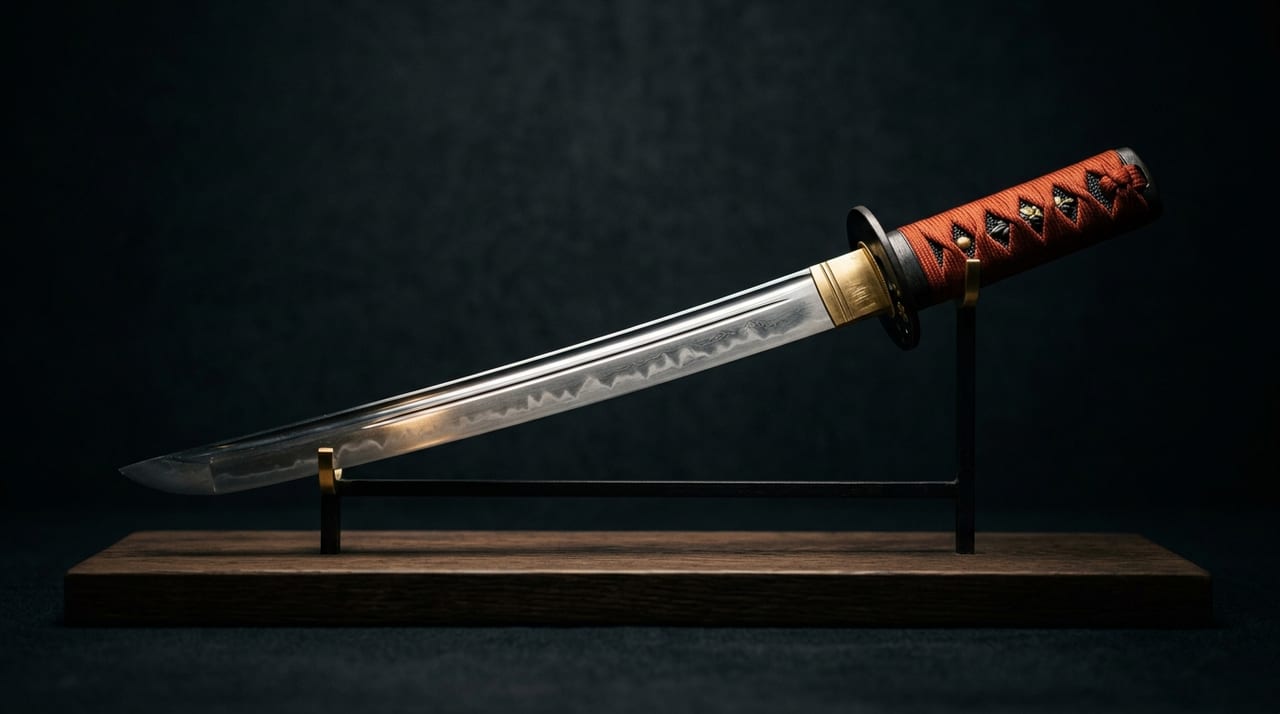 * Image is for illustrative purposes only.
Table of Contents
Samonji — An Exceptional Master of the Soshu Tradition in Chikuzen
Samonji was a swordsmith who was active in Hakata, Chikuzen Province (present-day Fukuoka Prefecture) during the Nanbokucho period. His real name is said to have been Sa no Yasuyoshi, his common name Saemon Saburō, and his Buddhist name Genkei. He earned the name "Samonji" from signing his blades with only the single character "Sa," and to distinguish him from his successors, he was also called "Ōsa" (Great Sa) or "Shin Samonji" (Original Samonji). From the late Kamakura period through the early Nanbokucho period, he was known as a swordsmith who independently developed the techniques of the soshu tradition in Kyushu, far removed from the central sword-making hubs of Kyoto and Kamakura.
In the history of the Japanese sword, there are numerous examples of the working style of a particular era or school being transmitted to local swordsmith groups and developing into a unique form there, and Samonji is counted as one of the representative examples of such regional transmission. Not merely inheriting the central soshu tradition but forming a school rooted in the land of Chikuzen and maintaining a lasting reputation for posterity, Samonji occupies a unique position in the history of the Japanese sword.
Samonji and the Master-Disciple Transmission with Masamune and Lineage
Samonji is sometimes counted as one of the "Ten Virtuous Disciples of Masamune," a renowned master who was active in Kamakura, Sagami Province (present-day Kanagawa Prefecture). However, the grouping itself known as the "Ten Virtuous Disciples of Masamune" is a framework of transmission formed in later ages, and reliable contemporary historical documents supporting individual master-disciple relationships are scarce, so it is necessary to note that there are various theories. Regarding the relationship between Samonji and Masamune, no primary historical documents directly indicating apprenticeship have been confirmed, and the relationship is understood purely as transmission.
As for lineage, it is said that in the sword tome "Ōseki-shō" and other sources, the following lineage is recorded.
- Ryōkai (ancestor)
- Sairen (Dangisho Sairen, also called Kuniyoshi)
- Jitsua
- Sa (Samonji)
- Sa Yasuyoshi
There is also a tradition that Jitsua was Samonji's father, and from this we can discern the process by which the working style of the soshu tradition in Chikuzen was passed down through generations and refined into a unique form. This transmission of lineage suggests that Samonji as a swordsmith was not solely responsible for importing the soshu tradition, but rather came into being upon the accumulated tradition of sword-making in Chikuzen.
The Establishment and Succession of the Chikuzen Samonji School
The school founded by Samonji is called the "Chikuzen Samonji School," and it was known as a group with high technical skill among sword-making groups in the Kyushu region. After Samonji's passing, disciples and successors including Yasuyoshi continued to forge blades, and while inheriting the "Sa" signature, they are said to have transmitted the working style of the soshu tradition in Chikuzen. The fact that this advanced technique of the soshu tradition took root and was established as a distinct school in Kyushu, despite being geographically distant from Kyoto and Kamakura, is a noteworthy example in considering the regional transmission of the Japanese sword.
The sword-making activities of the Chikuzen Samonji School were not unrelated to the historical context of the Nanbokucho period, a time of continued warfare. With increased demand for weapons, swordsmith groups throughout the regions honed their own techniques and produced distinctive working styles unique to each area. Samonji and his school likewise demonstrated their presence as bearers of the soshu tradition in Chikuzen in the context of the sword-making demand of that era.
Extant Representative Works
Samonji's signed works are primarily tanto, with tachi being extremely rare. Among the existing works, there are several that later received designation as national cultural treasures.
- The only known signed tachi — designated as a national treasure and housed in a museum in Fukuyama City, Hiroshima Prefecture.
- One of the finest short swords among the tanto — designated as a national treasure and likewise housed in a museum in Fukuyama City.
- Additionally, several tanto bearing designation as important cultural treasures have been transmitted.
This attests to the fact that Samonji's works have been highly valued across the ages.
All of these works are said to have passed through the hands of powerful warrior families from the Sengoku period through the Edo period, and were treasured not merely as weapons but as symbols of authority and legitimacy. The very scarcity of existing examples can be said to substantiate the rarity of Samonji's works and the high value of their significance as historical materials.
Characteristics of His Working Style — The Soshu Tradition in Kyushu
Samonji's working style is said to have been strongly influenced by the soshu tradition represented by Masamune. It is characterized by the jigane and hamon both being bright and clear, rich activity of nie, and prominent jikage and kinsuji. The soshu tradition was originally a working style cultivated in Kamakura, a central location, but Samonji inherited this in Chikuzen, Kyushu, and developed it by adding his own interpretation and technique.
In this respect, Samonji is positioned not merely as an imitator of the soshu tradition, but as a swordsmith who demonstrated one high point of soshu tradition adoption in provincial areas. The question of how central perfected techniques were reproduced or uniquely transformed in a different climate and environment is an intriguing theme in considering the technical history of the Japanese sword. The beautiful clarity of the jigane and hamon seen in Samonji's works can be said to be the crystallization of accumulated experimentation and refinement.
What Samonji Conveys to the Present
The works created by Samonji and his school are presently highly evaluated as demonstrating one point of achievement in sword-making during the Nanbokucho period, a time of upheaval. While there are various theories about the relationship with Masamune, his teacher, his achievement in inheriting and developing the soshu tradition in the land of Chikuzen is an important example in considering the regional transmission and formation of schools in the Japanese sword.
Because the number of existing works by Samonji is limited, each blade has high documentary and artistic value, and has continued to exert great influence on later swordsmiths and enthusiasts. His path of inheriting the technique of a central master craftsman locally and refining it into a unique style is also a key to understanding how the Japanese sword craft was nurtured in various regions. Through columns introducing the lineage and working style of these historically significant smiths, TOUKENZA conveys the profound world of the Japanese sword.