The Kyōhō Meibutsuchō: Structure, Daizuke, and How to Read the Burned Sword Records in the Famous Sword Register Compiled by Hon'ami Kōchū
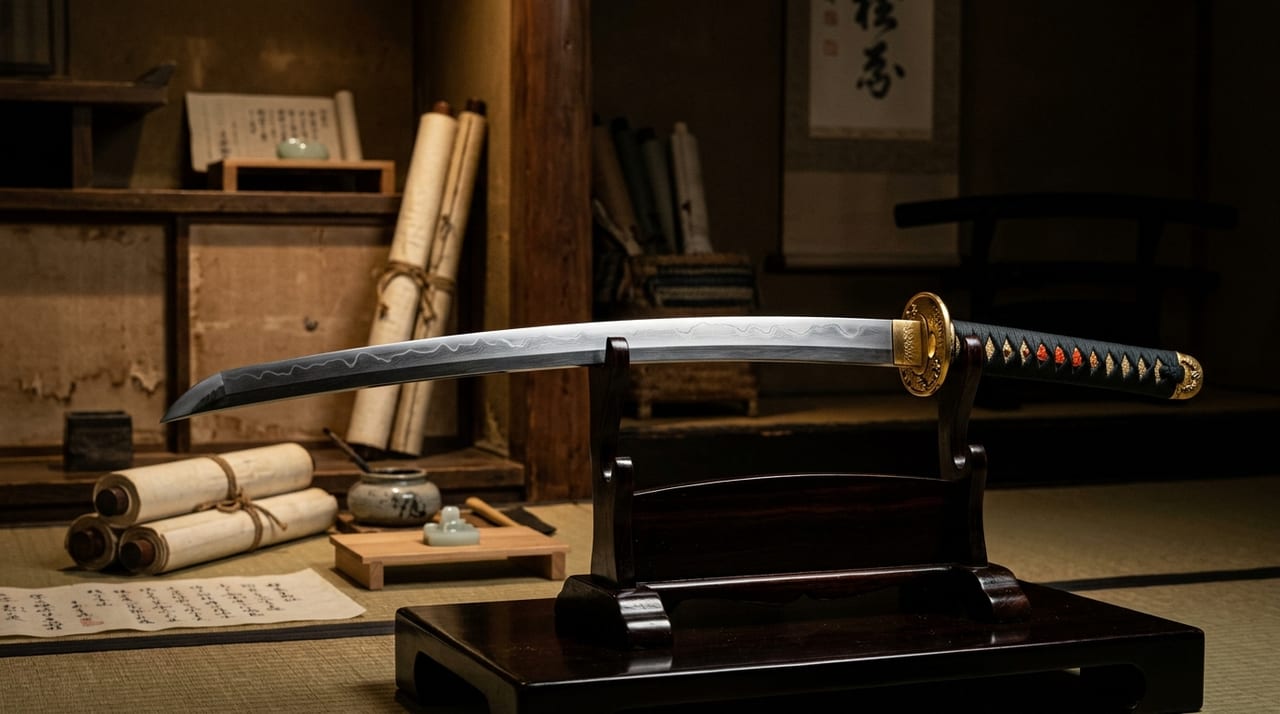 * Image is for illustrative purposes only.
Table of Contents
The Kyōhō Meibutsuchō (Kyōhō Register of Meibutsu) is a register of famous swords compiled on shogunal orders in the mid-Edo period. This work, which continues to be cited as a foundational reference in sword research to this day, is unparalleled in that it systematically records how blades known as meibutsu (named treasure swords) were recognized, appraised, and what was lost. This article examines in order: the background of the compilation, its structure, the meaning of the daizuke, the treatment of burned swords, and the limitations of the work as a source.
Background of the Compilation: The Hon'ami Family and Tokugawa Yoshimune
The Kyōhō Meibutsuchō is said to be a list of famous swords submitted to the shogunate by Hon'ami Kōchū and others acting on the orders of the eighth shogun, Tokugawa Yoshimune, in Kyōhō 4 (1719).
The Hon'ami family was a clan whose trade was the polishing, wiping, and appraisal of swords, and they held the authoritative position of issuing origami (appraisal certificates), the certificates of assessed value. The monetary amounts on the origami functioned as an indicator of a sword's value itself, and the family gained such social trust that the word "origami-tsuki" (literally "with an origami") later passed into common usage as a general expression meaning "guaranteed" or "certified."
Behind Yoshimune's order to compile the register of meibutsu is thought to have been a policy intent to track and administer, as the shogunal house, the distinguished swords that had been passed down in the shogunate and various domain households. As legal frameworks related to swords were being developed during the Kyōhō Reform period, registering the locations of meibutsu (named treasure swords) also held significance in terms of controlling the prestige and assets of the warrior class.
The Three-Volume Structure and Criteria for Inclusion
The meibutsu register is generally described as having three volumes: upper, middle, and lower.
- Upper volume: The Tenka Sansaku ("three greatest tōkō under heaven") — works by Awataguchi Yoshimitsu, Masamune, and Gō Yoshihiro
- Middle volume: Works by notable tōkō (swordsmiths) other than the three greatest
- Lower volume: Meibutsu (named treasure swords) that had already been lost to fire
This tripartite division functions not as a simple ordering by the Japanese syllabary or by era, but as a systematized ranking of tōkō. The Sansaku were regarded throughout the Edo period as the supreme tōkō, and the very structure of placing their works first embodies the values of the meibutsu register.
Each entry records the sword's name (go), the name of the tōkō, the type and dimensions of the sword, its provenance and successive ownership, and the assessed value known as the daizuke. As for the total number of entries, there are various theories depending on which version or manuscript copy is used as the basis and how burned swords and later additions are counted, so the numbers differ by source. This article does not assert any specific number.
Daizuke: What the Assessed Values Tell Us
The daizuke is among the most distinctive elements of the meibutsu register's entries. It is a record that quantifies the value of a sword in units of silver, directly reflecting the economic and symbolic place of swords in the warrior society of the time.
There are two points to bear in mind when reading the daizuke.
- It functions as a relative ranking: The monetary amounts of the daizuke are less the actual transaction prices in the market than an index of the ranking certified by the Hon'ami family. They are useful for comparing which sword ranks higher among works by the same tōkō.
- Daizuke is also recorded for burned swords: Even for swords that have been lost, the daizuke is recorded in order to preserve the valuation of the time. This shows that the meibutsu register is not an "inventory of existing assets" but a "register of the concept of meibutsu."
Records of Burned Swords: The Historical Role Borne by the Lower Volume
The structure of including burned swords in the lower volume straightforwardly demonstrates that the Kyōhō Meibutsuchō is not merely a physical inventory register. Many meibutsu (named treasure swords) were lost in major fires from the early to mid-Edo period, such as the Osaka no Jin (1614–1615) and the Meireki Great Fire (1657).
Among burned swords, some survive as yakemi (burned blades), while others underwent saiba — that is, the hamon (temper line) was restored through re-quenching. Blades that have undergone saiba have lost their original jigane (steel of the blade surface) and hamon, so they require a separate evaluation from their original condition. By having the record of the burning and the circumstances of the fire noted in the meibutsu register, later researchers can obtain clues to trace "at what stage this sword was burned."
The stance of recording lost swords in a register and continuing to pass down that knowledge reflects the aesthetic sensibility of the warrior class, which treated swords not merely as tools but as bearers of history and culture.
Manuscripts and the Limitations as a Source
The original and copies of the Kyōhō Meibutsuchō are said to be non-extant, and everything that survives today is a later manuscript copy. Since transcription errors, additions, and deletions that arose during the copying process differ by version, there are variations between manuscript copies in the names, provenance, and daizuke figures for the included swords. When citing sources, it is required to specify which version or manuscript copy serves as the basis.
Furthermore, inclusion in the meibutsu register and modern designation as a cultural property operate under entirely separate criteria. Not all swords listed in the meibutsu register have been designated as kokuhō (National Treasures) or jūyō bunkazai (Important Cultural Properties), and conversely, there are many designated cultural properties that are not included in the meibutsu register. The meibutsu register records the understanding of the mid-Edo period, and cannot be used as a substitute for modern value assessments.
Moreover, there are countless fine swords that were not recorded in the meibutsu register. Whether or not a sword is listed is merely evidence of whether it was recognized as a meibutsu in the warrior society of the 17th to 18th centuries, and it does not directly determine the quality of the sword itself or its present-day assessment.
Perspectives for Reading the Meibutsu Register
When investigating meibutsu (named treasure swords) using the Kyōhō Meibutsuchō as a guide, holding the following perspectives in mind allows the meaning of the entries to come into fuller relief.
- Classification by tōkō: Whether it is a work of the Sansaku (Yoshimitsu, Masamune, Gō Yoshihiro) or of another tōkō — reading the ranking from the volume in which it appears
- Flow of provenance: Which domain households and shogunal families it passed through — tracing the social journey of the sword
- Level of daizuke: Contextualizing the high or low assessment of the time through comparison with other swords in the same volume
- Whether it was burned and the circumstances: Whether it is included in the lower volume, and the recorded time and cause of the fire — prerequisite information for estimating the current condition
- Origin of the go: Reading the historical context of the sword from the type of name — whether derived from an anecdote, appearance, or the name of a past owner
The meibutsu register is a record as of its compilation, and subsequent changes in ownership, disappearances, and the results of later investigations are not reflected in it. Treating it with respect as a primary source while reading it alongside the findings of later scholarship is the best way to make the most of this register.