Where Famous Sword Names Come From: Mikazuki, Onimaru, Heshikiri and Yagen Toshiro and the Patterns of Naming
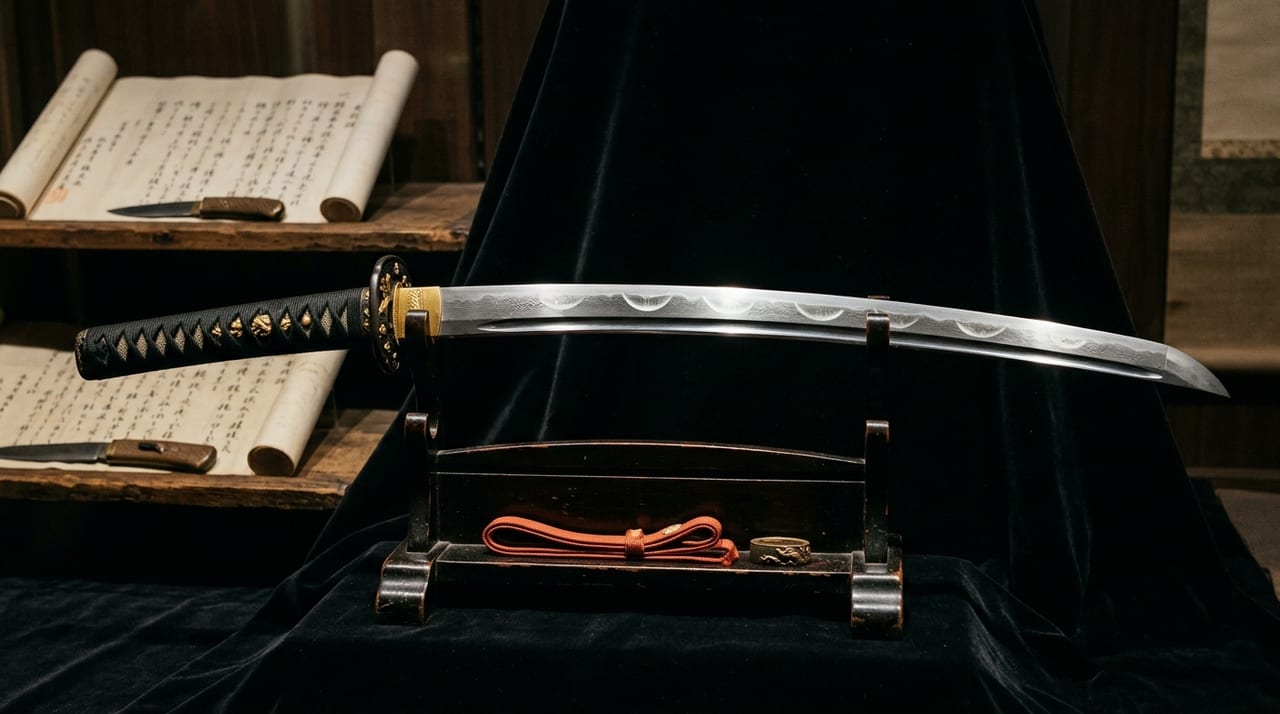 * Image is for illustrative purposes only.
Table of Contents
"Mikazuki Munechika," "Heshikiri Hasebe," "Onimaru Kunitsuna," "Yagen Toshiro." The names of famous swords often have mysterious words preceding the name of the swordsmith. The part that serves as this prefix is called a "gou." The gou is not a character carved on the blade itself, but rather a common name given in later generations based on the sword's appearance, previous owners, or anecdotes associated with it. By tracing the origins of a gou, one can see how famous swords have been passed down through the ages.
How Do "Gou" and "Mei" Differ?
The tang of a sword usually bears characters carved by the swordsmith, inscribing their name or place of manufacture. This is called the "mei," which serves as a primary record indicating the creator.
In contrast, the gou was not given by the swordsmith. It is a common name that attached naturally over the course of transmission—whether given by an owner, derived from anecdotes associated with the sword, or based on aesthetic judgments of its form or hamon. A sword that bears a gou is one that has come before many eyes and has been passed down through many stories.
During the Edo period, Honami Mitsutada, acting on the orders of Tokugawa Yoshimune, compiled a catalog of famous swords called the "Kyoho Meibutsu-cho" in the fourth year of Kyoho (1719). This is an instance where famous works bearing gou were systematically recorded, and details are compiled in the compilation of the Kyoho Meibutsu-cho.
Four Types of Origins Visible in Gou
Looking at representative gou, their origins can be roughly divided into the following categories.
- Aesthetic judgments of form or hamon (example: Mikazuki Munechika)
- Supposed targets or events that were cut (examples: Dojigiri Yasutsuna, Heshikiri Hasebe, Onimaru Kunitsuna)
- Connection with owners or beliefs (example: Juzumaru Tsunetsugu)
- Anecdotes involving familiar objects (example: Yagen Toshiro)
Below, we examine each origin in turn. Note that the origins of gou include both those verifiable through historical records and those that remain part of oral tradition. This is why phrases like "as is said to..." and "as it is claimed..." appear frequently.
Aesthetic Judgment of Form and Hamon—Mikazuki Munechika
The gou of Mikazuki Munechika is said to derive from the numerous crescent-shaped uchinoke patterns visible on the blade surface. Uchinoke is a type of hamon pattern in which crescent-shaped forms appear along the cutting edge. Unlike a narrative, this name is based on visible features of the sword itself—a gou grounded in direct observation.
The maker is Sanjo Munechika of the Heian period, and it is now held as a National Treasure in the Tokyo National Museum. For details about the maker, refer to the explanation of Sanjo Munechika, and for the sword itself, see the explanation of Mikazuki Munechika.
Supposed Targets and Events That Were Cut—Dojigiri, Heshikiri, Onimaru
The most numerous are gou based on anecdotes.
Dojigiri Yasutsuna is named after the tradition that Minamoto no Raikou cut off the head of the demon Shuten Doji, who lived on Mount Oeyama in Tanba, with this tachi. The gou itself points to a scene from the narrative. Details can be found in the explanation of Dojigiri Yasutsuna.
Heshikiri Hasebe is also written as "圧切." According to the "Kuroda-ke Gochōhō Kojitsu," the name derives from the story that Oda Nobunaga, angered at his tea servant Kannai, pushed this sword under a food shelf where the servant had fled and cut him down by pressing. The "Kuroda Kafu" records that Nobunaga gave it to Kuroda Yoshitaka in the third year of Tensho (1575), and it is now a National Treasure held in the Fukuoka City Museum. The maker is Hasebe Kunishige.
Onimaru Kunitsuna is known from a story involving Hojo Tokimasa. According to the "Taiheiki," Tokimasa was troubled by a small demon that appeared in his dreams. One night, an old man claiming to be the spirit of the tachi Kunitsuna appeared in his dream and told him that if he removed the rust, the demon would be vanquished. When Tokimasa performed the maintenance as instructed and propped up the sword, the tachi fell and cut off the head of a small silver demon that had been on the stand of a brazier, and thereafter the demon no longer appeared in his dreams. It is said that from this incident the gou Onimaru was given to the sword. For details, see the explanation of Onimaru Kunitsuna.
Connection with Owners and Belief—Juzumaru Tsunetsugu
Juzumaru Tsunetsugu is said to have received its gou from the fact that Nichiren was captivated by the beauty of the blade, wound a prayer bead strand around the handle, and wore it as "the tachi of dispelling evil and manifesting truth." Originally, it is said to have been a protective sword given by followers to Nichiren when he entered Minobu Mountain. This is an example of a gou arising from a sword's connection with a person and a faith, and reading it together with the explanation of Juzumaru Tsunetsugu deepens understanding.
Anecdote Involving a Familiar Object—Yagen Toshiro
Yagen Toshiro is said to be the work of Awataguchi Yoshimitsu, a tanto. In 1493 (Meiō 2), when Hatakeyama Masanaga was defeated in Kawachi and attempted to commit seppuku, the sword would not penetrate his abdomen, so he threw it away. It then pierced a yagen (a mortar for grinding medicines) that was nearby. This story is said to be the origin of the gou.
The tanto is said to have passed to the Ashikaga shogunate, Matsunaga Hisahide, and Oda Nobunaga, but its later whereabouts are unclear. There is a theory that it was destroyed in the Honnoji Incident, and it is currently considered lost. It is worth remembering that neither the anecdotal origin of the gou nor the records of transmission are entirely certain.
Points to Keep in Mind When Reading About Gou
When reading about the origins of gou, it is good to keep the following three points in mind.
- The anecdotal origin is a tradition, and multiple accounts may be passed down for the same sword
- The establishment of a gou most often occurs a long time after the sword was made
- The gou is the gateway to appreciation, and the basis for value lies in the totality of the metal, hamon, form, and provenance
Swords with gou tend to be discussed with their anecdotes taking precedence. However, when viewing the actual sword, truly appreciating a famous sword means observing the quality of the blade itself beyond the anecdote.
Swords on display can be viewed from the sword catalog.