The History of Japanese Swordsmith Apprenticeship: From Edo-Era Guild Training to Modern Successor Shortage
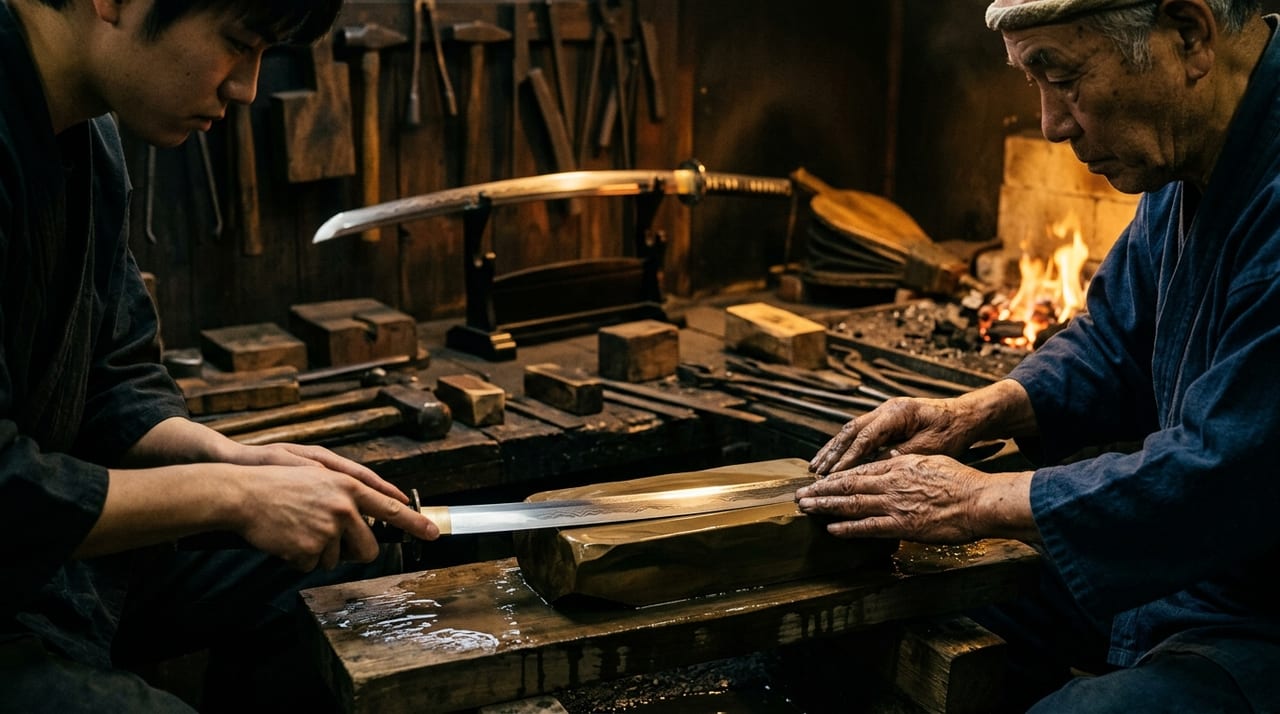 * Image is for illustrative purposes only.
Table of Contents
How was the apprenticeship system born?—The master-apprentice system of the Edo period
Japanese sword-making techniques have been passed down through direct instruction from person to person, rather than through documents or diagrams. This form of transmission became established during the Edo period. Most sword makers were either in the position of receiving protection from a clan, or were independent craftsmen who set up workshops in towns. In either case, the basic form for becoming a fully qualified craftsman was to live under a particular master and learn the techniques through practice over many years—a system known as "live-in apprenticeship."
Techniques were systematized according to schools, with regional and lineage characteristics. The five traditions of Yamashiro, Yamato, Bizen, Soshu, and Mino were collectively known as the "Gokaden" (Five Great Schools), and each school maintained a closed transmission structure in which unique forging methods and the fine points of hardening were passed only to disciples. Not disclosing the technical information possessed by the master was a means of protecting the school's value, and the system whereby only by becoming a disciple and earning trust could one approach the essence of the techniques continued to function across many generations.
The Meiji severance—The sword prohibition edict and sword makers' career change
This chain of transmission faced a major rupture during the Meiji period. When the Edict on the Abolition of Swords (Haitorei), issued in 1876 (Meiji 9), prohibited sword-wearing, demand for Japanese swords as practical items declined rapidly. Many sword makers lost their livelihoods and were forced to transition to other metal-working industries, such as manufacturing farm tools, blades, and machine parts. Only a limited number of workshops had the resources to take on new disciples and pass on their techniques, and it is said that not a few schools saw their lineages cut off.
On the other hand, interest in Japanese swords as works of art and ritual objects did not disappear entirely, and a small number of sword makers continued to forge swords on a modest scale. It can also be argued that it was only because these craftsmen preserved their techniques during this period that later revival became possible. The Sword Abolition Edict severed the institutional demand, but it did not completely eliminate the techniques themselves.
From occupation-era prohibition to postwar reconstruction
An even more serious rupture came after the Pacific War. The Supreme Commander of the Allied Powers (GHQ) regarded Japanese swords as weapons as part of its occupation policy and strictly restricted their possession and manufacture, including sword-making. Sword makers were essentially left without work, and the transmission of techniques came to a near standstill.
The turning point came in the 1950s. Discussions to reposition Japanese swords as works of art and cultural properties progressed, and under a system requiring official approval for each sword produced (now Article 18-2 of the Swords and Firearms Control Law), sword-making as a work of art came to be conditionally permitted. In conjunction with this, the nation's certification system for becoming a sword maker was established, and apprenticeship for a certain period under a certified active sword smith became institutionalized as an essential condition for independent practice as a sword smith. This period witnessed a major shift in the very character of the system—from the closed transmission of schools as in the Edo period to a mechanism in which the nation certifies technical practitioners and publicly works to preserve techniques.
Modern apprenticeship systems—Certified training and master-disciple relationships today
The current apprenticeship system for sword makers is built on this framework established after the war. The basic path is to train for at least five years under a swordsmith who has previously received production approval, complete the training program run by the Agency for Cultural Affairs, and then obtain approval to make swords. The number of disciples a master can take on at one time is limited, and the form—whether live-in or commuting—differs from master to master; the master-apprentice character from the Edo period remains distinctly present today.
At the same time, changes have emerged. While in the past connection through a master or introduction was virtually the only path to apprenticeship, multiple pathways now exist in parallel:
- Direct apprenticeship under an active sword smith (both live-in and commuting forms)
- Basic courses in metalworking and forging offered by prefectural vocational training schools
- A phased pathway in which one participates in short-term experience programs to clarify one's intentions and later formally become an apprentice
Information flow has also changed. Sword smiths have emerged who share sword-making processes through social media and video streaming, making it easier for prospective apprentices to find leads in searching for masters. However, there is a shared recognition in the field that the core techniques that are learned through the body can only be transmitted through repeated face-to-face instruction.
Why is it difficult for successors to develop?—The historical rupture
When viewed from a historical perspective, the modern shortage of successors reveals structural factors beyond mere youth disengagement. Many Edo-period sword makers were positioned within the protection of clans or regional communities and could refine their techniques while their livelihoods were assured to some degree. The school as a community also supported both the disciples' livelihoods and the transmission of techniques.
In contrast, modern sword makers operate fundamentally as independent practitioners on a self-sufficient basis. While the nation's certification system serves to guarantee technical standards, it does not provide for livelihood support during apprenticeship or for securing sales channels after independence. It can be said that the comprehensive support functions once provided by schools and clans have been lost, leaving individuals burdened only by the long training period and low income.
Moreover, the number of approved swordsmiths nationwide is small and declining, which narrows the foundation for successor development. If there are few people capable of becoming masters, the capacity for accepting disciples is naturally limited. Related craftspeople such as polishers, scabbard makers, and metalworkers face similar structural constraints, so this must be understood not as a problem of sword makers alone but as an issue affecting the entire craftsperson ecosystem supporting Japanese sword culture.
Conclusion—Connecting institutions to the future
The Japanese sword craftsman's apprenticeship system has survived while undergoing major transformations across eras—from the closed transmission of schools in the Edo period, through the Meiji severance, the occupation-era prohibition, and finally to the postwar public certification system. Modern apprenticeship training preserves the core of face-to-face master-disciple relationships while incorporating new pathways such as vocational training schools and information dissemination.
Yet the issue of successor shortage remains unresolved. Looking back at history, it was the existence of a small number of craftspeople who preserved their techniques at each moment that prevented the severance of techniques. Along with institutional redesign, the question of how society as a whole can support those who hand down Japanese swords as a cultural asset to the next generation will continue to be asked.