Onimaru Kunitsuna — A Tenka Goken Imperial Treasure: The Awataguchi Masterpiece Passed from the Hojo Family to the Imperial Household
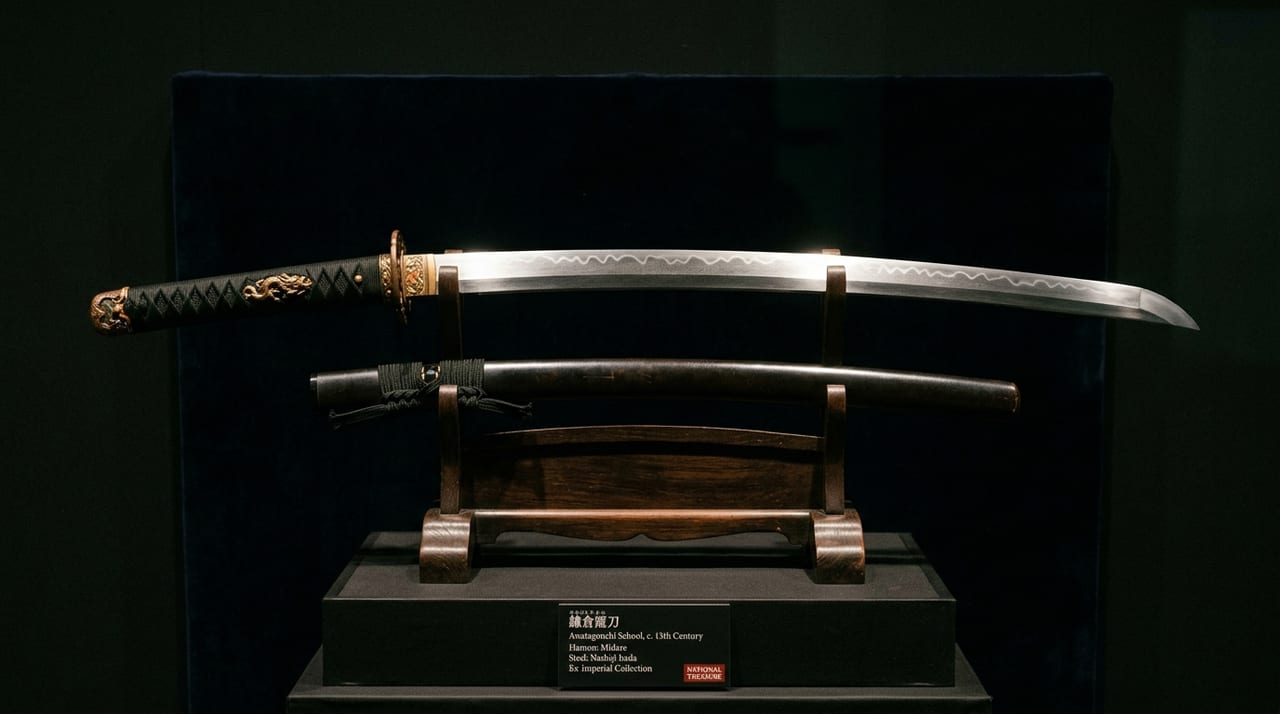 * Image is for illustrative purposes only.
Table of Contents
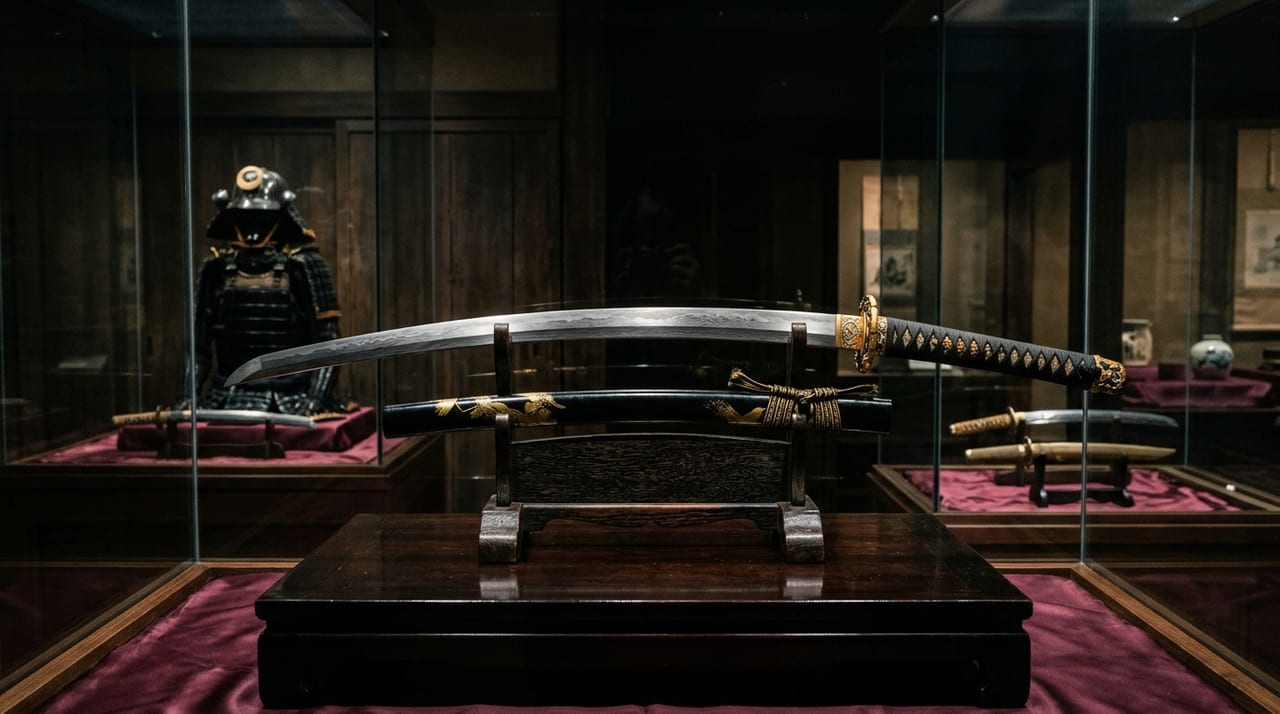
Onimaru Kunitsuna is a famous sword counted among the Five Heavenly Swords (Tenka Goken). It is said to have been made during the Kamakura period and is currently managed by the Imperial Household Agency as an imperial possession (gyobutsu = private property of the imperial household).
About the Five Heavenly Swords
The Five Heavenly Swords is a collective name for five swords that have long been regarded as especially renowned among the many Japanese swords: Mikazuki Munechika, Dōjigiri Yasutsuna, Ōdenta Mitsuyo, Juzumaru Tsunetsugu, and Onimaru Kunitsuna. While the designation itself became established in later periods, all of them are treasures among treasures, rich in history and legend. Currently, Mikazuki Munechika, Dōjigiri Yasutsuna, and Ōdenta Mitsuyo are designated as National Treasures, and Juzumaru Tsunetsugu is designated as an Important Cultural Property. Of the five, only Onimaru Kunitsuna holds a special status as an imperial possession that is not subject to cultural property designation. All five are ancient famous swords from the Heian through Kamakura periods, and comparing them offers an excellent entry point for surveying the highest achievements of each era and school.
| Sword Name | Current Designation/Status |
|---|---|
| Mikazuki Munechika | National Treasure |
| Dōjigiri Yasutsuna | National Treasure |
| Ōdenta Mitsuyo | National Treasure |
| Juzumaru Tsunetsugu | Important Cultural Property |
| Onimaru Kunitsuna | Imperial Possession (not subject to cultural property designation) |
Creator: Kunitsuna of the Awataguchi line
Kunitsuna, who is credited as the creator, was a swordsmith who worked in Awataguchi of Kyoto during the Kamakura period and is regarded as one of the master craftsmen representing the Awataguchi line. The Awataguchi line was a prestigious smithing group from Yamashiro Province, known for its precise jigane and refined craftsmanship. Their jigane is finely packed and has a lustrous quality, often described as nashiji-hada. Yoshimitsu, who was renowned as a master of short swords, was also a swordsmith of this line, and the name Awataguchi has become symbolic of the high status of the Yamashiro tradition. In considering Kunitsuna's work, the common beauty of this school—a calm and elegant hamon and precise jigane—serves as the standard.
The Name "Onimaru" and Its Legend
The name "Onimaru" comes with a legend. It is said that this sword alone defeated a demon's supernatural affliction that plagued influential figures of the Kamakura shogunate. The details—such as whom it appeared to in a dream—vary among different accounts, and the narrative was refined after the Muromachi period. In any case, the anecdote testifies that the sword itself was revered as a special entity imbued with spiritual power. Such names (gou = alternative names for swords) are evidence that famous swords have been remembered alongside their stories, and they teach us that the value of Japanese swords has been shaped not only by their appearance and craftsmanship, but also by their provenance and legends.
Provenance from the Hojo Clan to the Imperial Household
The provenance is illustrious. After passing into the hands of the Hojo clan, the regents of the Kamakura shogunate, it is said to have passed through the hands of successive rulers of the age: Nitta Yoshisada, Shiba Takatsune, the Ashikaga shogunate family, Oda Nobunaga, Toyotomi Hideyoshi, and the Tokugawa shogunate family. Then in Meiji 14 (1881), it was presented to the Imperial Household Ministry by the Honami family and became an imperial possession. The Honami family, which appears in this lineage, was a clan whose hereditary profession was the authentication and polishing of swords and is known as a pillar supporting the provenance of famous swords. The very fact that the transmission of famous swords has been recorded and preserved through the hands of authentication experts speaks to the rich depth of Japanese sword culture.
The Framework of Imperial Possessions
Because Onimaru Kunitsuna is an imperial possession, it is not subject to cultural property designation such as National Treasure or Important Cultural Property status. As private property of the imperial household, imperial possessions are protected within a legal framework separate from cultural property protection law and thus fall outside the scope of designation. Therefore, it is inaccurate to understand this as meaning "it is inferior in status because it is not a National Treasure." Rather, it is appropriate to regard it as a specially elevated entity existing outside the designation system. The connection between the imperial household and swords is ancient, and considering the history of swords being treated as sacred treasures relating to ritual, the weight of Onimaru Kunitsuna's transmission as an imperial possession becomes evident. Furthermore, imperial possessions are not displayed on a permanent basis; opportunities to view them directly are limited to special exhibitions and similar occasions. If one wishes to appreciate such swords, consulting museum special exhibition information and catalogs is the practical approach.
Points for Appreciation and Learning
Although opportunities to see Onimaru Kunitsuna itself are rare, there are many points of entry for learning.
- Comparing the Five Heavenly Swords side by side. When you compare five swords that differ in era, transmission, and provenance, you can directly appreciate that the evaluation of Japanese swords encompasses multiple dimensions: appearance, jigane, hamon, and provenance.
- Learning the distinctive characteristics of Yamashiro tradition jigane through the works of other swordsmiths of the Awataguchi line.
- Tracing the transmission from the Hojo clan through the Ashikaga, Oda, Toyotomi, and Tokugawa, and reflecting on the meaning of gifting famous swords within samurai society.
Through a single sword as an entry point, one's perspective expands to encompass both political and art history.
It should be noted that terms such as "Five Heavenly Swords" and "imperial possession" are sometimes used in marketing, but imperial possessions and National Treasure-class famous swords themselves do not generally appear on the open market. It is the correct approach to appreciate copies bearing the name of a famous sword (utsushi = swords created by later swordsmiths following a famous example as their model) as copies, and for swords claiming a particular provenance, one should always verify the authentication documents and supporting materials.
Symbol of Power and Famous Swords
The provenance of Onimaru Kunitsuna speaks to the fact that famous swords were not merely implements of warfare, but were continuously bestowed and received as symbols of authority and proof of legitimacy. Its path through the rise and fall of samurai governments and ultimately arriving at the present day as a treasure of the imperial household can be said to be a mirror reflecting the very history of Japanese swords.