Tsurumaru Kuninaga: Imperial Treasure and Tenka Goken Legacy
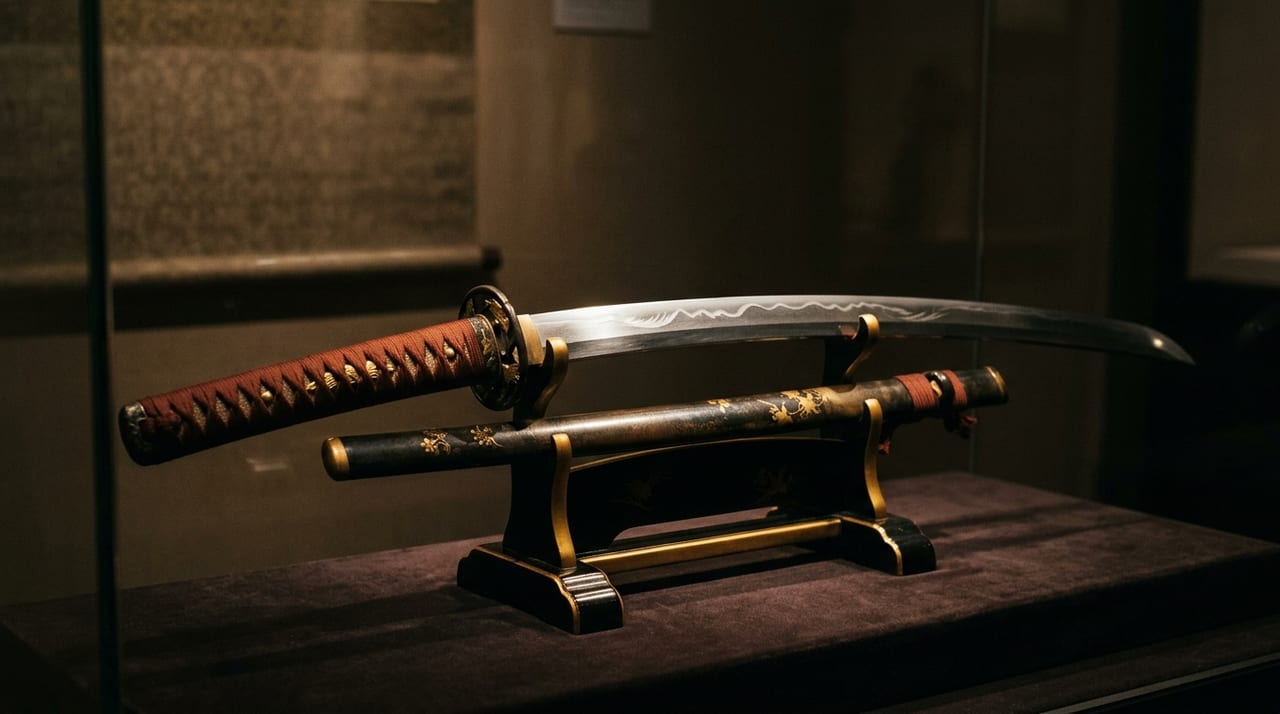 * Image is for illustrative purposes only.
Table of Contents
The Five Swords Under Heaven — A Grouping of Celebrated Blades with Distinguished Provenance
"The Five Swords Under Heaven" is a collective term that came into use from the modern period onward to refer to five tachi blades regarded as having particularly distinguished provenance, quality, and status within the history of Japanese swords. The composition of these five blades was once subject to various theories, but today the following five are widely recognized:
- Mikazuki Munechika (crafted by Munechika of Sanjo, Yamashiro; housed at the Tokyo National Museum)
- Dojigiri Yasutsuna (crafted by Yasutsuna of Hoki; housed at the Tokyo National Museum)
- Odenta Mitsuyo (crafted by Miike Tenta Mitsuyo of Chikuzen; housed at the Maeda Ikutokukai Foundation)
- Juzumaru Tsunetsugu (crafted by Tsunetsugu of Yamato; housed at Honmonji Temple)
- Tsurumaru Kuninaga (crafted by Gojo Kuninaga of Yamashiro; an Imperial treasure)
These five blades are all noted for being forged by master craftsmen from the Heian and Kamakura periods, and for having been carefully preserved and passed down over long centuries through renowned samurai families and the imperial household. Among the five, only Tsurumaru Kuninaga is held as an Imperial treasure under imperial household management, a distinction that most severely restricts opportunities for public viewing and remains a defining characteristic of this blade.
The Craftsman Gojo Kuninaga and the Sanjo School Lineage
The credited maker of Tsurumaru Kuninaga is Gojo Kuninaga, a master swordsmith of the Heian period. He is said to have resided in Gojo, Kyoto, during the Tengi era (around 1053–1058), and is counted among the swordsmiths who were active in Yamashiro Province. Gojo Kuninaga is traditionally said to have been a student of Sanjo Munechika, who was himself the maker of "Mikazuki Munechika," one of the Five Swords Under Heaven, and is thus positioned within the lineage of the Sanjo school.
The Sanjo school was a preeminent school representing Kyoto's sword-making culture of the Heian period, and through the master-student relationship between its practitioners, Tsurumaru Kuninaga and Mikazuki Munechika emerge as kindred creations born from the same cultural soil. During this period, when the samurai class was beginning to rise under the ritsuryo system, the sword-makers of Kyoto refined their techniques in response to demand from both the nobility and the martial classes. The working style of Gojo Kuninaga serves as an important resource in sword research, demonstrating the high level of craftsmanship of the age.
The Blade of Tsurumaru Kuninaga — A Typical Example of a Heian tachi
The blade of Tsurumaru Kuninaga is known for its elegant form, retaining pronounced characteristics of the Heian tachi. When the transmitted specifications and features are organized, they are as follows:
- Form: shinogi-zukuri, iorimune, ko-kissaki (typical construction of a Heian tachi)
- Blade length: approximately 78.6 centimeters
- Curve: approximately 2.7 centimeters (curvature from the hilt region)
- Nakago signature: two-character inscription reading "Kuninaga" positioned toward the ridge
- Method of wearing: hung from the waist by cord with the edge facing downward in the "hakitachi" style of wearing
Ko-kissaki refers to a form in which the point is small and compact, a characteristic feature found frequently in Heian-period tachi. Unlike the later-dominant uchigatana (worn edge-up in the belt), the tachi developed during an age focused on mounted combat, and both the method of wearing and the envisioned combat scenarios were entirely different. Understanding such stylistic differences serves as an entry point to comprehending how the Japanese sword evolved with time.
The name Tsurumaru is said to derive from the presence of a pattern in the hamon resembling the flight of a crane, but given the extreme difficulty of viewing the actual blade today, most enthusiasts know its elegance through photographs and illustrated records.
Provenance Traced Through Historical Records — From the Date Clan to Its Presentation to Emperor Meiji
Various legends have long been told concerning Tsurumaru Kuninaga. There are traditions claiming it passed from Taira no Koremochi (the "Yogo Shōgun") through the Adachi and Hojo clans to Oda Nobunaga, but these all lack substantive textual support. The provenance that can be reliably traced through historical records begins from the Genroku period of the Edo era onward. When records from the Genroku period onward are organized, they are as follows:
- 1st year of Jokyo (1684): The Honami family performed appraisal and valuation
- 2nd year of Jokyo (1685): A record remains of viewing by Maeda Tsunanori, daimyo of the Kaga domain
- 16th year of Genroku (1703): Valued at two hundred gold pieces
- 1st year of Hoei (1704): Inherited from Sendai daimyo Date Tsunamura to his eldest son Yoshimura
- 1st year of Enkyō (1744): Passed from Date Yoshimura to Munemura through succession
- 34th year of Meiji (1901): Presented by the Date family to Emperor Meiji upon his visit to Sendai
The fact that the Sendai Date clan preserved this blade carefully across multiple generations demonstrates how highly the family regarded it. Through its presentation in the 34th year of Meiji, Tsurumaru Kuninaga became an Imperial treasure and has remained so to the present day. The sequence from the Honami family's appraisal through the Maeda viewing records to successive inheritance within the Date house exemplifies how the authority of celebrated swords was formed and maintained within Edo-period daimyo society.
Status as an Imperial Treasure — Public Display Practices and Administrative Reality
Since the 34th year of Meiji, Tsurumaru Kuninaga has been housed in the imperial sword storehouse managed by the Imperial Household Agency and treated as an Imperial treasure. "Imperial treasure" refers to property privately held by the imperial household and does not fall subject to designation as a National Treasure or Important Cultural Property under the Cultural Properties Protection Law. For this reason, Tsurumaru Kuninaga differs fundamentally in legal status from Mikazuki Munechika and Dojigiri Yasutsuna, both of which are designated as National Treasures.
Although both are imperial-related items, holdings in the Imperial Collections, Sannomaru Shōzōkan Museum are made available for public viewing as state property, whereas Imperial treasures fall outside this scope. The Imperial Collections, Sannomaru Shōzōkan Museum is a facility housing artworks that were donated to the state by Their Majesties the Emperor Emeritus and Empress Emerita, and operates under an entirely different legal classification from Imperial treasures. Understanding such differences in administrative systems provides a precise answer to the question "Why is only Tsurumaru Kuninaga not displayed?"
Conversely, the existence of Tsurumaru Kuninaga is not completely concealed. Through illustrated records, research publications, and press photography, many enthusiasts and researchers have been exposed to its image, and restoration work on sword fittings has been undertaken by related parties. Precisely because the opportunity to encounter the actual blade is limited, each photograph and piece of literature that is transmitted carries profound significance.
What the Five Swords Under Heaven Convey to Future Generations
The concept of the Five Swords Under Heaven indicates not merely the high quality of the swords themselves. The very fact that a single blade passes down through changing hands over centuries without being lost is rare, and in this sense, the Five Swords Under Heaven embody not only the artistry of the Japanese sword but the history of transmission and stewardship itself.
Tracing the provenance of Tsurumaru Kuninaga provides a path to understanding the transformation of the relationship between the Japanese sword and society, from the Heian-period sword culture of Yamashiro through the sword appreciation of Edo daimyo society to the modern imperial collection. The fact that two blades born from the master-student relationship of the Sanjo school stand together among the Five Swords Under Heaven further testifies to the profound role that Heiankyo as a cultural center played in the history of the sword.
While Tsurumaru Kuninaga itself, as an Imperial treasure, is not subject to sale or public display, its historical context—the form of the Heian tachi, the working style of the Sanjo school, and the donation from the Date clan to the imperial household—provides rich comparative perspectives when appreciating swords in current circulation. For those wishing to deepen their knowledge of sword history and appreciation, our column listing is also available for reference.