How to Appraise a Sword without a Swordsmith's Signature — Practical Appraisal Methods and Technical Grounds for Identifying the Maker of a Mumei Blade
 * Image is for illustrative purposes only.
Table of Contents
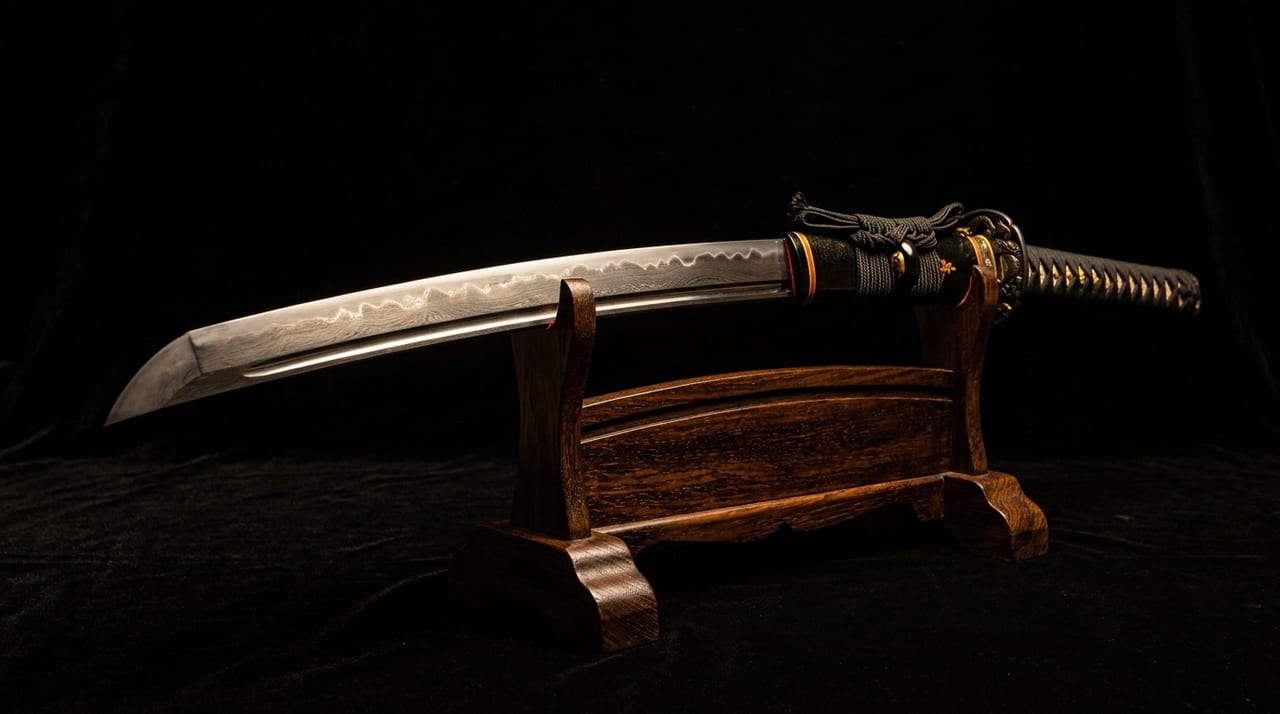
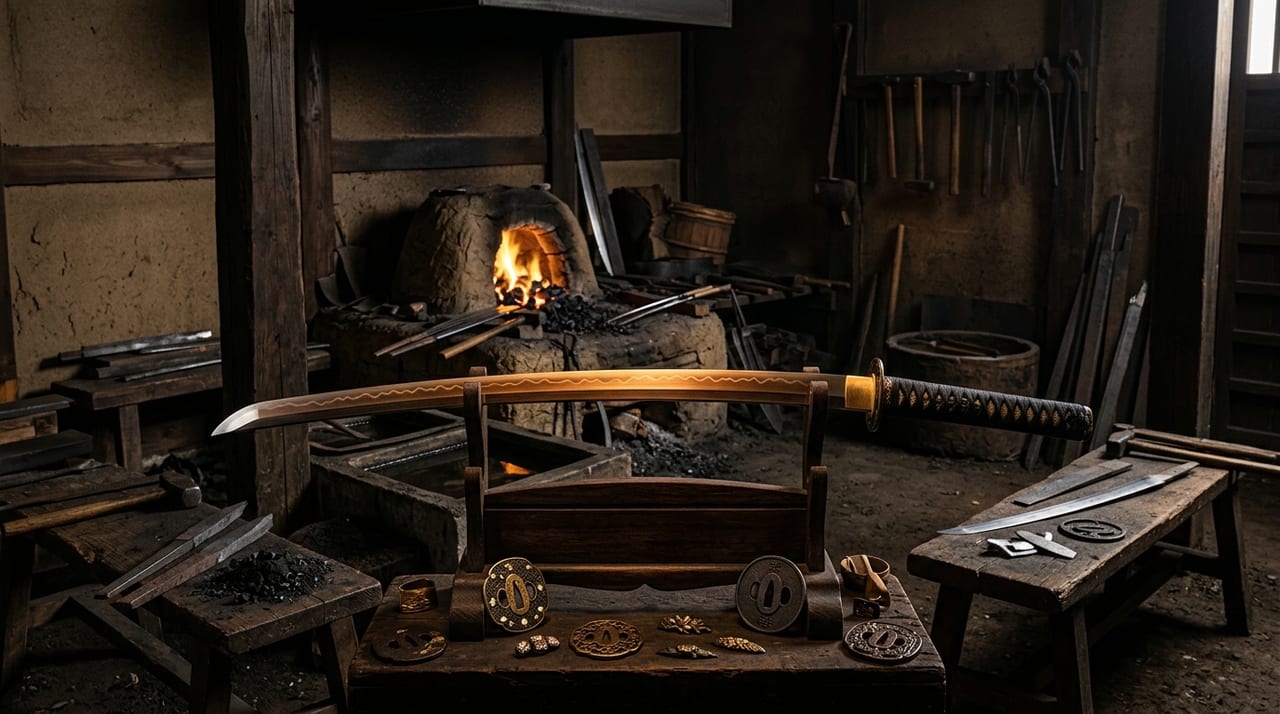
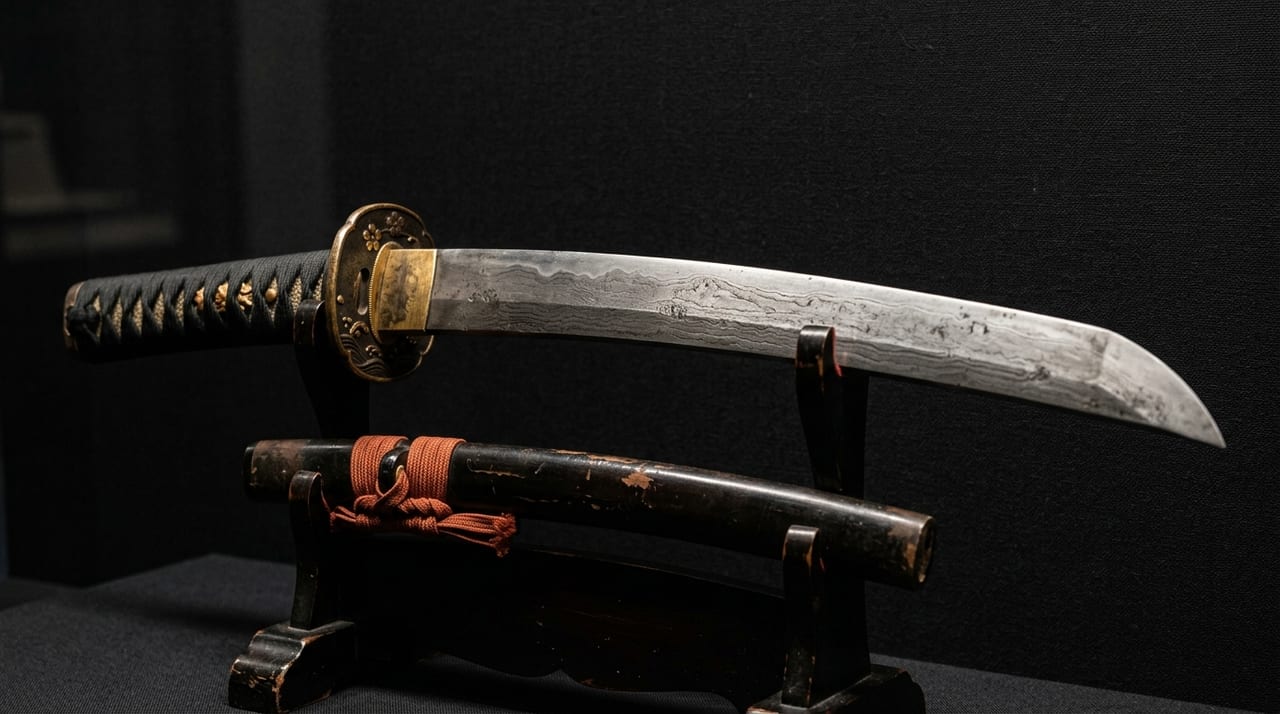
Among nihontō, there is no shortage of blades that do not bear a mei — the name of the tōkō carved into the blade. The absence of a mei does not necessarily mean lesser value; many famous mumei masterpieces regarded as the work of great smiths have been passed down. So when faced with a sword that lacks even the most direct of clues — a signature — how does an appraiser narrow down "who made it"? This article organizes the background behind how mumei blades come to exist and the practical points of focus used in actual appraisal, explaining the depth of the art of appraisal.
Why Mumei Blades Exist — Suriage, Ceremonial Presentation, and the Circumstances of Practical Swords
The reasons a sword has no mei are not uniform; broadly, they can be divided into three types of circumstances.
Loss of mei through suriage is the most representative cause. Tachi made in the Heian and Kamakura periods were generally long, but as the age progressed and combat styles shifted toward the uchigatana, modifications that shortened the lower portion of the blade together with the nakago (tang) became widespread. Since the mei is carved into the nakago, when suriage cuts away the base of the nakago, the mei carved there is lost along with it. Even works by renowned tōkō have lost their mei through suriage and have since been passed down as mumei; such cases are not uncommon.
Cases where no mei was cut from the beginning are also common. Known examples include swords made as formal presentation pieces or gifts to warrior families that were intentionally left mumei, practical swords mass-produced in workshops where the mei was omitted, and swords forged by apprentices or substitutes under a master's supervision that received no mei.
As a later measure, there are also cases where the mei was removed for some reason, such as cutting out a gaku-mei.
Against this background, a nakago that remains in its original state from the time of manufacture is called an "ubu nakago." In appraisal, the starting point is to determine whether the nakago is ubu or has undergone suriage. If the nakago is ubu and there is no mei, there is a high likelihood that "no mei was cut to begin with," whereas if the nakago has been through suriage, one can infer that "a mei existed but was lost" — and this changes the direction of subsequent reasoning.
Jigane and Sugata — The True Face of the Blade Reflecting Origin and Period
Since there is no direct evidence in the form of a mei, the appraiser carefully reads the indirect information inscribed in the blade itself. The foremost of these is the jigane — the steel surface grain pattern produced by orikaeshi tanren (folding). The representative types of jihada and the traditions in which they tend to appear are as follows.
- Itame-hada: A mixture of large and small swirls like the grain of a wooden board. Common in Bizen-den; the typical example features dense, beautiful itame in which ji-nie and utsuri appear.
- Masame-hada: Straight, linear wood grain runs through it. Appears frequently in Yamato-den swords, giving an upright and orderly impression.
- Mokume-hada: Ring-like circular patterns intermingle. Said to be seen mainly in the Yamashiro-den tradition, though there is variation depending on the period and individual tōkō.
- Ayasugi-hada: A distinctive surface pattern with wavy, flowing lines. Said to be seen frequently in swordsmith lineages of Echigo, it commands attention at a glance.
These categories are, however, mere tendencies; even among works by the same tōkō, differences arise depending on the material and method of tanren (forging). One cannot determine origin or school from jigane alone, and it is important to treat it as "one basis for narrowing down" and no more.
Sugata — the depth and position of sori (curvature), the overall length of the sword, and the cross-sectional profile of the blade (whether shinogi-zukuri or hira-zukuri, and the height of the shinogi ridge line) — is also an important clue for estimating the period. The Kamakura period has many elegant forms with deep koshi-zori, the Nanbokuchō period tends toward blades that are longer with higher sori, and the Edo period is said to feature many practical forms with relatively subdued sori. Combining jigane with sugata greatly improves the accuracy of period estimation.
Hamon and Boshi — The "Brushwork" of the Tōkō Revealed by Yaki-ire
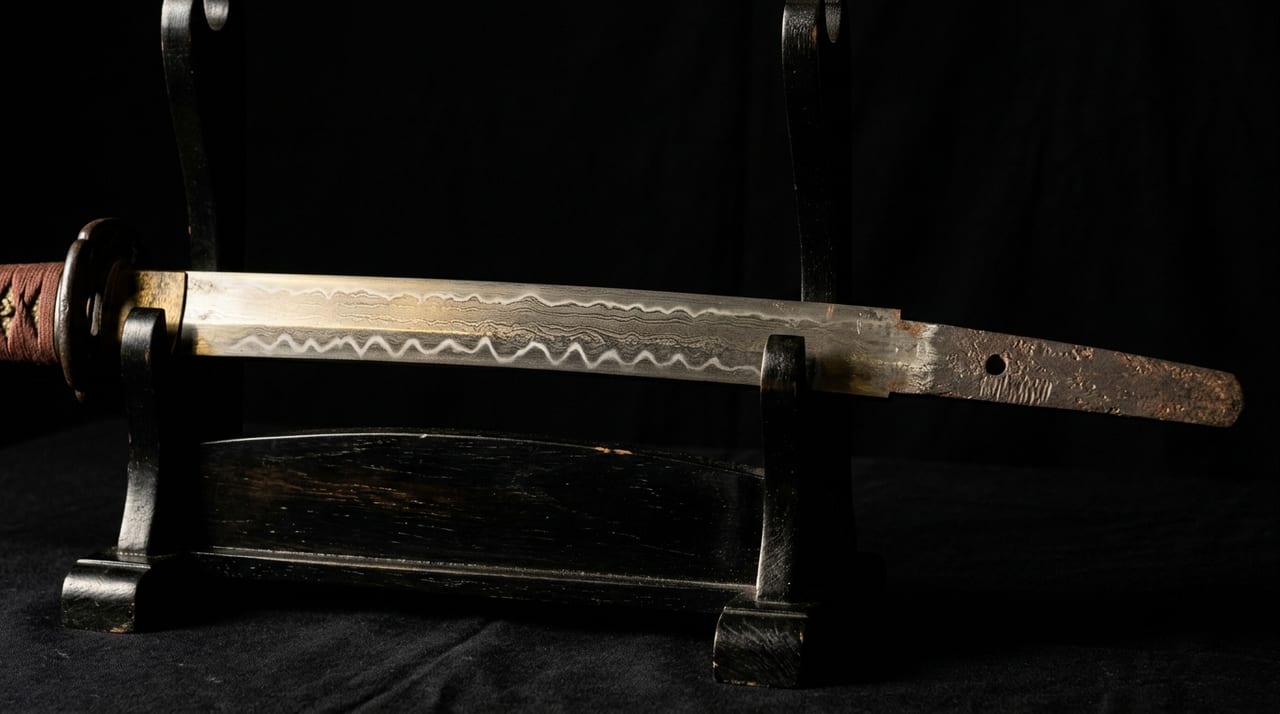
The hamon (temper line) is the pattern produced by yaki-ire (quenching) of the blade, and is said to be the part where each tōkō's individual character is most strongly expressed. Broadly divided, it falls into suguha, gunome, chōji-ba, and midareba, but within those there are countless finer subtypes.
What appraisers particularly emphasize is the quality of the particulate activity along the edge of the hamon.
- Nie-dominant: The particles are coarse, with a brightness vivid enough to confirm individual grains with the naked eye. Common in Sōshū-den swords; chikei also mixes into the jigane, giving an overall powerful impression.
- Nioi-dominant: The particles are fine, spreading like mist, and appear as a soft band of light. Common in Bizen-den swords, forming a calm and refined hamon.
The difference in quality between nie and nioi is difficult to convey in photographs, and can only be discerned by tilting the actual sword at an angle while applying light to it. For this reason, the accumulation of repeated hands-on experience is indispensable in appraisal.
The manner in which the bōshi (temper line in the point) — the tip portion of the blade — is subjected to yaki-ire is also one of the points of focus. The shape of the bōshi — how the hamon settles at the kissaki (point): whether it turns back in a large, rounded manner, closes sharply in a small one, or returns at length — shows certain tendencies by tōkō and school. Combining the overall character of the hamon with the bōshi allows one to verify correspondences to a specific school or period with even greater accuracy.
Nakago Shape and Yasurime — Traces That Remain Even When the Mei Is Gone
Even a nakago from which the mei has been lost retains much information. First, the shape of the nakagojiri tends to vary by school and period, and multiple forms are distinguished, such as "kurijiri," "iriyamagata," "kengata," and "funasokokata."
Next, the yasurime (file marks) — the linear finishing pattern applied to the surface of the nakago — is said to tend to show each tōkō's habitual angle and depth of cut. Types include "katte-sagari," "suji-chigai," and "kesho-yasuri," and there are tendencies in the yasurime favored by specific schools.
The number, position, and shape of mekugi-ana (mekugi holes) are also consulted. Swords that have undergone modifications often have multiple mekugi-ana, and these themselves serve as material for estimating the period and history of use.
Furthermore, the color and texture of the rust that has naturally formed on the nakago over years of preservation also serves as supplementary material for age estimation. In an ubu nakago, all of this information is preserved together, so comprehensive observation of the nakago alone can sometimes enable a certain degree of period and lineage estimation even without a mei. On the other hand, in a nakago that has undergone suriage, much of the information on the nakago side is lost, so judgment must focus on the blade-side elements such as jigane, hamon, and sugata.
Narrowing Down from the Gokaden — The Sequence of Reasoning in Appraisal and Institutional Support
In the appraisal of mumei blades, the basic approach is not to leap directly from individual characteristics to "this tōkō," but to follow a sequence of reasoning that narrows down step by step.
- Grasping the sugata and period character: From the overall sori and construction of the sword, a rough period range (Kamakura, Nanbokuchō, Muromachi, Edo, etc.) is estimated.
- Identifying the tradition: From the quality of the jigane and hamon, one narrows down which of Yamashiro-den, Yamato-den, Bizen-den, Sōshū-den, or Mino-den it is closest to.
- Narrowing to school and lineage: Which branch within the tradition it is closest to is considered based on the details of the hamon, the bōshi, and the shape of the nakago.
- Estimating an individual mei (where possible): Only when consistency across multiple elements is confirmed does the appraisal advance to a more definitive conclusion such as "work of the such-and-such school" or "the possibility of attribution to such-and-such."
The conclusions reached through this process can receive official backing in the form of a kanteisho (appraisal certificate) issued by a specialist institution. Within Japan, the public interest incorporated foundation NBTHK (Society for the Preservation of Japanese Art Swords) is the leading certification body, certifying the authenticity, period, and maker of swords under graded categories such as Hozon Tōken, Tokubetsu Hozon Tōken, Jūyō Tōken, and Tokubetsu Jūyō Tōken. Even for a mumei sword, lineage or an individual attribution may be certified in the form of "such-and-such school" or "attributed to such-and-such" based on the comprehensive characteristics of jigane, hamon, sugata, and nakago; on the other hand, when evidence is insufficient, only the period and province of origin are recorded, with the sword remaining "mumei."
The kanteisho is ultimately a record of the expert panel's combined judgment and is not an immutable proof, but it is said to carry higher objectivity than an individual's assessment, having passed through consideration by multiple specialists. When handling a mumei blade, confirming the presence and content of such a kanteisho is an important step in understanding the sword's provenance and value.
Conclusion — The Essence of Appraisal: Layering Multiple Clues
Appraisal of a mumei blade is a cumulative process that begins with determining whether the nakago is ubu or has undergone suriage, then layers multiple clues — the texture of the jigane, the yaki-ire of the hamon and bōshi, the sugata, and the shape of the nakago and yasurime — narrowing down step by step from within the broad framework of the Gokaden (five traditions). The fact that no single characteristic can yield a definitive conclusion, and that judgment is built up while confirming the consistency of multiple elements — this is the essence of appraisal, an art that demands long years of experience and knowledge.
The absence of a mei is not a deficiency but also a trace of the history the sword has traveled. If one considers that the skill of the tōkō of old lies hidden beyond the mei lost to suriage, the time spent appreciating a mumei blade becomes a richly imaginative experience rather than a diminished one. Also see this site's columns on the fundamental perspective of appraisal that comprehensively evaluates jigane, hamon, sugata, and mei and a comparison of jigane by each of the Gokaden traditions.