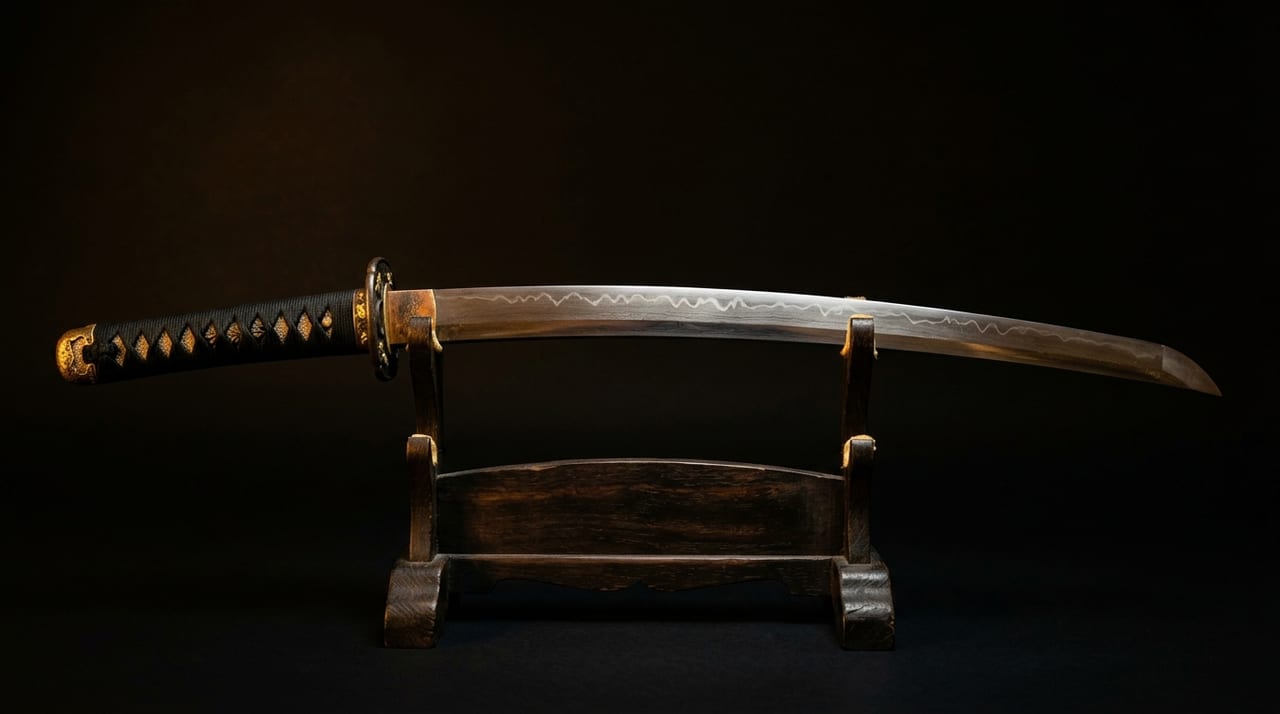
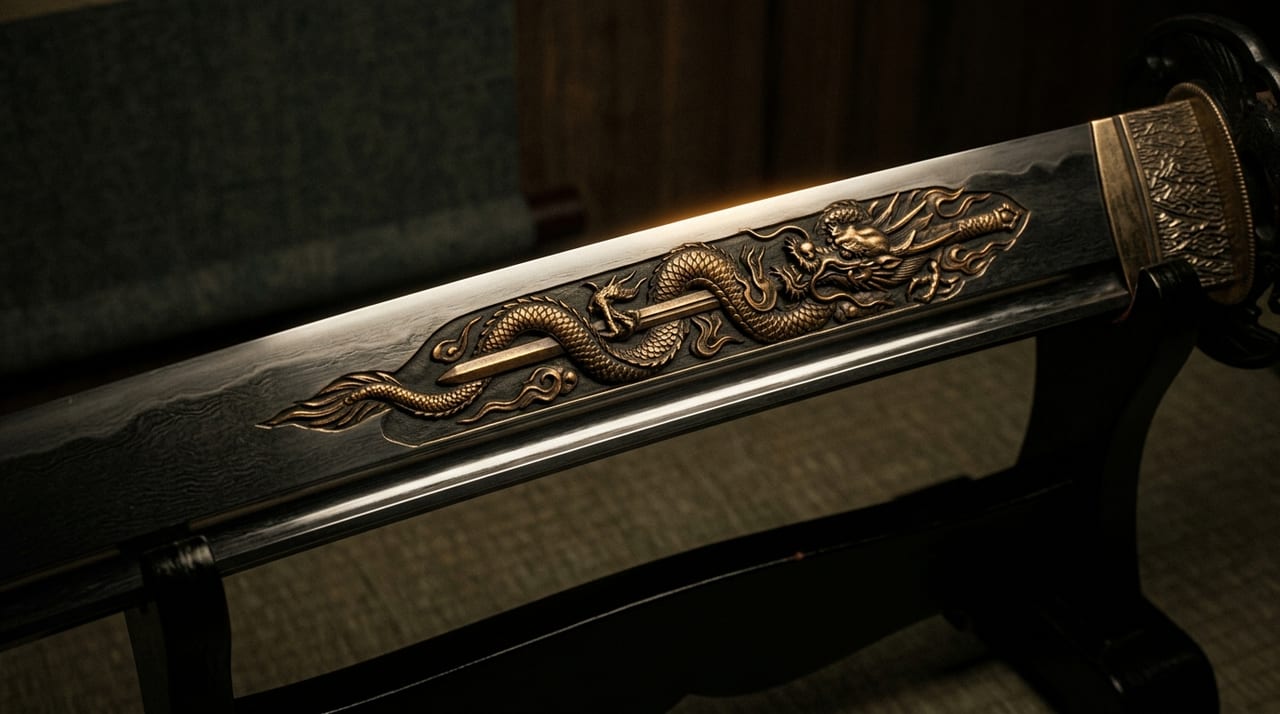
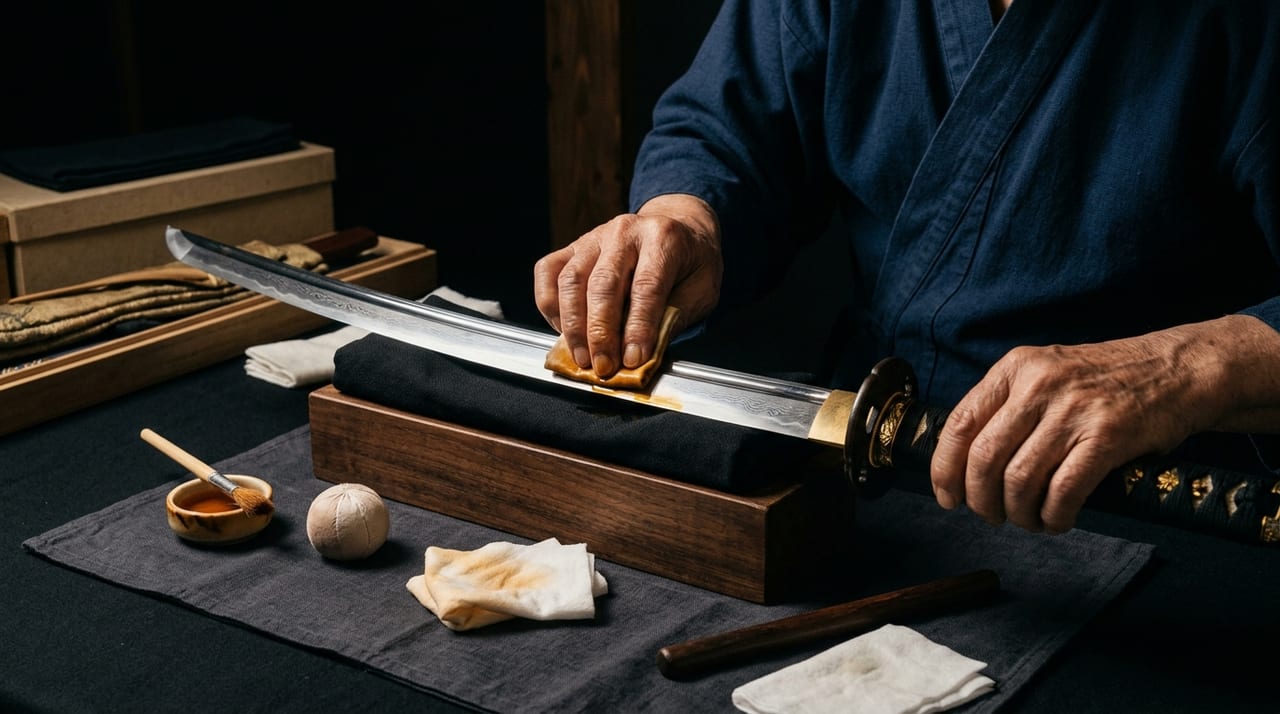
Nihontō Appraisal Value Standards — A Practical Framework for Comprehensive Evaluation of Jigane, Hamon, Sugata, and Mei
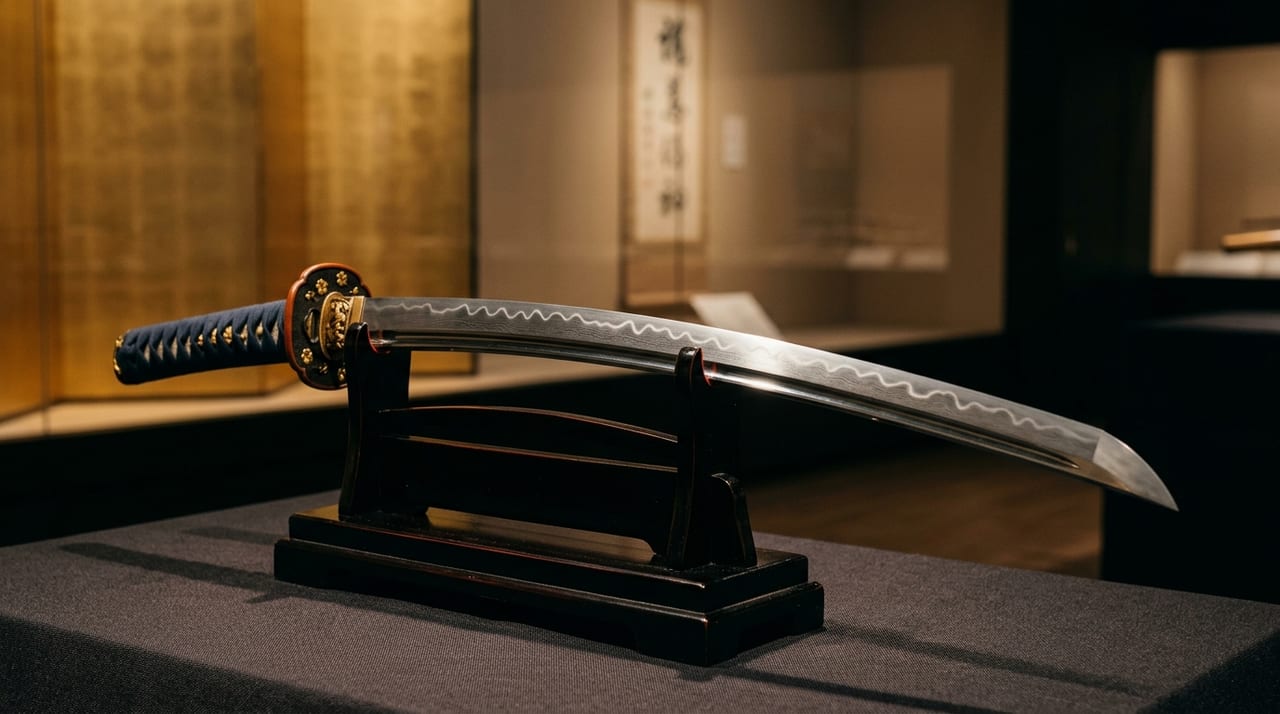 * Image is for illustrative purposes only.
Table of Contents
What Is Appraisal — A Composite Art That Cannot Be Evaluated by a Single Indicator
It is difficult to reduce the value of nihontō to a simple binary of "high or low" or "genuine or fake." A sword has at least four independent axes of evaluation — jigane, hamon, sugata, and mei — and its overall value is determined by the combination of quality across each. Even if a blade bears a mei, an undistinguished hamon will lower the appraisal. Conversely, a mumei blade with outstanding jigane and hamon may be highly regarded as a "mumei Jūyō." This article organizes the meaning of each of the four axes and presents a framework for structuring actual appraisal thinking.
Axis One: Jigane — Quality and Character of the Steel
Jigane refers to the blade surface apart from the hamon, and is a concentrated expression of the tōkō's tanren technique and the properties of the steel used. There are three main points of evaluation.
Type and quality of kitae-hada. Forging grains such as itame, mokume, masame, and ayasugi-hada each have characteristics specific to their school. For example, the Rai School is known for its fine ko-itame, and the Gassan School for its ayasugi-hada. Being well-ordered without disruption in the kitae-hada, or displaying the school's typical characteristics, are conditions for a high appraisal.
Chikei and ji-nie. The richness of the fine luminosity appearing in the jigane — ji-nie being the gleam of martensite particles, chikei being the bright points along forging lines — indicates the precision of the steel. A blade with fine, uniformly distributed ji-nie is highly regarded as a "finely forged" work.
Tone and translucency. The color of the jigane, which changes according to the viewing angle, is described with terms such as utsuri and "luster." The chōji-utsuri of Bizen-den and the distinctive luster of Sōshū-den are important indicators in jigane evaluation.
Axis Two: Hamon — The Sculptural Art Born from Yaki-ire
The hamon is the pattern along the edge created in the yaki-ire process and is said to be the aesthetic heart of the nihontō. The axes of evaluation are three: form, activity, and refinement.
Form (shape of the hamon). The basic forms of the hamon — suguha, notare, chōji, gunome, and others — serve as grounds for identifying the school and period. The more closely a blade displays a typical form, the more highly it is evaluated for its correspondence with representative works of the school.
Activity (hataraki). The accompanying phenomena appearing within the hamon — nie, nioi, kinsuji, sunagashi, uchinoke, and others — are called "hataraki." The more abundantly these appear, the more the blade is said to have "rich hataraki," and this is regarded as a mark of high quality.
Refinement (hin'i). A qualitative assessment referring to the overall uniformity, rhythm, and artistic unity of the hamon. Just as the same chōji hamon may be described as "refined chōji" or "rough chōji," a comprehensive judgment by an experienced appraisal eye is required.
Axis Three: Sugata — The Overall Form of the Blade and Its Period Character
Sugata is the aggregate of external measurements such as the blade's length, sori, motohaba, sakihaba, and kissaki shape, and reflects the period and intended use. There are two main appraisal standards.
Period consistency. Each period has its typical sugata. The grand sugata with a large kissaki of the late Kamakura period, the slender sugata with inward sori of the Muromachi period, the long and bold sugata of the Momoyama period… The key check is whether the sugata of the sword at hand is consistent with its attributed period classification. When the period and sugata are at variance, the possibility of later suriage or a false mei arises.
Balance and completeness. The formal completeness — including whether the ratio of motohaba to sakihaba (and the depth of koshi-zori) maintains good proportion and whether the kissaki shape is undamaged — is also factored into the appraisal. Blades that have undergone repeated repairs, polishing, and corrections over a long history may lose their balance.
Axis Four: Mei — The Tōkō's Signature and Provenance
Mei is the tōkō's signature engraved on the nakago and serves as the basis for identifying the maker and confirming provenance. However, there is a principle in appraisal that the mei alone is not treated as independent evidence.
Genuine mei versus false mei and later mei. The authenticity of a mei is judged by comprehensively examining the calligraphic style, consistency with the yasurime, and any discrepancy with the oxidation state of the nakago. When a kanteisho (such as from the NBTHK) is included, it serves as a confirmation point, but the reliability of the kanteisho itself varies by issuing body and grade. This point is thoroughly organized in Types of Sword Kanteisho and Their Reliability — Appraisal Standards of Major Bodies Including NBTHK and NTHK, and How to Use Them in Transactions.
Treatment of mumei blades. Mumei blades are attributed through "kiwame," meaning they are assessed as "believed to be the work of [maker's name]." Those designated as mumei Jūyō Tōken may hold value equal to or exceeding that of signed blades. Signed and Unsigned Nihontō — How the Presence or Absence of Mei Affects Value and Appraisal is also a useful reference for how the presence or absence of a mei functions as an appraisal axis.
Comprehensive Evaluation: A Practical Perspective for Integrating the Four Axes
In actual appraisal, the four axes are not scored independently; instead, they are judged in an integrated manner from the perspective of consistency — "how far does this deviate from the typical example of its period and school?" Concretely, the following checks are performed.
- Does the kitae-hada of the jigane correspond to the typical characteristics of the declared (or suspected) school?
- Do the form and hataraki of the hamon resemble representative works of the same school and period?
- Does the period classification indicated by the sugata agree with the mei (or estimated period)?
- Are the calligraphic style, placement, and depth of the mei unnatural in comparison with other examples of genuine mei?
When these four points are consistent, the likelihood of a "typical authentic work" increases; when any point diverges, the judgment becomes "requires closer examination." Even if a blade scores highly on a single axis, if the others are inconsistent the overall appraisal falls — this is the essential complexity of nihontō appraisal.
Conclusion: The Appraisal Eye Is an Eye for Consistency
The framework for comprehensively evaluating jigane, hamon, sugata, and mei provides a "form" for appraisal. However, knowing the form and developing one's eye are two different things. The foundation of an appraisal eye is built by actually examining many genuine blades and internalizing the typical examples and exceptions for each axis. It is only by continuing to attend exhibitions at the Japanese Sword Museum, appraisal meetings held around the country, and cross-referencing with illustrations in specialist publications that the framework becomes a living tool for judgment. Even when comparing many blades in an online catalog, simply viewing them with the four axes in mind significantly changes the insights one can gain.