Appreciating hi (grooves) and horimono (carvings) on nihontō — Reading the decorative beauty of bōhi, Kurikara, and Fudō Myōō
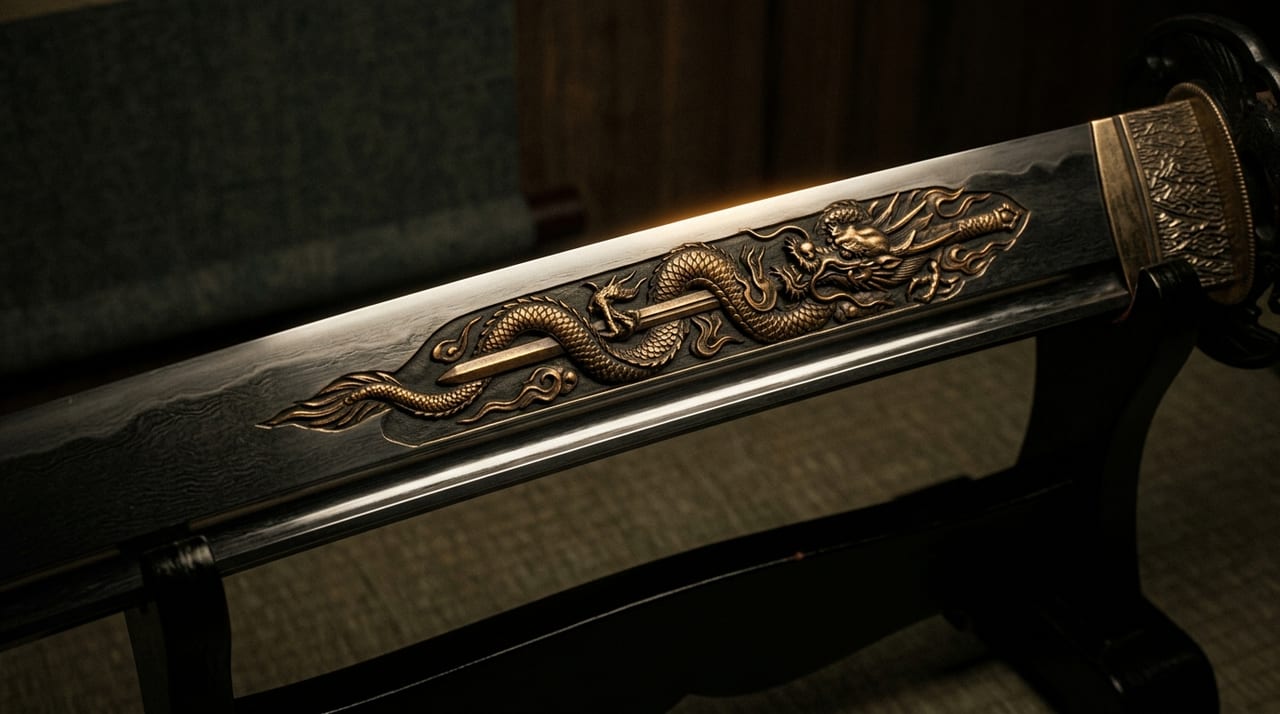 * Image is for illustrative purposes only.
Table of Contents
hi and horimono — The Two Major Elements of Blade Decoration
Looking closely at the blade of a nihontō, one may find grooves and carvings applied in addition to the hamon (temper line) and jigane (steel of the blade surface). These are called hi and horimono, and they are as important an object of appreciation in sword connoisseurship as the hamon and jigane.
Hi are grooves cut into the blade, combining functional aspects such as material savings, weight reduction, and acoustic effect with a decorative aspect that enhances the aesthetic harmony of the blade. Horimono are images with religious and ritual significance — such as dragons, Kurikara, Fudō Myōō, and Sanskrit characters — carved directly into the blade.
Types of hi and How to Appreciate Them
The form of hi varies according to period, school, and commission. The main types are summarized below.
- bōhi: The most common form, in which a single narrow groove runs near the mune (back of the blade). It is said that swinging a sword with bōhi produces a "swish" sound, and that the groove also serves a wind-cutting function. The width, depth, and positions of the start and end points differ by tōkō (swordsmith).
- futasuji-hi: A form in which a thin secondary groove (soehi) is added below the bōhi. More decorative, it reveals the technical skill of the tōkō (swordsmith).
- koshi-hi: A short groove entered only in the lower part of the blade (near the mune-machi). Compound forms such as "koshi-hi with soehi" also exist.
- kakinagashi: A form in which the groove does not extend to near the kissaki (point) but fades away partway. It gives an elegant impression.
When appreciating hi, paying attention to the shape of the start and end points (whether "maru-dome" or "ken-dome," etc.), the distance from the mune, and the uniformity of depth will reveal the skill of the tōkō (swordsmith).
Types of horimono and Their Religious Background
Horimono were carved into the blade to embody the spiritual foundation and prayers of the warrior. The main types and their meanings are as follows.
- Kurikara: An image of a dragon coiling around the sharp sword of Fudō Myōō, this is the most widely seen horimono on nihontō. Also called "Kurikara-ryū," it is depicted in a composition of a dragon swallowing (or coiling around) a sword. It is said to have the spiritual power to sever evil and dispel wickedness, and was carved as a prayer for the warrior's protection.
- Fudō Myōō: A myōō of esoteric Buddhism, depicted in a wrathful form holding a sword in the right hand and a rope (kensaku) in the left. Carving Fudō Myōō into the blade was intended to imbue the sword itself with sacred power. The intricate carving based on the iconography of the Garbhadhatu and Vajradhatu mandalas required a level of skill approaching that of a Buddhist sculptor.
- bonji: Sanskrit characters representing buddhas, bodhisattvas, and myōō, carved as bīja (seed syllables). The most common are "Kān," the bīja of Fudō Myōō, and "Man," that of Mañjuśrī. Though simple, they were favored by warriors as symbols that heightened the spiritual power of the sword.
- gomabashi: A rod-shaped carving modeled on the fire tongs used in goma rituals, associated with prayer and ritual practice. It is often carved in combination with Kurikara and Fudō Myōō motifs.
The Craft of horimono — tōshō and horimono-shi
Horimono on the blade may be executed by the tōshō (swordsmith) himself or by specialist craftsmen (horimono-shi). Particularly intricate Fudō Myōō carvings and three-dimensional Kurikara-ryū were often entrusted to independent craftsmen called horimono-shi.
The techniques of horimono are diverse — katakiri-bori, ke-bori, maru-bori, taka-bori, and more — and the quality of a work is determined by the power of depiction, the delicacy of the lines, and the handling of three-dimensionality. When appreciating horimono, examining the sharpness of the carved lines, the intricacy of the dragon's scales, and the finish of the background surface (ji) with a magnifying glass (loupe) reveals the level of the craftsman's skill.
Practical Appreciation — Where to Focus
The following summarizes the key points when actually appreciating hi and horimono.
For hi, use the reflection of light to check the finish at the start and end points. Whether the sides of the bōhi are smoothly polished and whether the bottom maintains a uniform depth are the benchmarks of technical level. For horimono, examine the unity of the image and the decisiveness of the lines. The Kurikara carving of a fine work shows the dragon's body movement and the curve of the sword in organic harmony, blending into the blade as part of it even while serving as decoration.
Hi and horimono also excel as an "entry point" to sword appreciation. Appreciating hamon (temper line) and jigane (steel of the blade surface) requires a certain level of experience and discernment, but the forms of hi and the images of horimono are visually easy to understand, making them the ideal objects of appreciation as an introduction to the artistic and spiritual world of the nihontō.
Finding Swords with hi and horimono — Opportunities for Purchase and Appreciation
Swords with hi or horimono are found in large numbers among the inventories of sword fairs and dealers. Swords with only bōhi are relatively common, but those with intricate Kurikara or Fudō Myōō carvings are rare and tend to command high prices even among swords of otherwise comparable condition.
As opportunities for museum appreciation, many kokuhō (National Treasure) and jūyō bunkazai (Important Cultural Property) class swords on display at the Japanese Sword Museum (Ryōgoku, Tokyo) and sword-related museums around the country also include works with horimono. While exhibitions are behind glass, the depth of the hi and the three-dimensionality of the horimono can be brought out by the angle of the lighting. Participating in viewing events is a precious opportunity to hold the sword in one's hands and examine the details directly.
Once one begins looking at nihontō with an awareness of hi and horimono as decorative elements, new discoveries emerge one after another from the same single sword. The world of blade decoration, in which functional beauty and religious belief are fused, makes one appreciate anew the profound depth of the nihontō's appeal.