Signed (Komei) and Unsigned (Mumei) Japanese Swords — How the Presence or Absence of a Mei Affects Value and Appraisal
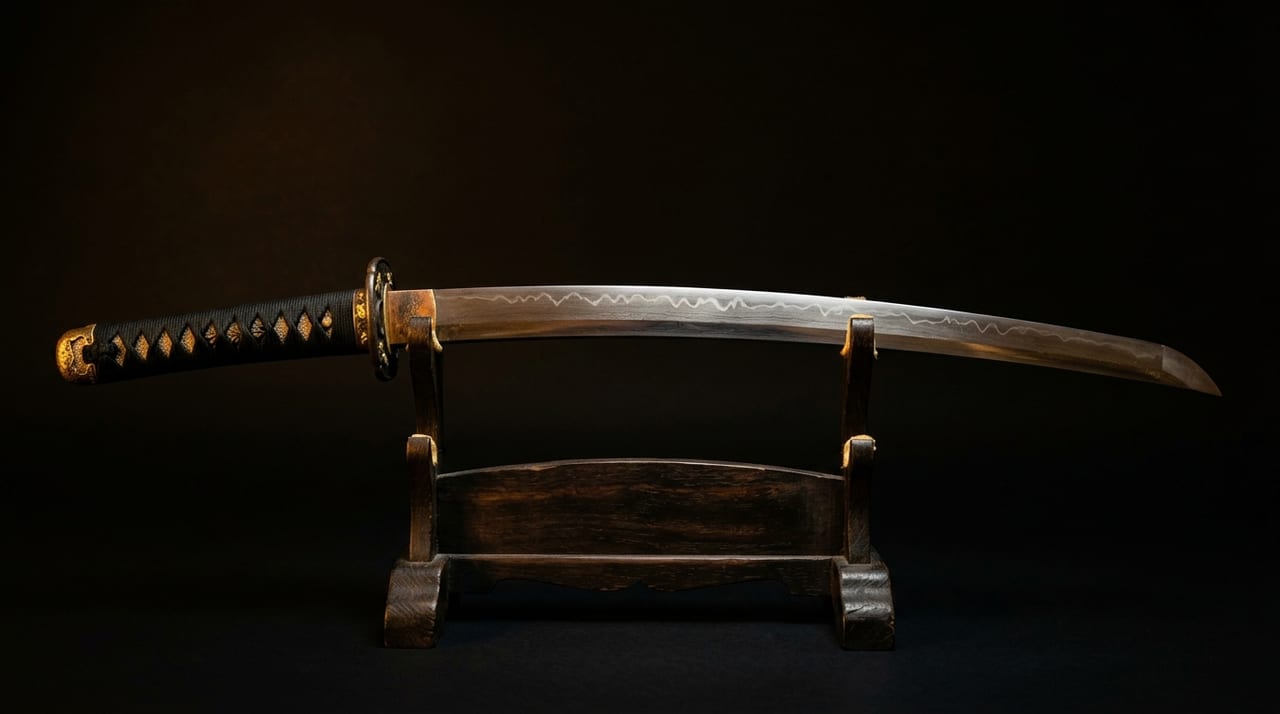 * Image is for illustrative purposes only.
Table of Contents
The Mei as a Sword's "Identity Document"
The mei engraved on the nakago of a Japanese sword is the signature of the tōkō who made it. The mei, inscribed in formats such as "resident of ○○ Province, made by △△" or "peerless △△," carries meaning beyond mere identification. The mei is a declaration by the tōkō of responsibility for their own work, and also proof attesting to the sword's provenance.
On the other hand, swords without a mei — mumei swords — exist in considerable numbers among surviving Japanese swords. The reasons are varied: cases where the mei was lost when the nakago was shortened through suriage (shortening), cases where no mei was intentionally struck, or cases where the mei has rusted or been damaged to the point of illegibility.
Loss of the Mei Through Suriage — From Ōdachi to Uchigatana
The most common cause of mumei swords coming into existence is suriage. The ōdachi and tachi that were extremely popular during the Nanbokuchō period underwent modifications in the Edo period and later, with the nakago cut down to reduce the sword to a more portable uchigatana or wakizashi. When part of the nakago was removed in this process, any mei engraved there was lost along with it.
Notable swords from the Nanbokuchō period in particular tended to be large works, and many became mumei through subsequent suriage. Among the outstanding kotō of the Kamakura period as well, no small number lost their mei through practical modifications carried out from the Sengoku period through the Edo period.
Masterpieces Even Without a Mei — The World of "Meibutsu Mumei"
Being mumei does not necessarily mean lesser value. There exists the phrase "meibutsu mumei" (unsigned named treasure sword), reflecting the fact that many historically renowned swords are unsigned.
Dōjigiri Yasutsuna, counted among the Tenka Goken (the Five Great Swords Under Heaven), is a kokuhō tachi now held at the Tokyo National Museum; the mei struck on its lengthy nakago consists of only the two characters "Yasutsuna," and the details of its period and place of production have been established through the traditions and appraisals surrounding the tōkō. There are also many meibutsu swords, such as Onimaru Kunitsuna, that lost their mei through suriage yet have had their maker identified through tradition and the characteristics of the hamon.
In NBTHK assessments as well, mumei swords are classified and evaluated in forms such as "maker unknown," "attributed to ○○," or "in the style of ○○," with the maker and period estimated from the hamon, jigane, and shape recorded in the kanteisho.
The Presence or Absence of a Mei and Market Pricing
In the sword market, the presence or absence of a mei exerts a significant influence on price formation. In general, among swords of the same quality and period, a signed work tends to command a higher price than a mumei one. This is because the mei allows the maker to be identified, and the reputation and renown of that tōkō is added to the price.
However, the possibility that even a famous tōkō's mei may be a gimei (false mei) complicates appraisal. False-mei swords bearing the names of historically renowned masters — Masamune, Yoshihiro, and Gō Yoshihiro, among others — have been produced in large numbers since the Edo period, and gimei determinations are made even in NBTHK Jūyō Tōken assessments. A sword whose mei is found to be false may have its classification changed to "mumei."
Conversely, a sword that is mumei yet is appraised as the work of a renowned tōkō based on its jigane, hamon, and shape may command a higher price than a work by the same tōkō bearing a gimei. "A Masamune mumei is more reliable than a Masamune with a false mei" is a paradox often spoken of in the sword trade.
The Practice of Reading a Mei — The Pleasures of Appreciating Signed Swords
With a signed sword, appreciating the blade deepens when one deciphers the inscription. The Chinese characters used in inscriptions — such as "province" (kuni), "resident" (ju), "made by" (saku), and "using" (motte) — are largely formulaic, but each tōkō's calligraphic style and idiosyncrasies of character form are expressions of individuality.
There is skill in the way a mei is carved; the manner of incising characters into the nakago with a chisel — the depth, width, and type of chisel used — can sometimes reveal the tōkō's level of mastery. By comparing multiple works by the same tōkō, it can sometimes become possible to estimate the period of production (early, middle, or late work) from changes in the calligraphic style of the mei.
Determining the Authenticity of a Mei — Perspectives for Detecting False Mei
In the appraisal of Japanese swords, determining the authenticity of a mei is an important task. Because swords bearing the mei of renowned masters command high prices, there is a long history of gimei swords — swords with a false mei carved in at a later date — being produced in large numbers since the Edo period.
There are several perspectives for detecting gimei.
- Whether the color of the rust on the mei matches the color of the rust on the nakago as a whole. A mei carved later may show a rust color that differs from the aged patina of the nakago.
- Whether the depth of the carving and the cross-sectional shape of the cut match the carving methods of tōkō of the period.
- Whether the calligraphic style, character forms, and composition of the inscription are consistent with known examples.
NBTHK judges and Hon'ami family appraisers judge the authenticity of a mei from their experience of having examined many actual swords. With advances in digital technology, methods of verifying the period-authenticity of carving marks using X-rays and 3D surface analysis are also beginning to be introduced.
The existence of a mei is part of the appeal of a sword, but the correct path to deepening one's appreciation of Japanese swords over the long term is to avoid excessive reliance on a mei of uncertain authenticity and instead cultivate an eye for appreciating the beauty and craft of the blade itself.
Conclusion — The Mei is a Gateway; the Essence is the Blade
Whether a sword is signed or mumei is an important element of sword evaluation, but it is ultimately nothing more than an entry point for evaluation. The ultimate value of a sword is determined by the quality of the blade itself: the beauty of the jigane, the landscape of the hamon, and the balance of the sori and the overall form (sugata).
The mei gives a guide toward the maker, but the true joy of appreciating Japanese swords lies in not relying too heavily on the mei, and instead developing an eye to appreciate the blade directly.