Complete Guide to Japanese Sword Maintenance Tools — Types and Correct Use of Uchiko, Nuguigami, Chōji Oil, Mekugi Nuki, and Tō Oil
 * Image is for illustrative purposes only.
Table of Contents
Japanese Sword Maintenance — Essential Tools and Practices
To preserve the beauty of a nihontō, regular and proper maintenance is indispensable. Each tool used to prevent rust on the blade and slow the deterioration of the koshirae (mounting) serves a specific purpose. This article explains the main tools needed for maintenance and how to use them correctly.
Uchiko — The First Step to Bringing Out the Hamon
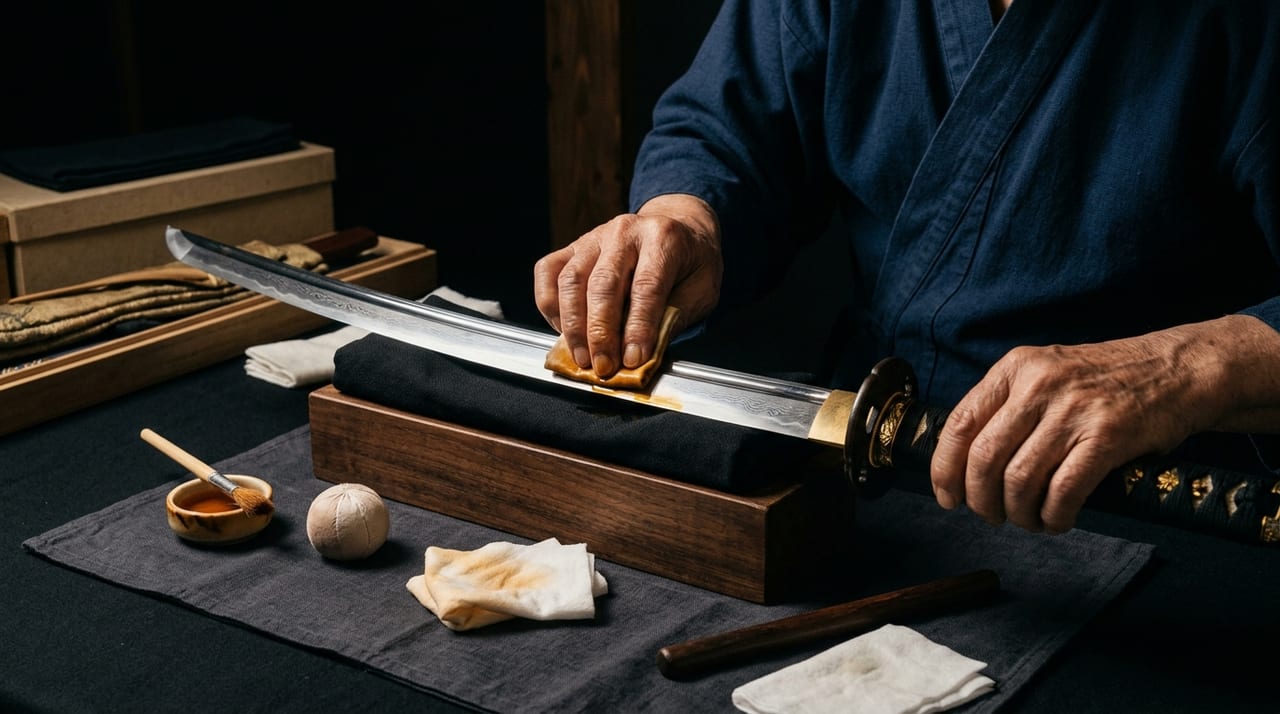
Uchiko is a powder used to remove oil, moisture, and fine dust adhering to the blade. It is generally made from finely ground stone powder, with a smooth, flour-like texture. As the first step in sword maintenance, the uchiko is gently pressed against the entire blade and then wiped away with a soft cloth.
The effect of uchiko is not limited to simple cleaning. When applied correctly, the hamon becomes more clearly visible, and early detection of rust is also made easier. Regular application of uchiko approximately once a month is recommended.
Nuguigami — Avoiding Microscopic Scratches on the Blade
The paper used for wiping should not be ordinary washi but rather nuguigami, a paper made specifically for swords. Regular paper has coarse fibers that risk scratching the blade. Nuguigami is a specialized product with finely uniform fibers that minimizes friction on the blade.
The correct method is to apply the uchiko first, then place the nuguigami flat against the side of the blade and wipe in a single direction from the base toward the kissaki (point). Back-and-forth motion is strictly prohibited. The edge of the blade should be wiped by folding cloth against it; paper should not be used on the edge.
Chōji Oil — The Key to Rust Prevention
Chōji oil is a natural oil extracted from cloves, with properties ideally suited for preventing rust on nihontō. It has a distinctive fragrance, and this fragrance itself is proof that the sword has been properly maintained. After cleaning with uchiko and nuguigami, chōji oil is applied thinly and evenly across the entire blade.
If too much oil is applied, it instead attracts dust and dirt, soiling the blade. "Thin and even" is the cardinal rule for applying chōji oil. Particular care is needed at the junction between the nakago (tang) and the blade, and at the areas of contact with the koshirae (mounting), as oil tends to penetrate there. After application, excess oil should be wiped away with a clean cloth.
Mekugi Nuki — Periodic Disassembly and Inspection
The koshirae (mounting) of a nihontō secures the blade to the tsuka (hilt) with a small wooden wedge called a mekugi. It is important to periodically remove this mekugi and clean the gap between the blade and the tsuka. The mekugi nuki is the specialized tool used to remove the mekugi.
When the mekugi is removed, the inner surfaces where the blade and tsuka meet should be wiped especially carefully. Moisture and dust collecting there can cause rust and corrosion. The mekugi itself should be replaced with a new one if it has deteriorated. This work is recommended several times a year, particularly at the change of seasons.
Tō Oil — Protection for the Entire Koshirae
Tō oil is used for protecting the wooden parts and metal fittings (tsuba, hilt wrapping, and saya (scabbard)) of the koshirae (mounting). Unlike chōji oil, tō oil is intended not for the blade but for moisture-proofing and preserving the entire koshirae.
Applied to metal fittings in particular, tō oil prevents oxidation and slows the discoloration of copper alloys. Applied to wooden parts, tō oil prevents drying out and reduces the occurrence of cracks and warping.
Maintenance Schedule
The guidelines for regular maintenance are as follows.
- Monthly: Basic cleaning with uchiko and nuguigami
- Every 3 months: Application of chōji oil and inspection of the mekugi
- Every 6 months: Cleaning of the inner blade surfaces using the mekugi nuki, and application of tō oil to the entire koshirae
- Annually: Full inspection by an appraiser, and togi (polishing) or restoration as needed
In particular, during seasons of high humidity (the rainy season and autumn rains) and for a newly purchased sword, more frequent maintenance is required.
The Spirit of Maintenance
Caring for a nihontō is not mere "object management" but a "dialogue" with the sword. Through monthly maintenance, one notices changes in the condition of the blade and can detect early signs of deterioration. It is this kind of continuous observation that is the secret to keeping a sword in good condition for a long time.