Esoteric Buddhism and Japanese Sword-Forging Ritual — The Spiritual Role of Furnace Ceremonies, Auspicious Objects, and Talismanic Inscriptions in the Swordmaking Process
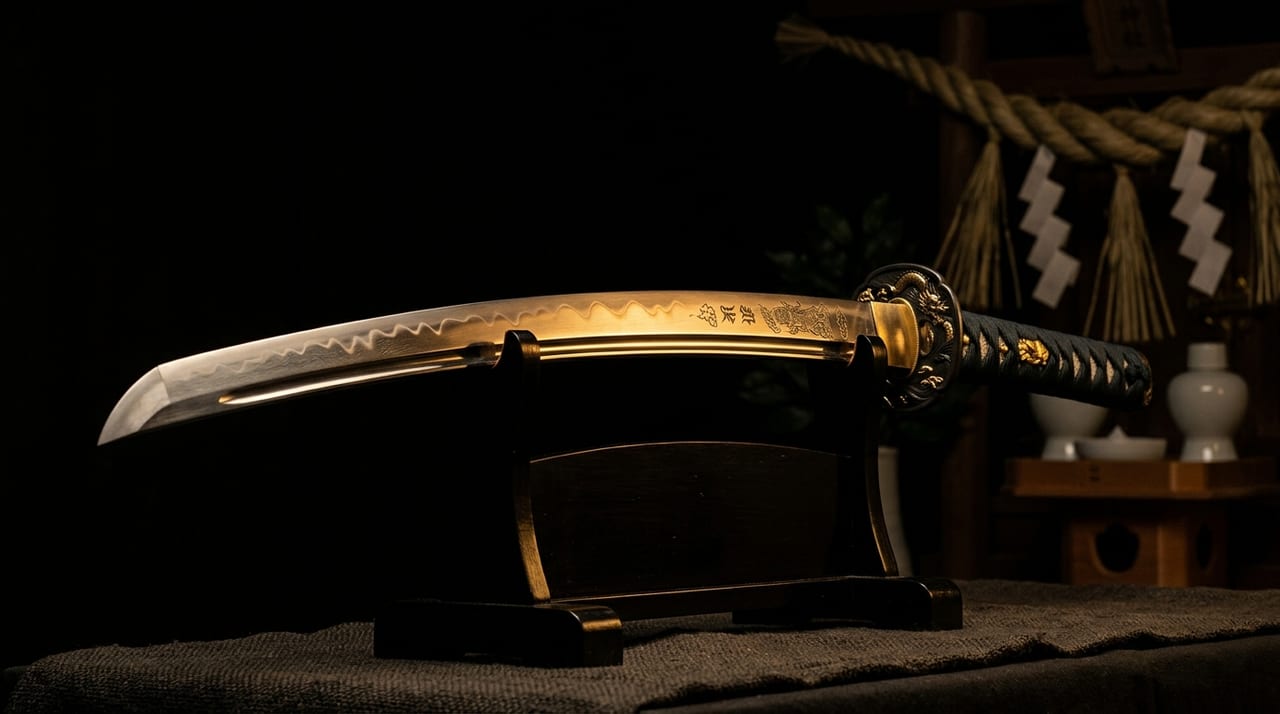 * Image is for illustrative purposes only.
Table of Contents
Japanese Sword Forging Was a "Sacred Profession"
Viewed through modern eyes, the process of making a nihontō is the practice of advanced metallurgical engineering; yet for the tōkō of the medieval period, it was above all a sacred undertaking carried out in collaboration with the gods and buddhas. The kaji-ba (forge) was not a mere workshop but was managed as a consecrated space, and tōkō continued their tanren while purifying themselves and offering prayers to the gods and buddhas.
The relationship between nihontō and religion is clear from the fact that the places where tōkō trained were closely bound to shrines and temples. The Yamato Five Schools — the groups of tōkō from Yamato (Nara) — each operated under the patronage and supervision of influential shrines and temples, and the religious institutions to which each school looked differed as follows.
| School | Patronage / Base |
|---|---|
| Senjuin School | Tōdai-ji |
| Tegai School | Tōdai-ji |
| Taima School | Taima-dera |
| Hōshō School | Independent base |
| Shikkake School | Independent base |
Tōdai-ji and Kōfuku-ji are separate temples and cannot be treated together as belonging to the same lineage. Because the sword itself was an object of offering to the gods and buddhas and also a protective talisman on the battlefield, religious legitimacy was indispensable to its creation.
Concrete Forms of Esoteric Buddhist Ritual
As esoteric Buddhism (the secret Buddhism of Shingon and Tendai) permeated warrior society from the Heian through the Kamakura period, esoteric elements were also incorporated into the forge.
One of the most important rituals was the "ro-biraki (furnace opening)" ceremony. When firing a new furnace for the first time, or before beginning the first work of the new year, the tōkō offered the following items before the furnace and a Shinto priest — or the tōkō himself — intoned the norito:
- Sakaki branches
- White wood nusa (paper streamers)
- Salt
- Rice
- Sake
This ritual is still carried out by some tōkō today, and the first firing using tamahagane is treated as a particularly important religious moment.
The most pronounced surviving influence of esoteric Buddhism is the carving of Sanskrit characters (bonji) on the blade. The seed syllable "Kan," symbolizing Fudō Myōō, and bonji representing Kurikara Ryūō (the Dragon King Kurikara) were carved into blades. These were not mere decoration; they functioned as talismanic inscriptions (jufu) bestowing spiritual protection upon the sword. Kurikara is the dragon coiling around the sword of Fudō Myōō, and by engraving this esoteric Buddhist symbolism — the union of sword and dragon — upon the blade, a weapon was elevated into a sacred talisman.
Talismanic Inscriptions, Auspicious Objects, and the Forge as Space
Religious significance was also embedded in the physical space of the forge. It was common for an image or votive tablet of Fudō Myōō or Inari (known as the god of the forge) to be enshrined at the front of the furnace, so that the eyes of the gods and buddhas were directed toward the work at all times. Entry into the forge was strictly restricted, and those deemed impure — in particular, there existed a custom forbidding women to enter — were barred from the premises. This was a direct application of the esoteric Buddhist concepts of kekkai (consecrated boundary) and purity.
The straw ash used as a welding flux was also invested with meaning beyond its role as a mere chemical flux. The ash from burning rice straw, connected to rice-farming culture, was interpreted as lodging in the sword the blessing of the gods who govern the bounty of the five grains.
There were also ritual conventions for handling tamahagane. Tamahagane, the highest-grade iron material, was treated as a "divine metal," and some tōkō avoided touching it with bare hands. The custom of reciting a brief prayer toward the tamahagane before tanren was observed in various regions well into the modern era.
Yaki-ire and Its Mystical Perception
The stage of the swordmaking process to which the greatest religious and mystical significance was attached was yaki-ire (quenching). In this process — heating the blade in the furnace and then rapidly cooling it in water — the fate of the sword was decided by a single instant of judgment, making it the supreme climax of the work.
Medieval tōkō judged the optimal temperature for yaki-ire by sensory criteria such as "the color of cherry blossoms" or "the color of the sky at dusk." Modern metallurgy specifies a precise temperature range of 650–850 degrees Celsius, but for the tōkō of the time this was intuitive knowledge that could not be fully put into words, transmitted from master to apprentice as secret oral tradition. It was natural that mystical significance came to be attached to this stage.
There is also a tradition of performing yaki-ire at night. There is a practical reason for this — the color of the blade (the color of radiant heat) can be discerned more accurately in darkness — but it was simultaneously invested with religious meaning: separating the work from the "profane" space of daytime and performing the most critical stage within the "sacred" time of night.
The Transformation of Forge Ritual in the Modern Era
After the Meiji period, following the separation of Shinto and Buddhism (Shinbutsu Bunri) and the contraction of the sword-forging industry brought about by the Sword Abolishment Edict (Haitōrei), forge rituals underwent great transformation. Rituals with pronounced esoteric Buddhist character were lost in many regions, and in many cases only Shinto elements survived.
Many tōshō today practice the furnace-opening Shinto ceremony and brief prayers at the start of work, but the form varies from studio to studio. Even in the tōshō training programs organized by the NBTHK, the spiritual and religious aspects fall outside the scope of technical instruction, and each tōshō carries on the personal customs learned from their own master.
Contemporary Swordmaking and Spirituality
Among tōshō today, there are those who, through practices such as the furnace-opening ceremony, regard swordmaking not as mere labor but as an endeavor of confronting the gods and buddhas. However, the thinking and the forms of practice differ from studio to studio and from individual to individual.
Forge ritual is being lost, yet its spiritual core — reverence for the material, veneration of the furnace fire, gratitude that a work has been brought to completion — lives on within the work ethic of modern tōkō. When appreciating a nihontō, holding this spiritual dimension in mind will cause the sword to emerge as something that transcends being a mere weapon or objet d'art.