Types and Reliability of Sword Kanteisho — Examination Standards of Major Organizations Including NBTHK and NTHK, and How to Use Them in Transactions
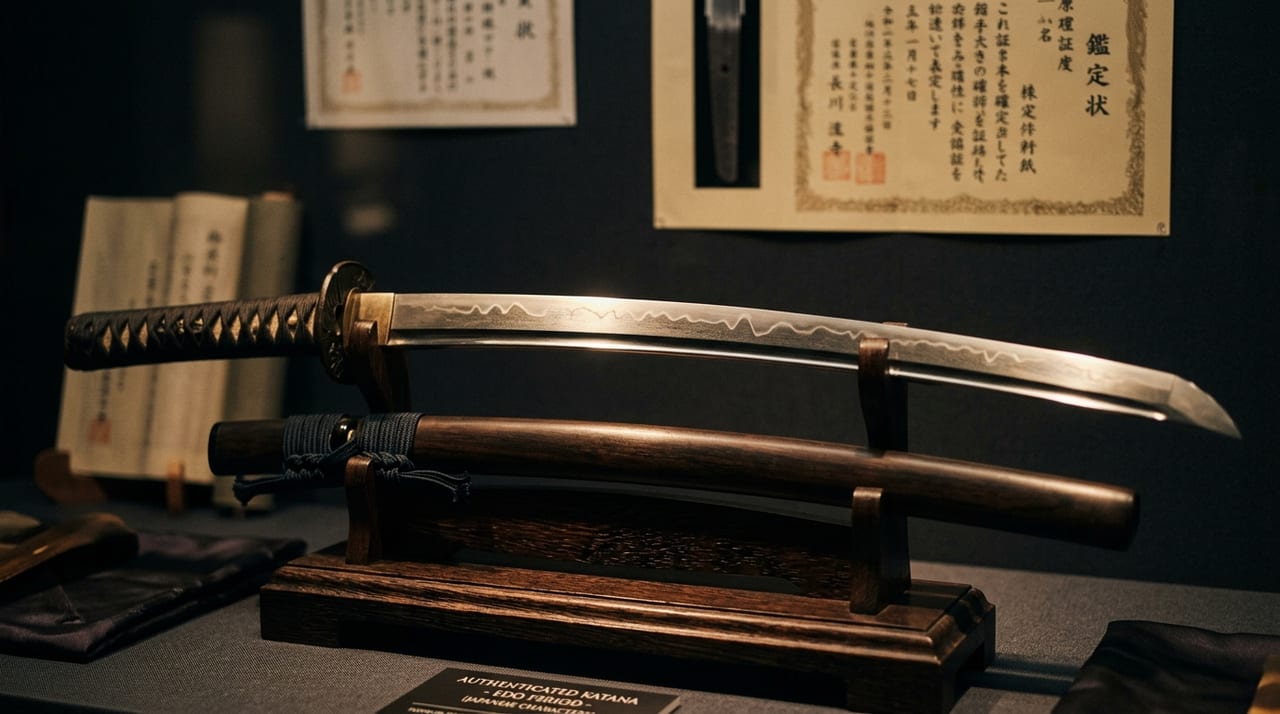 * Image is for illustrative purposes only.
Table of Contents
What Is a Kanteisho?
A kanteisho for a Japanese sword (also referred to as an oshigata or a preservation certificate) is a document recording the results of an examination conducted by an authoritative institution regarding the sword's maker, period, place of origin, and condition. Whether a kanteisho exists and what type it is greatly affects the price, credibility, and marketability when a sword is purchased, sold, exhibited, or inherited, making this essential knowledge for collectors.
In Japan, multiple organizations issue kanteisho, but the most widely recognized is NBTHK (the Society for the Preservation of Japanese Art Swords). Others include NTHK (NPO Nihontō Hozonkai), NBSK (Nihontō Bunka Shinkō Kyōkai), and special appraisals by the Japanese Sword Museum, with each organization differing in the rigor, format, and cost of its examinations.
NBTHK Kanteisho — A Four-Tier Evaluation System
NBTHK is the largest institution for Japanese sword appraisal and issues tiered kanteisho for both the blade and tōsōgu separately. For the blade, four tiers exist from the lowest: Hozon Tōken, Tokubetsu Hozon Tōken, Jūyō Tōken, and Tokubetsu Jūyō Tōken. The content of each tier is as follows.
| Tier | Content |
|---|---|
| Hozon Tōken | Issued to swords judged worthy of preservation as works of art; the first examination level, confirming the sword bears no false mei and is not a forgery |
| Tokubetsu Hozon Tōken | Awarded to swords that have undergone a more rigorous examination and whose tōkō has been identified or whose period and place of origin have been confirmed |
| Jūyō Tōken | Works judged to be of particular importance from the standpoint of sword research or art; available in limited numbers and carrying high market value |
| Tokubetsu Jūyō Tōken | Awarded in the highest-level examination to first-rate works of the kind that may be considered candidates for designation as kokuhō (National Treasure) or jūyō bunkazai (Important Cultural Property) |
Examinations are held several times a year, and since a specialist committee conducts the review, it is not unusual for the process from application to receipt of the certificate to take several months.
For tōsōgu (tsuba, menuki, fuchi-kashira, and the like), a parallel system of Hozon Tōsōgu, Tokubetsu Hozon Tōsōgu, Jūyō Tōsōgu, and Tokubetsu Jūyō Tōsōgu also exists.
NTHK and Other Organizations
NTHK (NPO Nihontō Hozonkai) is the appraisal organization with the second highest name recognition after NBTHK. Its examination committee differs from that of NBTHK and is composed of scholars, sword researchers, and preservation society members. NTHK kanteisho generally take the form of a shinsa shōmeisho or tokubetsu shinsa shōmeisho and are widely accepted among overseas collectors and at sword shows.
NBSK (Nihontō Bunka Shinkō Kyōkai) is a relatively new organization that has focused on developing kanteisho formats suited to export to English-speaking markets. In addition, individual appraisals carried out by the Japanese Sword Museum (Ryōgoku, Tokyo) for specific exhibitions or by request, as well as personal oshigata and written appraisal opinions by prominent researchers, are treated in the market as reference materials.
How to Identify a Missing or Forged Kanteisho
When assessing the reliability of a kanteisho, there are several points to check.
- Script, seal, and paper quality: Confirm that these conform to the official specifications of the issuing organization. NBTHK certificates use distinctive paper and a red seal, and anyone who has handled the genuine article will more readily notice differences from a forgery.
- Cross-checking the certificate number: The serial number or registration number recorded on the certificate can be verified by contacting the issuing organization. NBTHK provides a certificate number verification service, so when doubt arises, confirming directly with them is the surest approach.
- Balance between tier and the actual sword: Experience in judging with a discerning eye whether the tier of the kanteisho is commensurate with the quality of the actual sword is required. There are even paradoxical cases where a sword accompanied by a Hozon Tōken certificate appears to be of Tokubetsu Hozon quality, raising the possibility of obtaining a higher-tier appraisal upon re-examination.
The Role of Kanteisho in Transactions
In actual sales and auction settings, swords accompanied by an NBTHK Tokubetsu Hozon Tōken certificate or higher generally command a higher valuation than comparable pieces without a kanteisho. When a Tokubetsu Jūyō Tōken-class certificate is present, the sword is treated as a top-lot item among sword dealers and auction houses alike.
However, a kanteisho is only "the result of an examination at a given point in time," and if deterioration in storage conditions, improper maintenance, or polishing causes damage to the hamon (temper line) or jigane (steel of the blade surface), the rating may fall upon re-examination. Conversely, there are also cases where new documentary discoveries or comparative research with similar examples lead to an upward revision of the tōkō attribution, resulting in the acquisition of a higher-tier certificate upon re-examination.
As a collector, it is important to develop the habit of comprehensively reading the "type and issuing organization," "year of issue," and "level of detail of the content" of a kanteisho and comparing them against the price. A kanteisho is not only a tool that enhances the value of a sword but also the industry infrastructure that guarantees transparency and trustworthiness in transactions.
Application Procedure and Estimated Costs for a Kanteisho
To obtain a kanteisho, it is necessary to bring the sword in person or submit it by post on a designated examination day. NBTHK holds regular examinations at the Japanese Sword Museum in Ryōgoku, Tokyo; examination fees vary by sword type and tier, but for a Hozon Tōken examination they are in the range of a few thousand to tens of thousands of yen, and for Jūyō examinations they may exceed tens of thousands of yen. Reissuance of a certificate (in case of loss or damage) also requires a fee, and safekeeping the certificate is as important a part of collection management as caring for the sword itself. The examination result is notified on the day or sent by post at a later date, and if the sword passes, the certificate is issued. Even if it does not pass, feedback from the examination committee may be provided, which in itself becomes a learning opportunity for the collector.
Summary
Kanteisho for swords are issued by multiple organizations led by NBTHK and differ in tier, format, and level of trustworthiness. By understanding the four-tier system from Hozon Tōken to Tokubetsu Jūyō Tōken, the positioning of other organizations such as NTHK and NBSK, how to identify forgeries, and how to use kanteisho in transactions, one can conduct the buying, selling, and collecting of Japanese swords more safely and appropriately. Approaching a kanteisho not as "a costly procedure" but as "a storyteller for the sword" is the foundation for building a collection over the long term.