Shinto and the Japanese Sword——The Spiritual Culture Unique to Japan Nurtured by Sacred Regalia, Dedicated Blades, and Sword Veneration
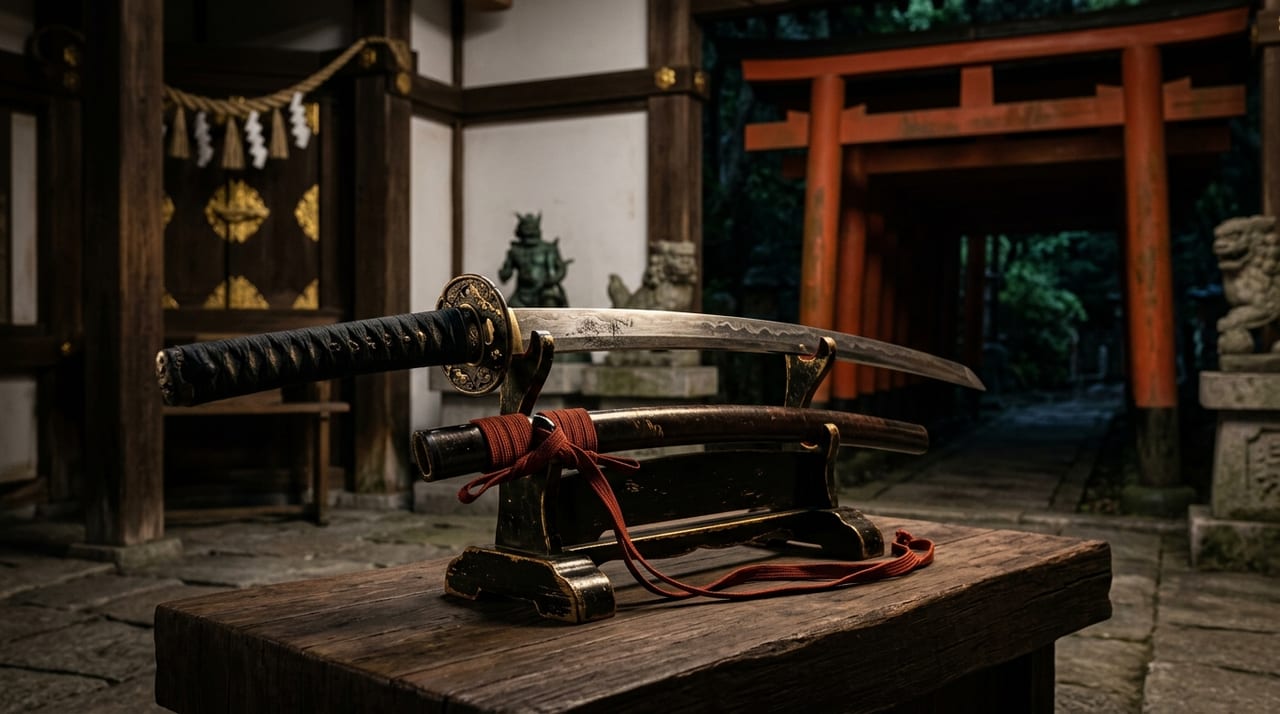 * Image is for illustrative purposes only.
Table of Contents
The Three Sacred Regalia and the Spirituality of the Sword
In Japanese Shinto, the sword is one of the most fundamental sacred objects. Among the "Three Sacred Regalia" passed down in the imperial family — the Yata no Kagami, the Yasakani no Magatama, and the Kusanagi-no-Tsurugi (also called the Ame-no-Murakumo-no-Tsurugi) — the Kusanagi-no-Tsurugi embodies the core of a belief unique to Japan that positions the sword as a symbol of divine will and power.
According to the Nihon Shoki, the Kusanagi-no-Tsurugi was obtained from inside the body of Yamata no Orochi when Susanoo-no-Mikoto slew it, and was later bestowed upon Yamato Takeru no Mikoto, who used it in a moment of crisis. This sword is enshrined to this day at Atsuta Shrine (Nagoya City, Aichi Prefecture) as a sacred object, and is not seen by the public as it is an object of veneration.
As symbolized by the Three Sacred Regalia, the sword has been understood in Japanese Shinto as a manifestation of "divine power that dispels evil spirits and maintains order." This idea deeply influenced later Japanese sword culture, giving rise to the custom of treating the sword not merely as a weapon but as a spiritual guardian.
The History and Significance of Dedicated Blades
The custom of dedicating swords to shrines and temples has continued since ancient times. Dedicated blades (hōnōtō) were presented to shrines and temples as offerings to the gods, as well as tokens of prayers and thanksgiving. In the Nara period, ceremonial swords in the form known as ōtachi-sō were produced at court, and records survive of their dedication to powerful shrines throughout the land, including Kasuga Taisha, Kashima Jingū, and Isonokami Jingū.
Isonokami Jingū (Tenri City, Nara Prefecture) is one of the shrines with a particularly deep connection to Japanese sword culture, and holds a large number of ancient swords including the Nanatsusaya-no-Tachi. The Nanatsusaya-no-Tachi is a distinctive sword with six branching prongs, gifted from Baekje in the 4th century, and has been transmitted through the generations carrying the significance of a sacred regalia.
As the warrior class rose to prominence in the Heian and Kamakura periods, the culture of dedicated blades also developed in the context of samurai service and vows. It became customary to dedicate a sword before a shrine before setting off to battle, praying for victory and long-lasting martial fortune. There are also many examples of swords being dedicated to shrines after battle as offerings of gratitude, and to this day fine blades from those eras are preserved as shrine treasures at shrines throughout Japan.
Sword Smithing and Shinto Ritual
Shinto elements are also deeply rooted in the work of the tōshō (swordsmith). A small shrine enshrining the Kamado-gami or the kaji deity (Kanayago-gami) is installed in the forge, and rituals of prayer and purification have been performed before and after work. The custom of the tōshō approaching their work dressed in white ceremonial garb is an expression of the belief that regards smithing as a sacred act.
Even today, the Society for the Preservation of Japanese Art Swords and the All Japan Swordsmiths' Association hold religious ceremonies for the dedication of tamahagane and sword-forging dedications at sites throughout Japan. The sword exhibitions and dedications at Yasukuni Shrine are also well known, and events in which tōkō (swordsmiths) enter the shrine precincts to perform live tanren (forging) demonstrations attract many worshippers and collectors.
Fine Blades Preserved Today at Shrines
At shrines throughout Japan, historically important swords are still preserved today as shrine treasures.
| Shrine | Notable Holdings |
|---|---|
| Kasuga Taisha (Nara Prefecture) | Holds a large number of tachi from the Heian period, including items designated as kokuhō (National Treasures) |
| Tsurugaoka Hachimangū (Kamakura City, Kanagawa Prefecture) | Preserves swords with deep ties to the Kamakura shogunate |
| Atsuta Shrine | In addition to the aforementioned Kusanagi-no-Tsurugi, holds many other important works |
These swords held by shrines and temples do not circulate on the open market and cannot be acquired, but they may sometimes be viewed through opportunities for public display (treasure halls and special exhibitions). Sword exhibitions at shrines offer collectors and researchers a distinctive emotional experience in that they present the swords within a "context of faith" different from that of a sword art museum.
Sword Veneration Continuing into the Present Day
Even today, the sacred conception imbued in the sword lives on throughout Japanese culture. The spiritual symbolism of swords has permeated various aspects of everyday life and culture.
- The futokoro-gatana carried with the shiromuku at weddings
- The shape of the kinpei used in the gohei (hei) of New Year's decorations
- The daitō dedicated at sumo's dohyō matsuri
Furthermore, digital content such as "Touken Ranbu" has created new contexts for sword veneration, and younger generations have come to engage with stories in which they discover the spirituality of swords as saniwa. This can also be seen as a renewal of sword veneration in a modern form, and is an intriguing phenomenon in which the Shinto worldview merges with 21st-century pop culture.
Sacred Swords and Guntō——Transformations of the Modern Era
After the Meiji Restoration, the samurai culture of wearing swords came to a legal end with the Sword Abolishment Edict (Haitōrei) of 1876, yet the ties between Shinto and swords continued unbroken. Centered on Yasukuni Shrine, a modern custom took shape in which soldiers dedicated swords while praying for martial fortune and longevity, and the guntō of the army and navy were treated as a kind of sacred proof.
After the war, the Shinto context of swords temporarily receded, but sword dedication and appreciation events at shrines were revived, and even today sword dedication ceremonies are held every year at sites throughout Japan. The relationship between Shinto and the Japanese sword lives on at the heart of Japanese culture, even as it has undergone historical transformation. When collectors visit the treasure halls of shrines, directing their thoughts not only to the historical background of the displayed swords but also to the meaning of those swords having been placed in a setting of faith, the depth of appreciation increases enormously.
Conclusion
The bond between Shinto and the Japanese sword continues in multiple layers, from the Three Sacred Regalia as the supreme sacred objects, through dedicated blades, smithing rituals, shrine-held swords, and modern culture. Rather than viewing the Japanese sword solely as a "weapon" or a "work of art," understanding it as a product of a spiritual culture unique to Japan allows one to receive its depth and breadth all the more richly.