Why Tsuba Dating Is Difficult
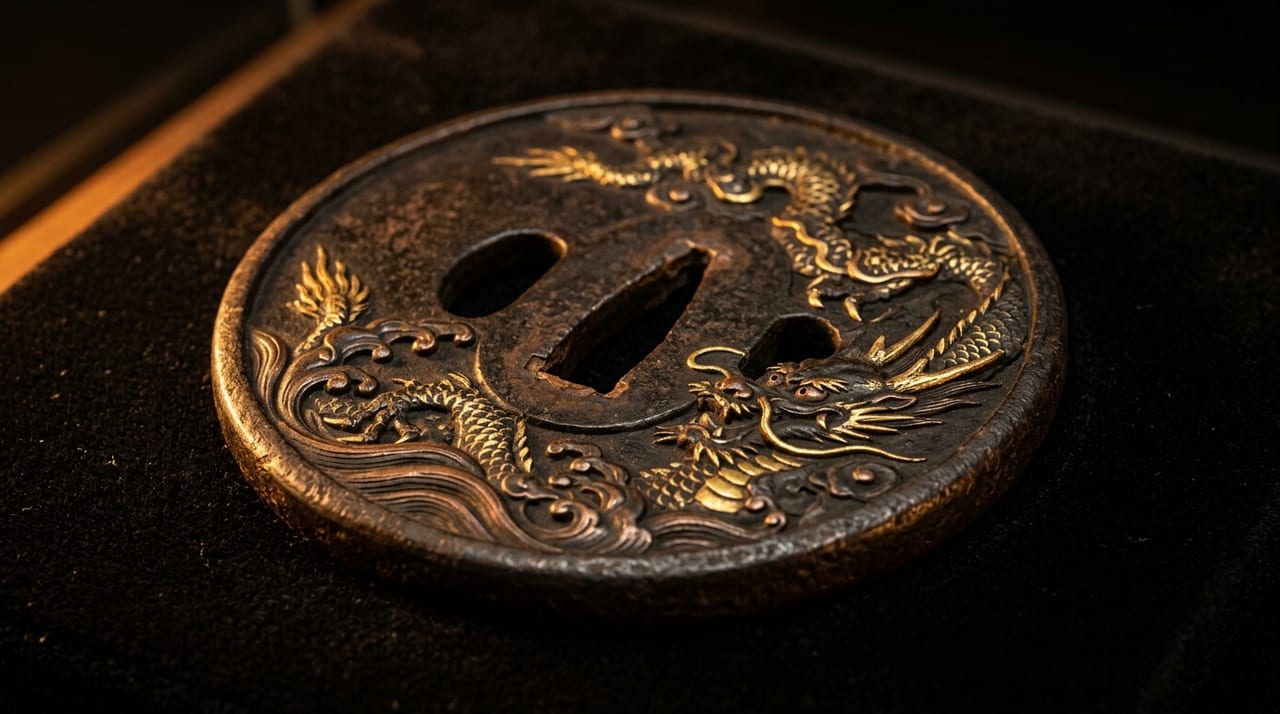
Compared to the blade itself, the manufacturing date of a tsuba (鐔) is easily overlooked. While the blade offers multiple chronological indicators—signature, file marks, oxidation of the tang—most tsuba are unsigned, and rust patina can shift with later maintenance and storage conditions. Yet physical features such as the forging character of the ground surface, the texture of rust, the finish of the ears (outer rim), and overall thickness directly reflect the technical level and aesthetic preferences of their era, and to a trained eye yield genuine period markers.
This discussion divides the evidence into three phases—early Edo, mid-Edo, and late Edo to Bakumatsu—and organizes each period's characteristics as a checklist. Since tsuba vary by school and region of origin, what follows represents general trends only. Individual judgments should consult expert appraisal.
Early Edo Period (early 17th to late 17th century): Characteristics
Ground Surface and Materials
- In iron tsuba, the forging marks are typically coarse, with clear traces of hammer work visible in the ground metal.
- Examples using nanban iron (南蛮鉄) are said to have a slightly rough, distinctively colored ground surface.
- Red copper (shakudo / 赤銅) and shibuichi (四分一) work was dominated by the Gotō family (後藤家) and Shoami school (正阿弥派), whose ground metal is uniformly refined and precise.
Rust Patina Character
- On iron tsuba, nearly four centuries of natural rust have stabilized into a deep, blackish layer. The patina resists flaking when rubbed and often shows a layered cross-section.
- The rust color tends toward dark brown to jet black. Red rust (ferric oxide) floating on the surface may indicate later water infiltration.
Ear (Rim) Shape
- Ears are typically finished rounded and thick, with an elliptical to kamaboko (fish-paste cake) profile in section.
- Sharp-cornered ears (kadomi / 角耳) are common in the late Edo period and rare in the early phase.
- When small openwork is applied, coarse file marks may remain at the ear edge.
Thickness and Weight
- An era when practical use as protective gear remained paramount; most examples are thick overall. Thin, refined work is uncommon.
- Substantial weight; handling them often yields a solid, weighty feel.
Mid-Edo Period (early 18th to late 18th century): Characteristics
Ground Surface and Materials
- Iron refining techniques improved, and the forging marks become finer and more uniform. Higo metalwork (肥後金工)—the Hayashi (林派), Nishigaki (西垣派), Hirata (平田派), and Shimizu (志水派) schools—flourished, elevating the artistic quality of iron tsuba.
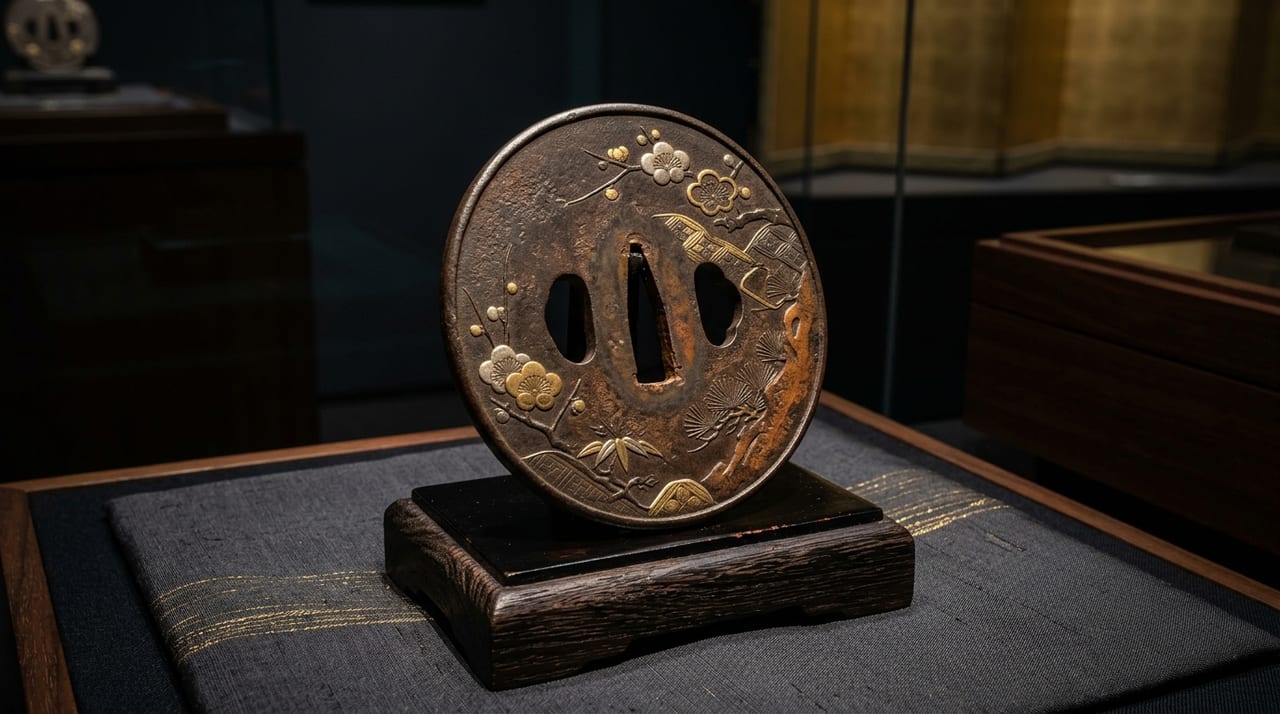
- Nara metalworkers (奈良金工) such as Sugiura Jōi (杉浦乗意), Nara Toshihisa (奈良利寿), and Tsuchiya Yasuchika (土屋安親) refined engraving technique in gold, silver, and copper, establishing a practice of expressing the ground metal as decorative inlay.
Rust Patina Character
- Approximately three hundred years of natural patina. The rust layer is somewhat thinner than early period examples and smoother to the touch.
- The signature black rust (烏色, karasu-iro or "crow black") of Higo work carries a distinctive luster; distinguishing it from polished or artificially applied rust becomes central to appraisal.
- Uniform iron composition encourages even rust distribution.
Ear Shape
- Higo makers favored "ears close to round with straight-cut profile" and "soft thread-edge" rims.
- Ear finishing often shows fine, carefully ordered file marks.
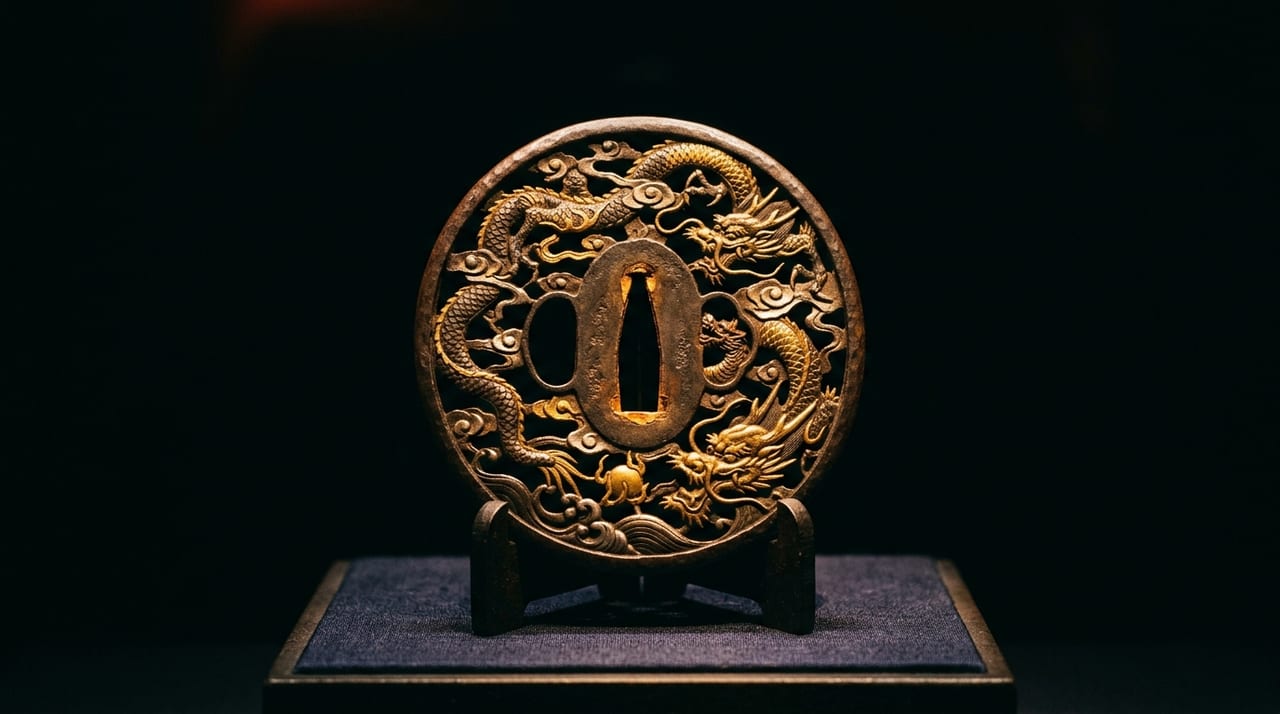
- Owari openwork tsuba (尾張透かし鐔) carry through-openwork and positive openwork to the rim, making the ears appear slender and delicate.
Thickness and Weight
- A transitional phase from practical to decorative emphasis. Thinner examples become more common.
- Even when thin, dense forging resists warping.
Late Edo to Bakumatsu Period (early to mid-19th century): Characteristics
Ground Surface and Materials
- The iron ground becomes exceptionally fine and uniform; forging marks fade to the point where the eye cannot discern them.
- Soft iron and mixed-metal variant forms appear frequently, strengthening the decorative orientation of the entire sword furnishing.
- Gold, silver, and copper inlay (象嵌) technique spreads widely, with examples showing elaborate patterns carved into the ground metal.
Rust Patina Character
- For Bakumatsu examples, patina age is approximately one hundred fifty to two hundred years. The rust layer is relatively thin; repeated polishing sometimes leaves almost no patina.
- Rust color ranges from black to dark gray. Reddish, thin patina may indicate water infiltration in the modern era.
Ear Shape
- Sharp-cornered ears (kadomi) dominate, with rims finished in sharp, four-sided angles.
- This era also introduces decorative ear forms such as window-type and mokko (木瓜, wood-melon) shapes.
- Ear finishing becomes uniform; polishing surfaces outnumber file-marked areas.
Thickness and Weight
- Prioritizing ornament, most are made thin. Tsuba crafted to complete a coordinated mounting set are especially thin and light.
- In hand, they typically feel lighter than early period examples.
Practical Checklist: Five Questions for Dating
The following five questions summarize the above evidence for examining a tsuba in hand.
- Are the forging marks coarse or fine? Coarse → older tendency; fine and uniform → mid to late period tendency
- Is the rust deep and resistant to flaking? Deep, stable rust → older tendency; thin, patchy → late period or polished examples
- Do the ears show roundness or sharp angles? Rounded → early to mid period; sharp-angled → late period to Bakumatsu
- What is the overall thickness and weight? Thick and substantial → utility-focused era; thin and light → advancing decoration
- Are inlay or polychrome techniques present? Multiple techniques → mid-period onward, concentrated especially in Bakumatsu
These are supplementary indicators only; dating from a single feature alone is hazardous. School, region, and individual skill produce many exceptions. Combining multiple markers with comparative study of known reference examples is the surest path to reliable appraisal.
Conclusion: Tsuba Dating Demands Composite Observation
Establishing a tsuba's manufacturing date requires the combined lens of ground surface, rust texture, ear form, and thickness. Relying on any one feature in isolation is counterproductive; cultivating the ability to read the whole in three dimensions is essential. For the novice, visiting sword museums, exhibitions, and connoisseur gatherings to compare authentic examples in person proves the most effective learning. Though a small sheet of metal, the tsuba is a craft object that condenses the technique and aesthetic sense of its era. Sharpening the eye to read its date opens a gateway to deeper understanding of Japanese sword culture as a whole.