The Echizen Kinai School's Dragon Tsuba: Edo-Period Masterpieces of Openwork Carving
 * Image is for illustrative purposes only.
Table of Contents
Echizen as a Region and Sword Fittings
Echizen, the region corresponding to northern Fukui Prefecture, has long been known as one of the major production centers for swords and sword fittings. Despite being distant from major consumption centers like Kyoto and Edo, the region's appeal lies in the fact that it produced artisan communities that established their own distinctive styles. The history of Echizen's sword fittings is fascinating for this reason. As for the blades themselves, Echizen is known for producing master craftsmen such as Echizen Yasutsugu, who served the Tokugawa shogunate, but in the field of metal fittings that adorn the sword, the region likewise developed its own unique lineage. With the Edo period, a school of tsuba makers bearing the name "Kinai" emerged in this region, leaving behind tsuba known for their distinctive style. The signatures read "Echizen-ju Kinai" and "Echizen Kinai-saku," among other variations, and extant examples are found in the collection of the Kyoto National Museum and other museums and sword dealers. The fact that they consistently inscribed "Echizen-ju," which indicates the production region, in their signatures suggests that the Kinai school possessed clear pride in their own distinctive style.
The Dragon Tsuba of the Kinai School—The Dynamism Born from Openwork and Hair-Thin Chiseling
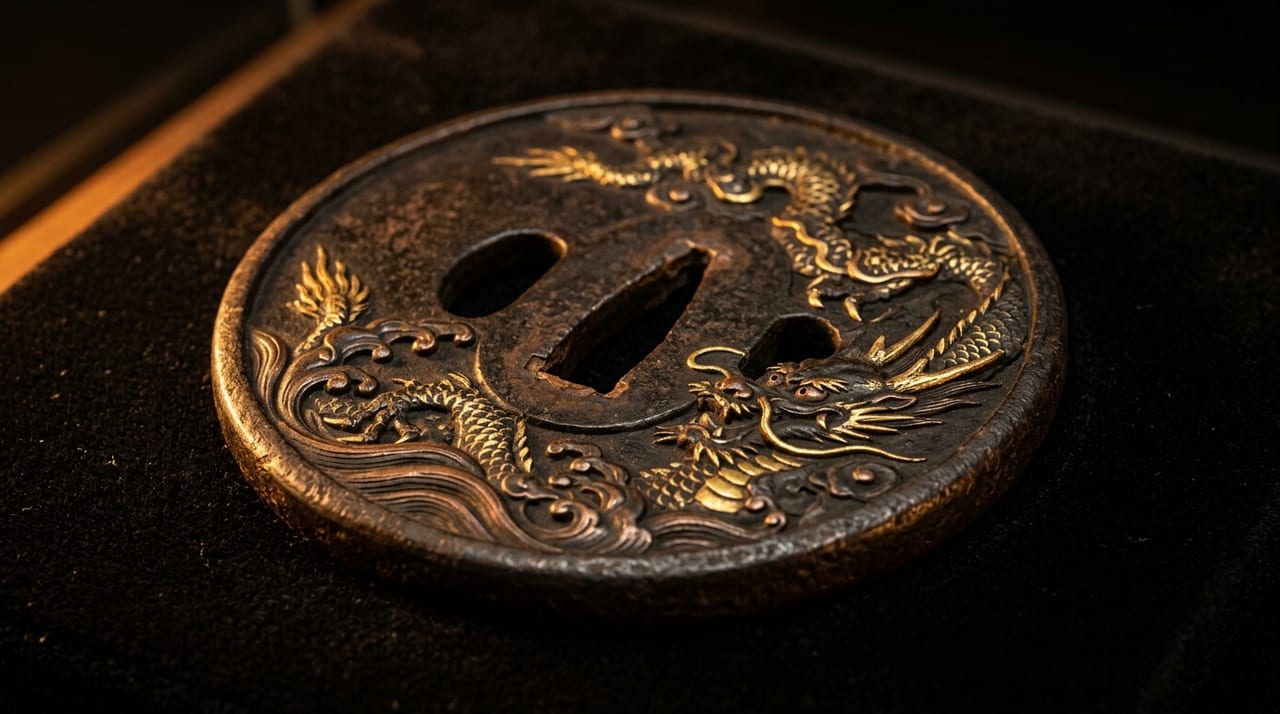
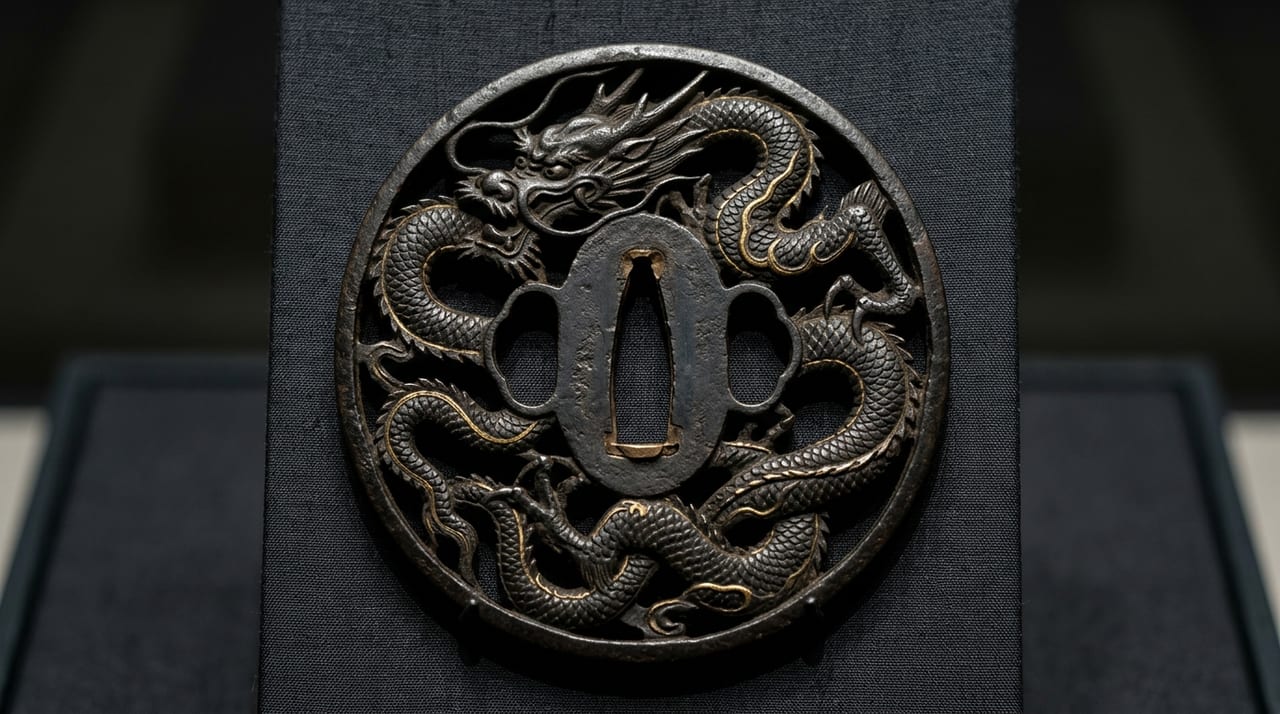
What has made the name of the Kinai school memorable to the present day is the openwork tsuba with dragon motifs. On a circular iron ground, the sinuous form of a dragon is rendered through bold openwork carving, while the details of scales and whiskers are rendered through fine hair-thin chiseling, giving the flat tsuba a three-dimensional sense of movement. Examples also exist where large areas are cut away through openwork, with gold-dot inlay arranged along the outline of the dragon, and these are known for designs that balance strength with decorative appeal.
While openwork technique itself is a general method employed by tsuba makers in other regions, what makes the dragon tsuba of the Kinai school unique is that it brings together within a single piece two contrasting techniques: the bold, sweeping carving of the ground and the delicate hair-thin chiseling executed along the dragon's outline. The composition allows for a two-tiered viewing experience: from a distance, it appears as a bold design, while up close, it reveals intricate line work.
Such forms could only be realized by craftsmen who possessed deep knowledge of iron, a hard and difficult material to work with. Large openwork cuts reduce structural strength, while adding delicate hair-thin chiseling increases the labor exponentially. The Kinai school's high skill is evident in their ability to reconcile these two conflicting demands on a single iron surface.
The dragon as a subject is a motif that has long been favored in armor and weapons as an auspicious beast that governs water and wards off calamity. The choice of this design for the tsuba, which protects the hand gripping the sword, likely carried meaning beyond mere decoration, functioning as a lucky charm. The fact that dragons have been favored subjects for carving throughout armor and weapons reflects the positioning of the dragon as a protective presence for the owner, much like the Kurikara dragon seen in blade carvings.
Designs Beyond the Dragon—Karakusa and Flowers in Kinai Work
The Kinai school's range extends beyond dragon designs. The following diverse designs have also been documented.
- Examples with realistic openwork carving of seasonal flowers and herbs such as orchids
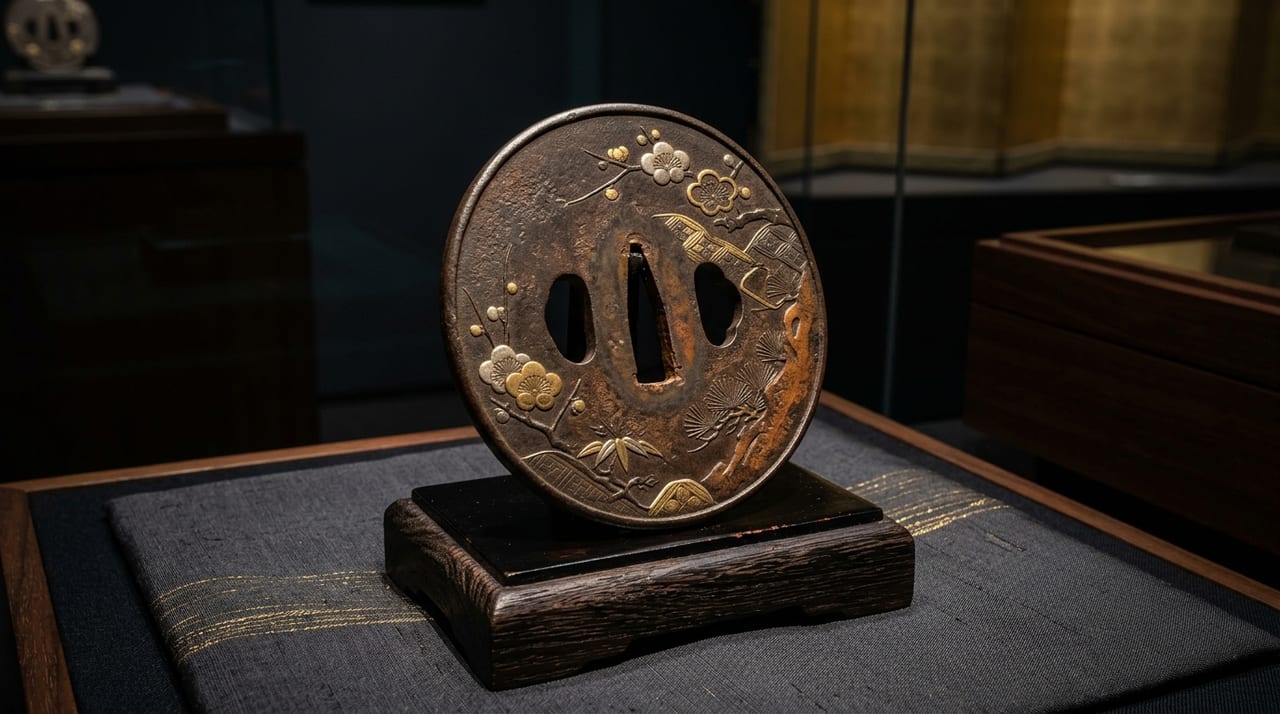
- Examples combining aoi crests and karakusa patterns with effective use of gold inlay, featuring high decorative appeal
- Examples using negative space effectively on irregularly shaped iron grounds
- Later examples arranging chrysanthemum motifs in bilateral symmetry, expressing quiet dignity
What these share in common is compositional skill that creates a sense of lightness through openwork technique while maintaining the weight and substance of the iron ground itself. The fact that the Kinai school was capable of handling both bold designs like dragons and delicate designs like orchids and chrysanthemums indicates that their carving technique possessed a versatility that extended beyond a single style.
Positioning the Kinai School—Differences from Owari, Kyoto, and Higo
Japanese sword tsuba display individuality according to their region of origin, with different aesthetic sensibilities established in each: the strong simplicity of Owari openwork, the refined elegance of Kyoto openwork, the robust quality of Higo tsuba, and so forth. As discussed in The Lineage of Openwork Tsuba—The Designs of the Three Major Schools in Owari, Kyoto, and Higo Openwork, the tsuba of the Kinai school, when compared with these major lineages, displays its individuality in simultaneously achieving bold openwork and precise hair-thin chiseling within a single piece.
While Owari openwork often captivates through the very simplicity of its design, the Kinai school does not spare effort in rendering fine details even while boldly cutting out the main subject. This "coexistence of boldness and precision" is the indispensable characteristic when discussing the Kinai school. Among sword fittings with strong regional character, it is positioned as a unique form created by the land of Echizen.
Reading Regional Identity Through a Single Tsuba
Though the tsuba receives less attention than the blade, its design concentrates within itself the aesthetic sensibility of the place and era in which it was made. Understanding what the tsuba makers of Echizen sought to express through the dragon tsuba of the Kinai school provides a key to grasping the broader context of swords overall.
When appreciating a sword, the eye naturally tends to focus on the blade pattern and the steel itself, but when one broadens one's gaze to take in the entire fittings and pays attention to the design of even a single tsuba, one begins to perceive the history of the land that the sword carries and the aesthetic sensibilities of its maker. By directing one's attention not only to the blade but also to the regional character expressed in the tsuba, the scope of sword appreciation expands further still.