Tsuba of the Early Edo Period — An Era of Abundant Splendor in Which the Higo Kinkō, the Gotō School, and the Shōami Competed
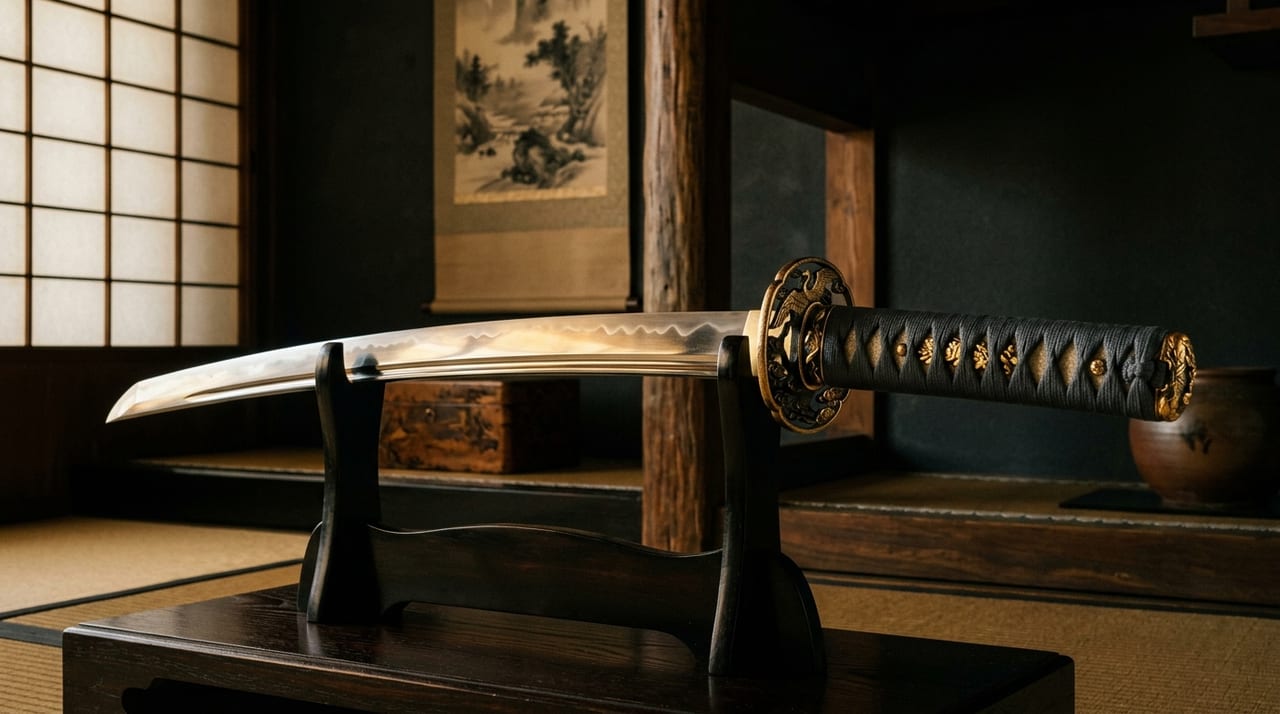 * Image is for illustrative purposes only.
Table of Contents
The Era of Peace and the "Artification" of Tōsōgu
With the destruction of the Toyotomi clan at the Summer Siege of Osaka in 1615 and the completion of Tokugawa rule over the realm, a period of peace lasting over 250 years followed. Demand for swords actually used on the battlefield plummeted sharply, and in its place demand rose rapidly for tōsōgu as "attire (shōzoku) demonstrating the prestige of the samurai."
In this era when the samurai class as a whole — daimyo, hatamoto, gokenin, jōshi — wore swords daily, tōsōgu — the tsuba in particular — transcended the domain of mere protective equipment and became a medium for expressing social status and aesthetic sensibility. Wearing a finely crafted tsuba at one's hip was also a signal of the owner's cultivation, wealth, and aesthetic discernment. While the shogunate bound the conduct of the daimyo through the Buke Shohatto, it was lenient regarding the design of tōsōgu, and the conditions took shape for each domain to retain master craftsmen and compete with their own distinct aesthetics.
In response to such demands of the age, several schools rose to prominence during the early Edo period (from the first half to the end of the 17th century), each pursuing a different aesthetic direction and forming a tsuba culture of abundant splendor.
Higo Kinkō — "Higo Tsuba" Embodying the Aesthetics of the Warrior
Occupying a distinctive position throughout the Edo period were the kinkō craftsmen who served the Kumamoto domain (Higo Province, present-day Kumamoto Prefecture). Hosokawa Tadaoki, the founding lord of the Hosokawa domain (Higo, 540,000 koku) — known as the husband of Gracia — was also a master of the tea ceremony counted among the "Seven Disciples of Rikyū," and his exacting aesthetic eye deeply influenced the craft culture within the domain. Moreover, the Hosokawa family, which harbored many former retainers of Katō Kiyomasa, retained a strong spirit of warriors with actual combat experience, and this directly shaped the character of the kinkō works as well.
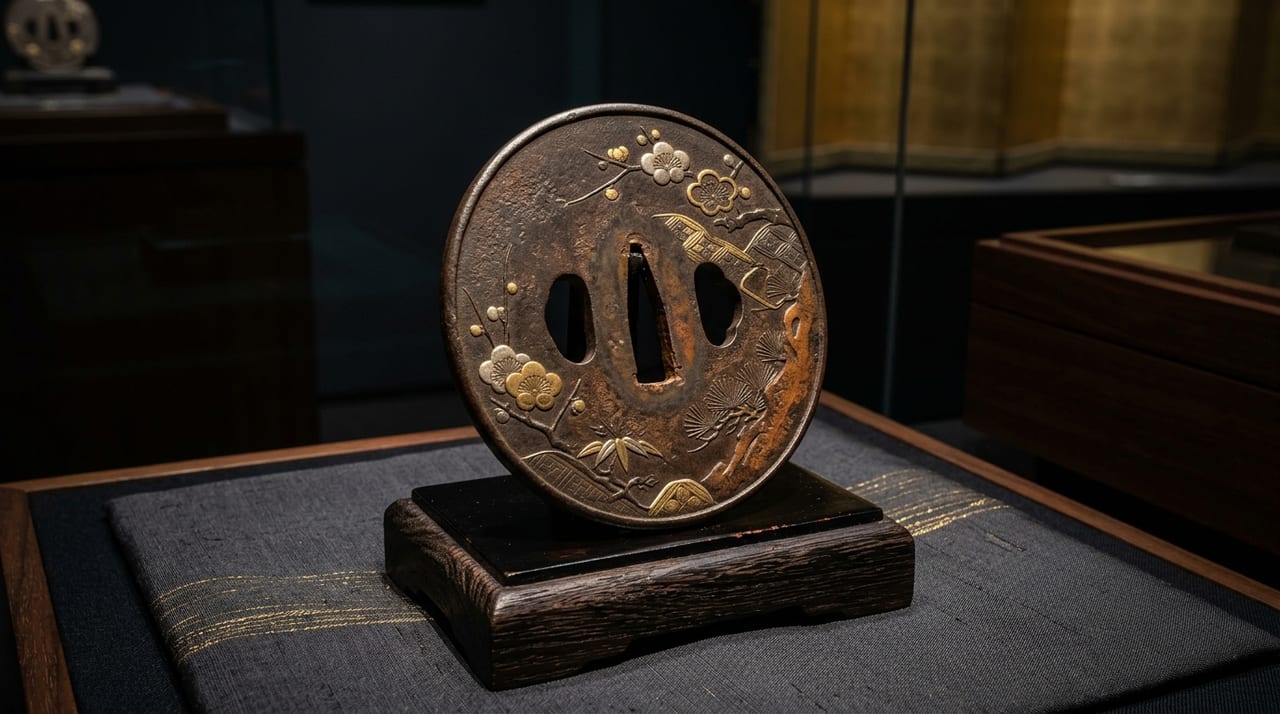
The hallmark of Higo kinkō is "rugged functional beauty." The prevailing style eschews gold, silver, and inlay as much as possible, drawing out to the fullest the beauty of the iron ground itself. The samurai spirit of the Hosokawa domain — earnestness and simplicity, an unadorned character — is reflected directly in the kinkō works. The attitude of investing enormous effort in the tanren of the jigane while deliberately eschewing visual showiness also resonates with the spirit of wabi in the tea ceremony.
The following are the major lineages of Higo kinkō.
- Hayashi family (hayashike): The most renowned lineage among Higo kinkō. The first generation, Hayashi Matashichi (hayashi matashichi), was active in the early Edo period and created tsuba of unadorned yet powerful character, applying only minimal openwork to an iron ground. The finish of the base material has a distinctive texture called tetsuaji, and it is still highly prized by sword enthusiasts today. The technique was passed down over several generations, and the Hayashi name became synonymous with Higo tsuba.
- Nishigaki family (nishigakike): A prestigious house of Higo kinkō standing alongside the Hayashi family. Known for meticulous treatment of the iron ground and distinctive openwork and carving, it has a style subtly different from the Hayashi family.
- Hirata family (hiratake): Known for a distinctive style that applied shippō (a decorative technique using enamel-like glaze) to tsuba. The combination of iron and colored glaze produced a unique brilliance not seen in other schools.
- Shimizu family (shimizuke): While inheriting the beauty of the rugged iron ground, it pursued distinctive motifs and openwork compositions.
Works of Higo kinkō survive in large numbers in museums and private collections both in Japan and abroad, and they receive high acclaim as craft art representative of the early Edo period.
The Gotō School — Authority of the Unified Beauty of Tōsōgu
The Gotō school, having laid its foundations in the middle of the Muromachi period as the pinnacle of tōsōgu production, maintained unwavering authority even into the Edo period. The family trade was passed down across a remarkable 17 generations, from the founder Gotō Yūjō (1440–1512) through the Bakumatsu period. Its status, recognized as the official purveyor to the shogunal house and the daimyo, was also a "cultural authority" that transcended the bounds of mere craftsmen.
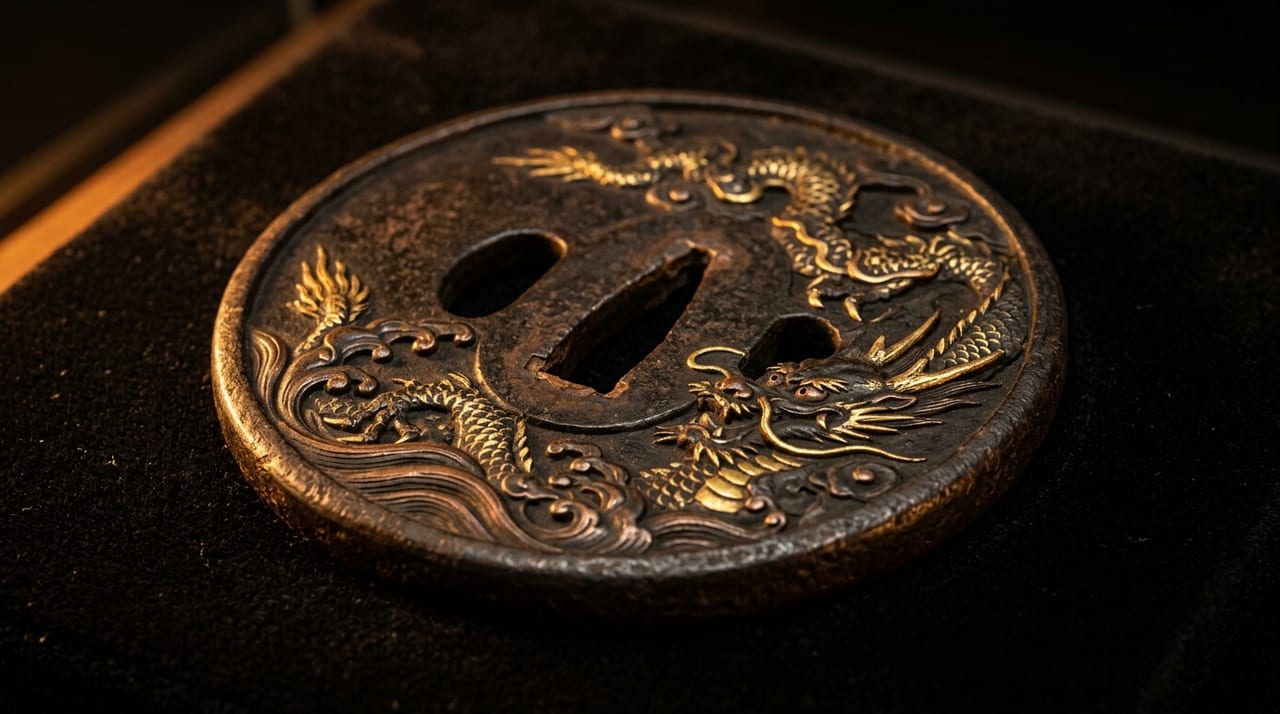
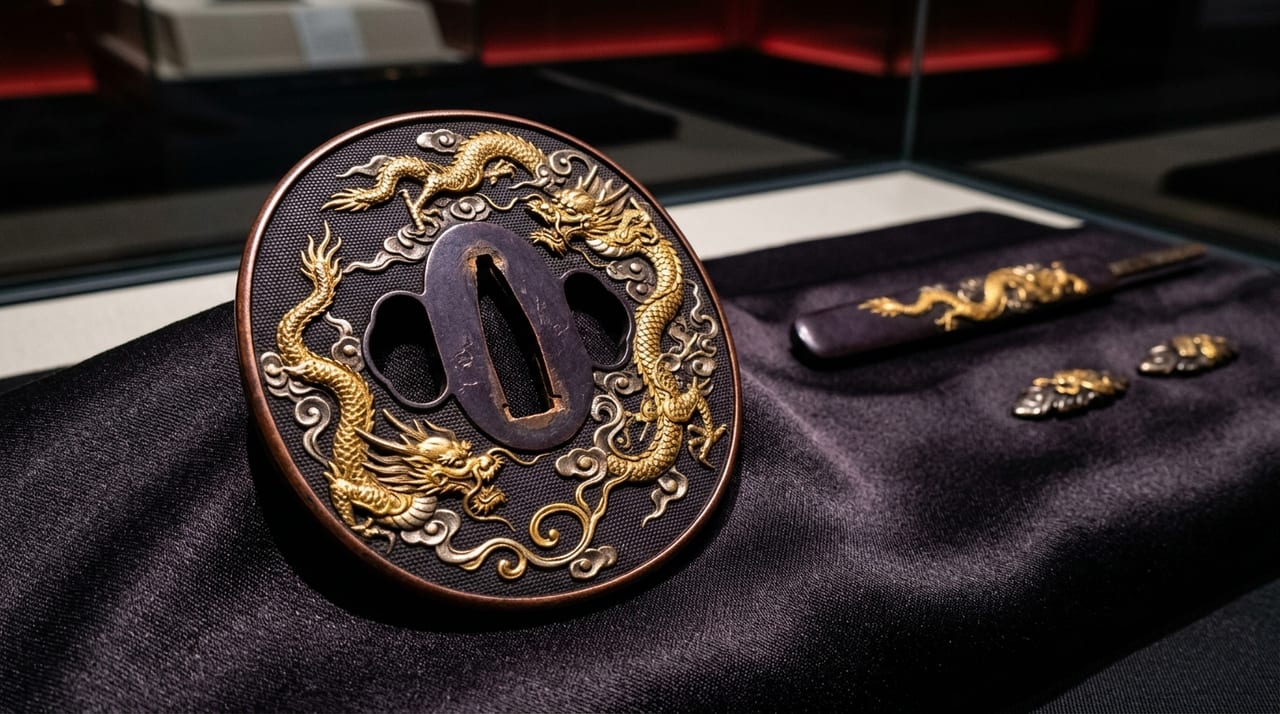
The hallmark of the Gotō school is the "unified beauty of tōsōgu." The concept of "Gotō yagu" — assembling matching sets of tsuba, menuki, fuchi, and kashira by the same maker on the same theme — is an especially refined concept within Japanese kinkō art. The Gotō school's trademark is a style that combines shakudō and gold as primary materials, and the contrast between the deep jet-black of shakudō and the brilliance of gold gives those who behold it an overwhelming sense of refinement. In addition, the precision of the takabori depicting auspicious motifs such as bamboo, plum, pine, crane, and dragon allows no rival.
In the early Edo period, master craftsmen such as the 7th-generation Gotō Kenjō and the 8th-generation Gotō Sokujō emerged, achieving further technical refinement. However, among the works circulating on the market as Gotō school pieces, there are no small number made by craftsmen connected to the Gotō house (artisans called "Gotō-style") or by later imitators. Attributing genuine works requires a high level of discernment and documentary corroboration.
The Shōami School — The Craft of Precise Openwork Spreading Nationwide
The Shōami school (shōamiha), a Kyoto-based school that flourished greatly during the Momoyama period, continued to be active across the country into the early Edo period as well. Distinctive characteristics emerged according to each base of operations — the Shōami of Edo, the Shōami of Kyoto, the Shōami of Nagoya — broadly supporting samurai demand throughout the country.
The Shōami style can be summed up in "the precision of its openwork." The technique of cutting complex patterns into the iron ground and making designs emerge through the contrast of light and shadow is the Shōami school's greatest strength. The range of subjects is also wide, including plants, waves, and geometric patterns. The finest pieces of the Kyoto-based Shōami in particular display a high level of achievement inheriting the technical standards of the Momoyama period, and their refined and delicate designs strongly reflect the influence of court culture.
The Shōami craftsmen based in Edo, on the other hand, tended to arrange their designs more powerfully to match samurai tastes, and regional differences emerged even within the same Shōami lineage. This can be said to be the result of the preferences of the samurai patrons and the accumulated technical expertise of the craftsmen interacting with one another.
Cross-School Influences and Mutual Exchange
Although the three schools each honed their own distinctiveness, the kinkō world of the early Edo period was by no means closed. The Gotō school's takabori technique was referenced by craftsmen of other schools, and the Shōami's openwork technique also influenced Higo kinkō. The movement of personnel through daimyo households and the traffic between Edo and the provinces via the sankin-kōtai system can also be thought to have facilitated the spread of techniques and designs.
The connection with the culture of the tea ceremony is also not to be overlooked. Through the active collection and appreciation of kinkō works by daimyo tea masters such as Matsudaira Fumai, the tsuba came to be socially recognized as an "object of appreciation" on par with tea utensils. This trend led to the rise of the "tsuba appreciation hobby" from the middle Edo period onward and developed into systematic evaluation activities such as the compilation of collection catalogues and kanteisho.
Conclusion — A Diverse Beauty Nurtured by Competition
The tsuba of the early Edo period are the product of a bountiful era in which three aesthetic directions competed — the rugged beauty of Higo kinkō, the refined beauty of the Gotō school, and the diverse openwork beauty of the Shōami. With each school grounded in different values and techniques, yet all striving together to answer the shared demand of "the samurai's aesthetic sensibility," Japanese kinkō art reached a remarkable height.
This very diversity is the source of the profound depth of the culture of Japanese tōsōgu. When viewed not merely as a component of a sword but appreciated through the three overlapping contexts of historical background, the technical lineage of schools, and the aesthetic sensibility of the patron, a single tsuba emerges as a microcosm reflecting the spirit of the people who lived in that age. That is precisely the reason why modern collectors and researchers find inexhaustible enjoyment in tsuba appreciation.