Modern Tsuba-shi and the Succession of Traditional Techniques — How the Tōsōgu Artists of the Reiwa Era Are Living the Tradition
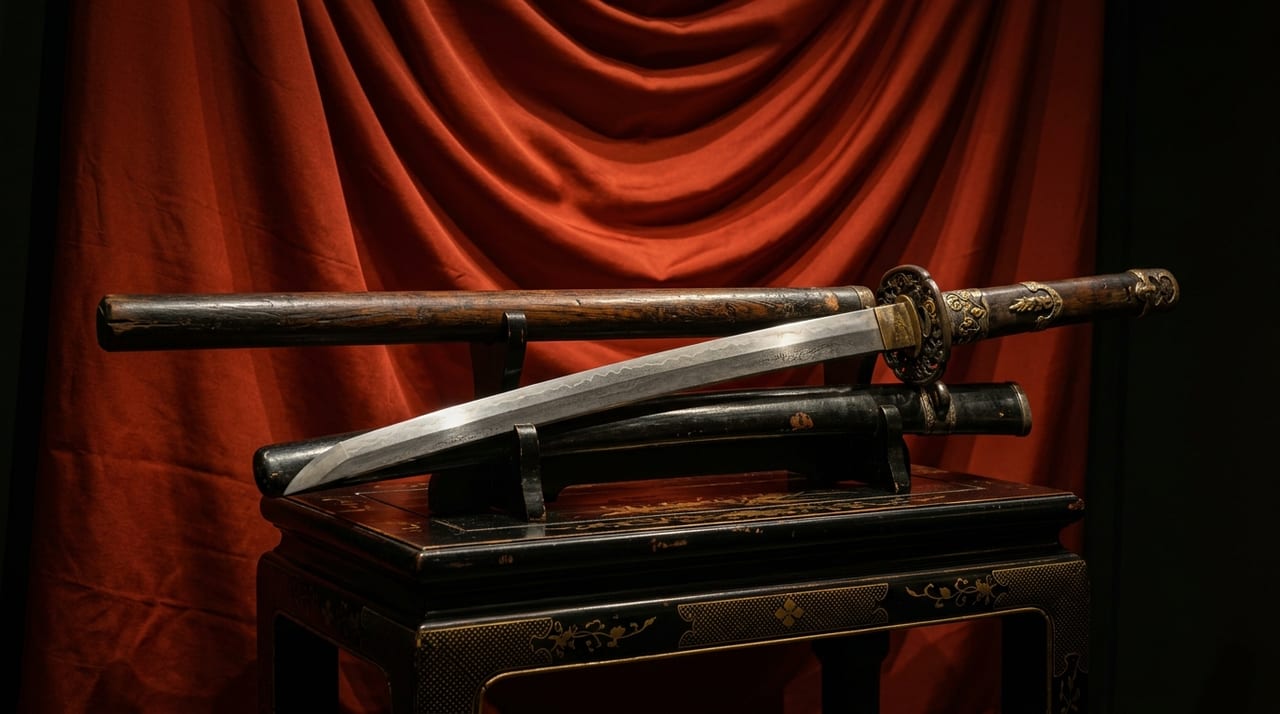 * Image is for illustrative purposes only.
Table of Contents
150 Years after the Haitōrei — Tsuba-shi Living in the Present
The year 2026 marks 150 years since the Sword Abolishment Edict (Haitōrei) of 1876 (Meiji 9). The craft of tōsōgu, once sustained by the demand of daimyo, hatamoto, and samurai, now lives on under the mission of "preserving cultural heritage."
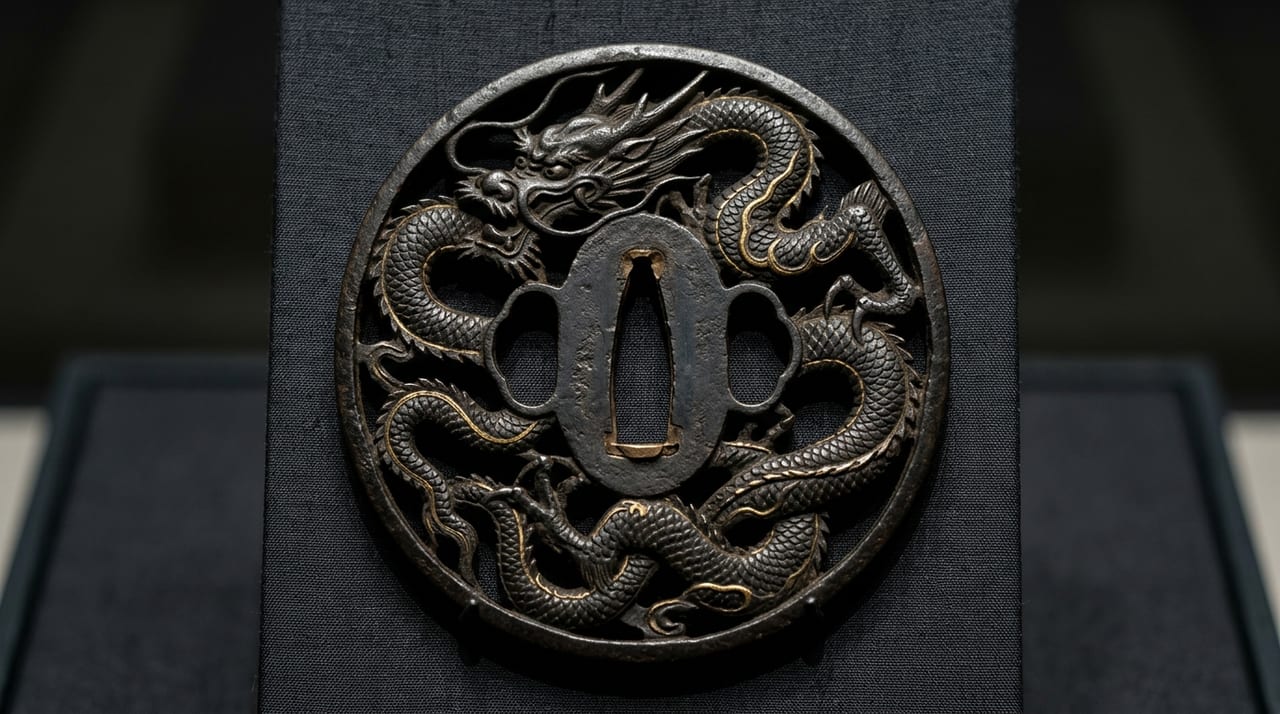
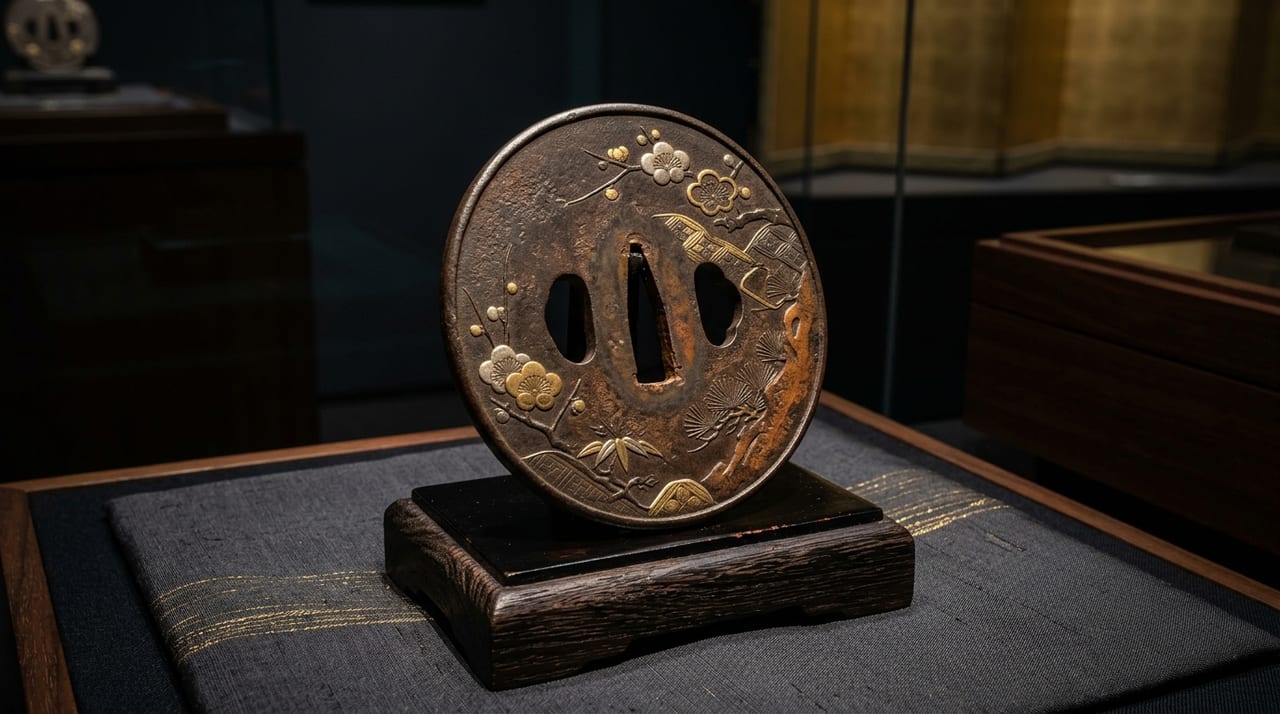
Modern tōsōgu artists (tsuba-shi and kinkō-shi) have left entirely behind the context of "accessories to a weapon" and are active purely as metal art craftspeople. Their numbers are not large, but they exist with certainty as bearers of traditional techniques, and their recognition in the context of contemporary art is steadily growing. The fact that a small piece of metal — a tōsōgu — concentrates within it centuries of aesthetic sensibility and accumulated technique is something an increasing number of people, both in Japan and abroad, are beginning to notice. In the Reiwa era, as interest in traditional crafts spreads to younger generations, the presence of the tsuba-shi as a profession is drawing renewed attention.
The Training of Modern Tsuba-shi — The Reality of Acquiring Technique
The paths by which modern tōsōgu artists acquire traditional techniques branch into several routes.
- Apprenticeship under a master (the apprentice system) is the most orthodox training method. One serves as an apprentice under an active kinkō-shi or tsuba-shi, studying techniques over a period of several to more than ten years. Beginning with something as basic as how to sharpen a tagane, one learns through direct practice the full range of processes: the properties of materials such as iron, copper, gold, and silver; the techniques of chōkin, kebori, takabori, and zōgan; and finally the finishing steps of polishing and patination. The problem is that the absolute number of masters is small, and the opportunity to enter apprenticeship is itself limited. Cases where it takes several years just to find a master willing to accept a student are not uncommon.
- Study at art universities and craft schools has also become an important gateway. Institutions such as the metalwork and metal arts program in the craft department of Tokyo University of the Arts, and Kanazawa College of Art, offer systematic instruction in the fundamentals of metal craft. Curricula specifically dedicated to tōsōgu are rare, but one can acquire foundational skills in tankin, chōkin, and chūkin, along with a deep understanding of materials. A "two-stage" training path — studying at university before entering a master's studio — is also increasing.
- Self-study and research as an independent route also exists to a certain degree. This approach involves direct examination of pieces held by domestic and international museums, close reading of old texts and catalogs, and the accumulation of copying and analyzing surviving works. This route is common among enthusiasts and artists in Europe, America, and Asia, and there are also cases of people reconstructing traditional techniques through their own interpretation. For the self-taught, visiting the Tokyo National Museum and the Japanese Sword Museum repeatedly to observe their masterpieces becomes the "master." In recent years, high-resolution images of museum collections published online have also been utilized as supplementary learning resources.
The Techniques of Modern Artists — A Struggle with Nearly-Lost Skills
A concrete technical challenge facing modern tsuba-shi is the problem of material procurement. Traditional alloys used in Edo-period masterworks — nanban iron, shakudō, and shibuichi — are not commercially available as standard products today. Shakudō is an alloy containing 3–5% gold in copper; with the right proportions and heat treatment, it develops a distinctive dark purple-black color. This "blackness of shakudō" is synonymous with Edo kinkō, but modern artists must reproduce the alloy ratio themselves from literature and experimentation.
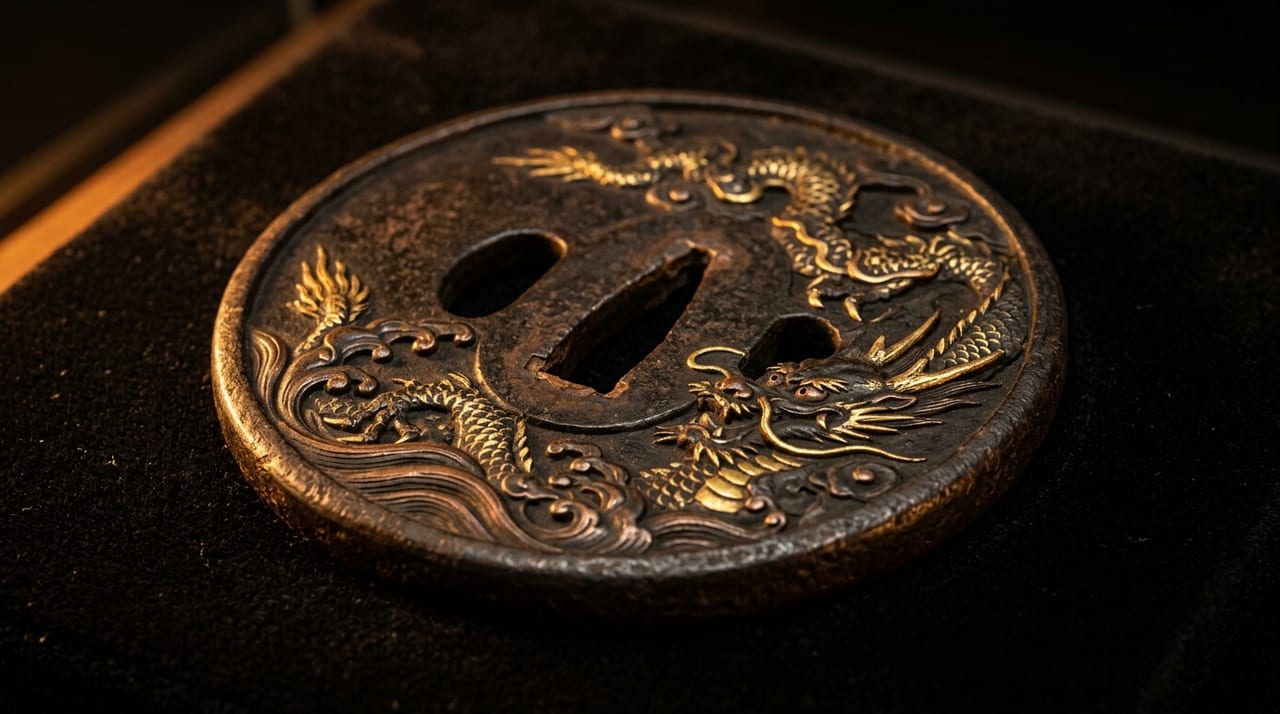
In engraving technique as well, mastering advanced skills such as nunome zōgan and takabori iroe demands exceptional concentration and precision of hand. Nunome zōgan is a technique in which fine grid-like cuts are made in the base metal and thin pieces of gold or silver are hammered in and secured; carving dozens of cuts uniformly within the span of one square centimeter requires a high level of mastery in both tools and feel. Many such techniques can only be acquired through hands-on apprenticeship, and there exists a "memory of the hands" that cannot be conveyed through video or photographs.
There are also ongoing attempts to find substitutes for natural materials that are now difficult to obtain. Certain whetstones and abrasives used in the Edo period have become unavailable due to mine and quarry closures, making it difficult in some cases to reproduce the texture of finished surfaces. Artists are responding through surveys of production sites and collaboration with material suppliers in Japan and abroad, but no fundamental solution has been reached.
The Works of Modern Artists — Between Traditional Style and Individual Expression
In the works of modern tsuba-shi and kinkō-shi, two broad directions can be seen.
Artists who pursue the meticulous succession of traditional styles aim to reproduce with the utmost fidelity the techniques of schools such as Gotō, Shōami, Higo kinkō, and Nara kinkō. Their stance is to follow the classical in all aspects — materials, composition, engraving technique, and finish — and to recreate even the atmosphere of the era. The finest works of this type can receive high recognition in NBTHK (Society for the Preservation of Japanese Art Swords) appraisals, and hold the potential to be spoken of as "modern classics" decades from now.
Artists who aim for a fusion with contemporary expression take traditional techniques as their foundation while incorporating contemporary motifs, abstract expression, and the aesthetic sensibility of modern craft. Some retain the form of the tsuba while exploring the abstraction of natural objects or geometric composition; others express themes of contemporary society — fragments of the city, lost landscapes, the accumulation of memory — through traditional engraving techniques. It is an attempt to reframe the format of tōsōgu as a "vessel" for contemporary art.
Recognition in Japan and Abroad, and the Documentation of Traditional Techniques
The venues in which the works of modern tōsōgu artists are recognized have been expanding steadily in recent years.
The open exhibitions hosted by the Japanese Sword Museum (Tokyo, Ryōgoku) are among the most authoritative venues for modern artists to present their work. Award-winning pieces gain broad recognition through exhibition and catalog publication, making it a gateway for emerging artists. At craft and art exhibitions in various regions, cases of works by modern tōsōgu artists winning prizes in the metal craft division are also increasing. As of 2026, modern artists who hold solo exhibitions dedicated to tōsōgu have also appeared, and opportunities to deliver works directly to enthusiasts are growing.
Recognition abroad cannot be ignored either. Western collectors and museums recognized the artistic value of Japanese tōsōgu early on, and high-quality collections have been formed at institutions including the British Museum and the Metropolitan Museum of Art. Cases in which works by modern artists reach international collectors through international Japanese cultural exhibitions and antique fairs are also increasing. Dissemination through social media (especially Instagram) and websites has contributed greatly to cross-border recognition, and artists who actively communicate in English and French have also emerged.
At the same time, the documentation and systematization of traditional techniques is an important contemporary challenge. Projects to record the skills of elderly craftspeople through video, photography, and text are progressing in Japan and abroad, and the use of digital technology — including precise recording of masterworks through 3D scanning and motion analysis of engraving techniques using AI — has also begun. A digital archive functions not as a means "to transmit" but as insurance "to prevent forgetting."
Between Tradition and Innovation — The Philosophy of Modern Tsuba-shi
The fundamental question that modern tsuba-shi face is the balance between "preserving tradition" and "creating expression that is meaningful in the present."
One artist says: "It is only after you become able to reproduce an old work perfectly that you can see your own expression. Until you can perfect the imitation, you have not yet internalized the tradition." This is the position that true creation is impossible without complete mastery of technique.
The words of another artist sound in contrast: "The master craftspeople of Edo also created using the most advanced techniques and the most advanced aesthetic sensibilities of their time. It is precisely we of today creating from a contemporary perspective that truly carries on their spirit." This is the interpretation that the essence of tradition lies not in "form" but in "attitude."
These two views may be not opposites, but two sides of the same truth. Both artists are identical in that they hold deep respect for the masterworks of the past and have devoted their lives to acquiring the technique to answer that respect. Only the direction of expression differs; the depth of their attitude toward tradition lies on the same line. What the tsuba-shi of the Reiwa era share is a quiet resolve to continue the work of the tsuba-shi as a "living craft."
Conclusion — As a Living Tradition
Modern tsuba-shi and tōsōgu artists are not "custodians" of cultural heritage but "bearers of a living tradition." In the 150 years since the Sword Abolishment Edict (Haitōrei), even after demand for tōsōgu as functional objects disappeared, tsuba-shi did not relinquish their techniques. It is because of that chain of succession that new works continue to be created at this very moment.
Their works are not mere revival. They are the moment when an accumulation of more than 600 years of tsuba art is renewed through the individuality and sensibility of the present. Every line engraved on a small disk of iron, copper, shakudō, or shibuichi is a bridge connecting past and present. To take those works in hand and appreciate them is also to directly touch the "now" of Japanese kinkō history. Opportunities to encounter tsuba and tōsōgu made by the hands of modern artists are also expanding through online catalogs.