Sakanoue no Tamuramaro and the Conquest of the Emishi——Northeastern Administration in the Early Heian Period and the Sword Culture of the Warabite-tō
 * Image is for illustrative purposes only.
Table of Contents
In the early Heian period, the warrior who distinguished himself under Emperor Kanmu's policy of conquering the Emishi was Sakanoue no Tamuramaro (758–811). In Enryaku 16 (797), he was appointed Sei-i Taishōgun and took charge of administering Mutsu and Dewa.
The Conquest of the Emishi and Aterui
At that time, the court's authority did not extend to the deep interior of the Tōhoku region, and a prolonged conflict continued with the local Emishi communities. Aterui, the leader of the Emishi side, repeatedly repelled the court's forces, but after more than a decade of fighting against Tamuramaro, he surrendered in Enryaku 21 (802). It is said that Tamuramaro pleaded for his life to be spared, but according to deliberations at court, Aterui and his companions were executed.
This series of conquests was a watershed moment in which the ritsuryō state extended its territory into Tōhoku, and at the same time an important juncture at which the martial cultures of the capital and the eastern provinces came into contact.
The Sei-i Taishōgun and the Ancient Military System
The title "Sei-i Taishōgun" was originally the office of supreme commander of an expeditionary force, appointed on a temporary basis for the conquest of the Emishi. In later ages, from the Kamakura shogunate onward, it became established as the title denoting the head of warrior government, but in Tamuramaro's time it was strictly a military post for warfare against the Emishi. Soldiers of the military units (gundan) under the ritsuryō system and troops conscripted from the eastern provinces were mobilized, and enormous quantities of provisions and personnel were committed with each campaign. The repeated expeditions placed a heavy burden on state finances, and it is known that in the later years of Emperor Kanmu's reign, the question of whether to continue them was debated alongside the construction of Heiankyō as one of two great undertakings.
Construction of Fortified Stockades and Administration of the Northeast
An achievement of Tamuramaro's that was equally important to his military campaigns was the construction of jōsaku (fortified stockades). Around the time of Aterui's surrender, Isawa-jō was built on land corresponding to present-day Ōshū City, Iwate Prefecture, where a Chinjufu (Pacification Headquarters) was established as a base for northeastern administration. Further to the north, Shiwa-jō was built, and the court's sphere of control expanded greatly into the Kitakami River basin. The jōsaku functioned not merely as military strongholds but also as centers of administration and trade, and served as places where the culture of the capital and local cultures met. The exchange of techniques in weapons and crafts, including swords, is thought to have advanced through such points of contact.
The Warabite-tō and the Sword Culture of the Eastern Provinces
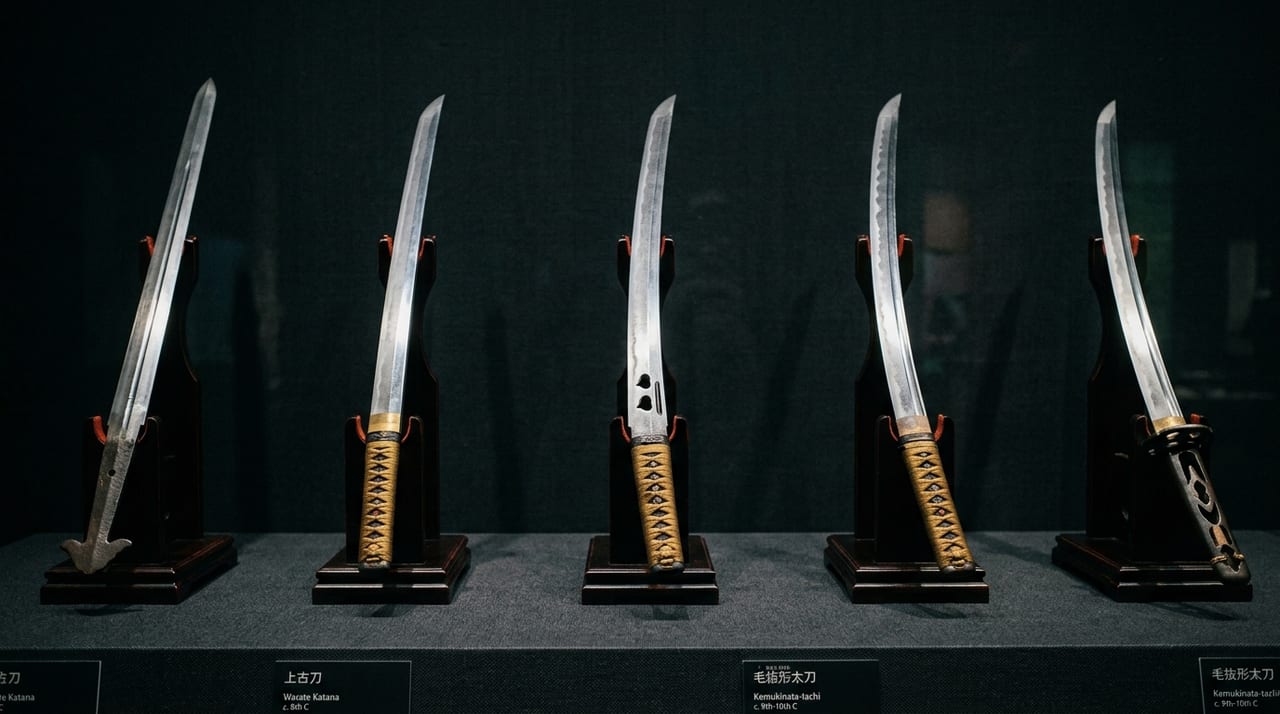
The warabite-tō is a notable ancient blade associated with Tōhoku and the eastern provinces. It has a distinctive form in which the head of the tsuka curls around in a round coil like the young shoot of a bracken fern, and examples have been excavated from archaeological sites and burial mounds dating from the late Kofun period through the early Heian period. It is a practical single-edged blade, and its construction is thought to have been designed with mounted combat and actual warfare in mind.
Because the warabite-tō is found in large numbers primarily in the Tōhoku region, it is regarded as a weapon deeply linked to the sword culture of the Emishi and other peoples of the eastern provinces. As for how the warabite-tō was involved in the establishment of the later nihontō (tachi) with sori, this is discussed as one of several theories regarding the origin of curvature, and a direct line of descent cannot be asserted with certainty.
From the Warabite-tō to the Kenuki-gata Tachi
When surveying the early Heian period from the perspective of sword history, the Kenuki-gata Tachi attracts attention alongside the warabite-tō. This blade, which has an openwork cutout in the shape of tweezers (kenuki) in the tsuka section, is notable for the tsuka and blade being made as a single piece from the same metal (tomogane), and a well-known view holds that it emerged from the intersection of the warabite-tō tradition and elements of continental-style swords. The Kenuki-gata Tachi invariably appears in sword history surveys as evidence showing the transition from the straight swords of jōkotō to the tachi with sori, and the view that the experience of mounted combat honed on the battlefields of Tōhoku influenced the change in blade form has become a compelling perspective when considering the evolution of weapons in this era.
The Early Heian Period as a Time of Transition
The early Heian period marks a transitional phase in which swords changed form from the ceremonial, straight jōkotō to practical blades with sori suited to mounted combat. The military contact between the capital and the eastern provinces, as exemplified by the conquest of the Emishi, forms an important backdrop for considering this practical evolution and localization of swords. It is not an era in which individual master smiths or celebrated swords can be identified, but the actual state of weapons as told by excavated materials conveys the appearance of the eve of the nihontō's establishment.
Perspectives When Appreciating Excavated Swords
Many warabite-tō and Kenuki-gata Tachi are excavated pieces or handed-down ceremonial swords, and they are not always in a condition that allows the detailed appreciation of the hamon or jigane possible with later celebrated swords. The focus of appreciation is placed on the overall form (the presence or absence of sori and its position), the structure of the tsuka, and the proportional balance of the overall dimensions. When viewing exhibits at a museum, keeping the following three points in mind will give you a three-dimensional sense of the change from straight swords to nihontō.
- Whether the blade and tsuka are made in one piece or separately
- From what position the sori begins
- What characteristics the fine details display, such as the head of the tsuka and any cutout designs
The Tamuramaro Legend and Its Influence on Later Ages
After his death, Tamuramaro was progressively mythologized as an ideal image of the warrior, and numerous legends relating to temples, shrines, and place names that recall his founding or prayers for victory in battle survive throughout Tōhoku. It is widely known that Kiyomizudera in Kyōto is traditionally said to have been built by Tamuramaro. While it is necessary to maintain a careful distinction between historical fact and legend, the very breadth of the legend's spread tells us how great an impression the conquest of the Emishi made on people of later ages.